

Artificial intelligence applications in layer poultry farming for sustainable development in Delta State, Nigeria
Abstract
Poultry farming remains a vital agribusiness in Delta State, Nigeria, yet its growth is derailed by high disease pressure, fluctuating feed costs, unstable electricity, and inefficiencies in farm operations. Emerging evidence and innovations suggest that Artificial Intelligence (AI) technologies, ranging from computer vision systems for egg grading and disease monitoring to precision feeders, water controllers and climate-smart housing, can address these constraints and promote sustainable development. This study examined poultry farmers’ perceptions of the adoption of AI applications in layer farming, focusing on their potential benefits, operational efficiency, and adoption barriers. Using a descriptive survey design, data were collected from 30 layer poultry farmers across Delta State, and analyzed using mean scores and standard deviation. According to the findings, AI is often seen as advantageous for lowering veterinarian expenses, avoiding mortality, promoting operational efficiency, and improving egg grading. Farmers were also aware of AI's potential to boost environmental sustainability and generate jobs. However, issues with its dependability in water and biosecurity applications, digital infrastructure, and pricing still exist. The findings complement previous research showing AI's revolutionary impact on agriculture, but they also underscore the necessity of encouraging laws, financial aid, and capacity training. All things considered, AI offers prospects for sustainability and efficiency in layer farming; yet, adoption necessitates removing financial and physical obstacles.
Introduction
A crucial component of Nigeria's agricultural landscape, poultry farming supports rural communities, generates jobs, and offers a significant source of high-quality protein in the form of meat and eggs. In particular, Delta State's favorable climate and robust agricultural foundation make layer poultry farming, which concentrates on rearing chickens for egg production, essential. Nigeria's expanding population has increased demand for eggs, making it essential to enhance the sustainability and production of layer poultry farming. Disease outbreaks, ineffective feed management, labor-intensive procedures, and environmental issues are just a few of the many difficulties the Delta State poultry industry faces, all of which jeopardize the long-term viability of the industry there. Modernizing and optimizing layer poultry farming operations is made possible by the advent of Artificial Intelligence (AI) technologies (Hamadani et al., 2024).
AI, which simulates human decision-making through intelligent systems and algorithms, has been used more and more in agriculture to boost output, cut waste, and increase efficiency. These technologies, which can be modified to satisfy the particular requirements of layer farming, include robots, computer vision, machine learning, and data analytics (Leong et al., 2025). AI-powered monitoring systems, for example, may follow the activity and health of poultry in real-time, allowing for early disease identification and a decrease in fatality rates. In a similar vein, AI-based automated feeding systems can maximize feed distribution, guaranteeing that hens get enough nutrients while reducing waste and expenses (Taleb et al., 2024). In addition to increasing production efficiency, Delta State's layer poultry farming has embraced AI, which is consistent with sustainable development ideals. The goal of sustainable farming is to strike a balance between social justice, environmental conservation, and economic viability. Precision farming methods powered by AI can maximize resource use to lower emissions and waste, among other environmental effects. AI can also help farmers make better decisions by giving them data-driven insights on market demands, production predictions, and flock management (Chand et al., 2024). Profitability can be increased while encouraging resource-saving behaviors for the coming generations.
Research on the use of artificial intelligence (AI) in agriculture, particularly in poultry farming, shows that it is becoming more and more relevant in fostering sustainability, production, and efficiency. AI has been incorporated into livestock management systems worldwide to address issues with environmental sustainability, feeding, disease prevention, and production efficiency (Kazembe and Mkandawire, 2024). Despite the substantial potential impact, there are currently few empirical studies conducted in Delta State and Nigeria. Globally, empirical research has shown how Artificial Intelligence (AI) may revolutionize poultry farming, especially in improving sustainability, disease detection, egg production, and farm automation. By using machine learning algorithms to identify respiratory sounds in poultry houses, Liu et al. (2020) made it possible to identify diseases like Newcastle disease early on in the field of disease detection and health monitoring. Similarly, Islam et al. (2025) demonstrated that AI models based on images could distinguish between healthy and ill birds with an accuracy rate of over 90%. However, Momah et al. (2024) noted that poor veterinary care and delayed diagnosis continue to cause significant death rates among poultry producers in the South-South region of Nigeria, particularly in Delta State. According to these results, AI-enabled monitoring systems have the potential to greatly lower losses and enhance regional sustainability.
Applications of AI in egg production and quality control have drawn attention, in addition to illness management. According to Yang (2023), grading eggs can be automated using computer vision and deep learning models, guaranteeing consistency in size, weight, and quality while reducing labor expenses and human error. According to Abanikannda and Leigh (2012), Nigerian small-scale farmers do not have access to contemporary grading equipment, which results in ineffective pricing and marketing strategies. This suggests that layer poultry farmers in Delta State, where market integration is still difficult, may become more profitable and competitive using AI-driven egg quality evaluation. Research demonstrates that AI improves productivity and decreases waste in agricultural operations and automation. AI-powered sensors that controlled humidity and temperature enhanced animal welfare and feed efficiency (Sajid et al., 2024). Similarly, AI decision systems-assisted automated drinkers and robotic feeds guaranteed accurate resource use. However, the majority of Nigerian poultry farms still mostly rely on manual feeding and watering, which raises labor costs and reduces production (Chukwuka, 2024). This demonstrates the potential for implementing AI technologies in Delta State, where smallholder producers who want to increase productivity dominate the chicken industry.
Research further emphasizes AI's contributions to social, environmental, and economic consequences from a sustainability standpoint. AI-enabled precision farming eliminates environmental contamination and feed waste, according to Vetrivel et al. (2024). Adoption issues still exist, nonetheless, particularly in poorer nations. According to Ahmed et al. (2024), the main obstacles to AI adoption in Nigeria include high technological costs, low farmer awareness, and inadequate infrastructure. In Delta State, these constraints are compounded by limited access to electricity, digital tools, and extension services, making technology transfer and farmer training critical for adoption. Empirical data demonstrate that AI greatly enhances farm automation, illness detection, and egg production, all of which contribute to the sustainability of poultry farming. Notwithstanding the significant advantages, Delta State's layer poultry industry has obstacles in integrating AI due to a lack of technical experience, infrastructure constraints, high technology costs, and farmers' reluctance to embrace new innovations. In order to promote sustainable development goals, it is imperative to look into how AI applications might be applied locally. This study aims to investigate the many AI technologies that are pertinent to layer poultry farming, evaluate their possible effects on sustainability and production, and pinpoint solutions for adoption obstacles in Delta State.
Material and Methods
This study uses a quantitative methodology based on a descriptive survey design to assess Artificial Intelligence (AI) applications in layer poultry farming and their contribution to sustainable development in Delta State, Nigeria. Ten (10) layer poultry farms in Delta State make up the population: Caritana Farms, Oatvana Farms Nigeria Ltd, Crown Farms Limited, Ajanla Farms, Elimor Farms Nigeria Ltd, Cynthia Poultry Farm, Flourish Farms, Ifeezendo Agro Ventures, and Dandani Farms. The farm serves as the analytical unit. A sample size of 30 individuals was determined. Three (3) knowledgeable employees per farm, viz., the farm manager, veterinary/animal health officer, and operations supervisor, were asked to provide data, which was then combined at the farm level to increase reliability.
An observation checklist (to confirm the presence and functionality of AI tools like sensors, CCTV/computer vision, automated feeders, drinkers, climate controllers, egg graders, and biosecurity infrastructure), a structured questionnaire (covering demographics, extent of AI adoption, disease management, egg production and quality, operations automation, sustainability outcomes, and adoption barriers), and a record extraction sheet (to capture farm Key Performance Indicators (KPIs) over the last 12 weeks, including mortality rate, eggs per hen housed, percentage of cracked eggs, feed use, and energy downtime) are the three complementary instruments that will be used to gather data for the study. The instruments were subjected to content validation through expert review (poultry health, agri-tech/AI, and research methods specialists), and a pilot test was conducted on farms outside the sampling frame to refine clarity. Reliability was checked using Cronbach’s alpha (≥0.70) for multi-item constructs, with weak items adjusted or removed. For data collection, permission was obtained from farm management, informed consent was sought from participants, and questionnaires were administered to 3 staff per farm. On-site visits will also include completion of observation checklists and extraction of relevant records. Data were entered promptly, with double-entry verification to minimize errors. Collected data were managed and analyzed using SPSS/Stata/R. An AI Adoption Index and a Sustainability Index will be computed, and analysis will involve descriptive statistics, visual summaries, and non-parametric correlation (Spearman) to explore relationships between AI adoption and sustainability outcomes.
Results
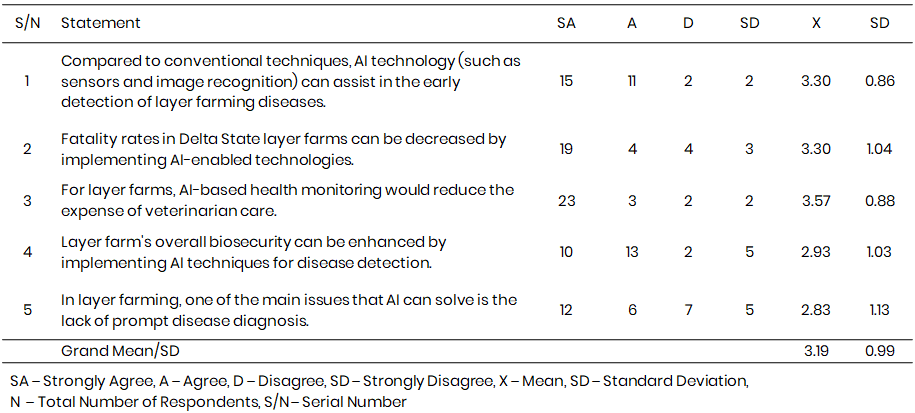
The results in Table 1 show that respondents mostly agreed that artificial intelligence (AI) technologies can enhance or support disease detection and management in layer poultry farming, with a grand mean of 3.19 (SD = 0.99). The highest agreement was on the view that AI-based health monitoring reduces veterinary costs (M = 3.57, SD = 0.88), highlighting its economic advantage. Similarly, respondents agreed that AI could assist in early disease detection and reduce poultry fatality rates (M = 3.30 each). However, perceptions were less robust on AI’s role in improving farm biosecurity (M = 2.93) and addressing the challenge of prompt disease diagnosis (M = 2.83), with higher variability in responses. The findings suggest that while AI is recognized as beneficial for cost reduction and mortality prevention, Layer farmers remain cautious about its broader applications in biosecurity and timely disease identification.
Table 1: Mean and Standard Deviation Scores of Response on the benefits of artificial intelligence technologies to enhance disease
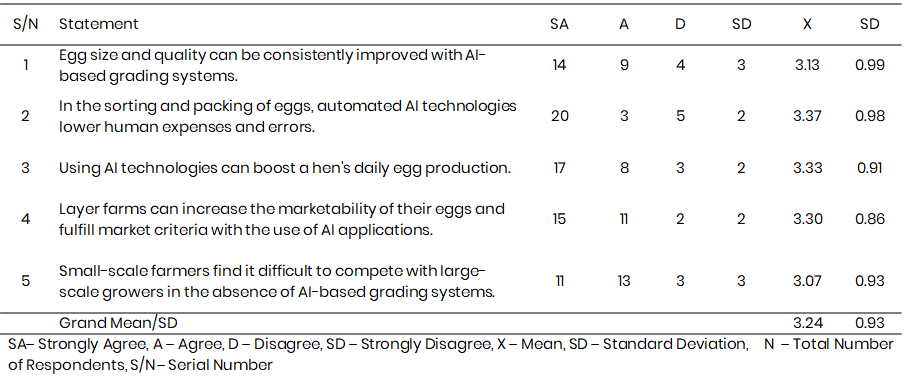
The data presented in Table 2 indicate that respondents generally agreed that AI can improve quality control, grading, and egg output in sustainable layer farming, with a grand mean of 3.24 (SD = 0.93). The highest agreement was on the need for AI in reducing human error and costs in egg sorting and packing (M = 3.37, SD = 0.98) and in boosting daily egg production (M = 3.33, SD = 0.91). Respondents also recognized AI’s potential to increase marketability and compliance with standards (M = 3.30). Improving egg sizes and quality through AI-based grading (M = 3.13) and supporting small-scale farmers (M = 3.07) received slightly lower ratings, suggesting some reservations about broader accessibility and impact. The results demonstrate that layer farmers view AI as a useful tool for increasing productivity, efficiency, and competitiveness in the production of eggs, even though smaller producers still face difficulties.
Table 2: Mean and Standard Deviation Scores of Response on how artificial intelligence (AI) can improve quality control, grading,
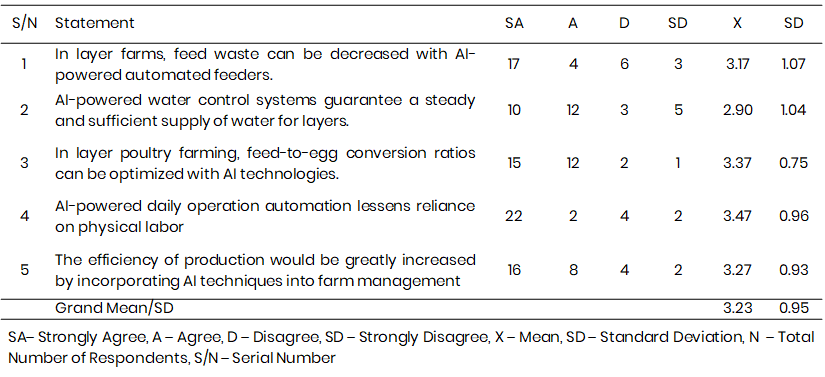
Furthermore, the interpretation in Table 3 reveals that respondents generally agreed that AI-driven automation can enhance efficiency in feeding, watering, and overall farm operations, with a grand mean of 3.23 (SD = 0.95). The highest agreement was on the role of AI-powered daily operation automation in reducing reliance on physical labor (M = 3.47, SD = 0.96) and optimizing feed-to-egg conversion ratios (M = 3.37, SD = 0.75), highlighting AI’s potential to improve productivity and reduce human effort. Incorporating AI into farm management also received strong support (M = 3.27). Concurrently, reducing feed waste with AI-powered feeders (M = 3.17) and ensuring a steady water supply (M = 2.90) scored lower, indicating mixed perceptions about the reliability of these systems. The findings stipulate that farmers view AI automation as a pathway to improved efficiency, cost savings, and productivity, though concerns remain about consistent water management applications.
Table 3: Mean and Standard Deviation Scores of Response on how layer poultry farmers in Delta State can increase the efficiency of
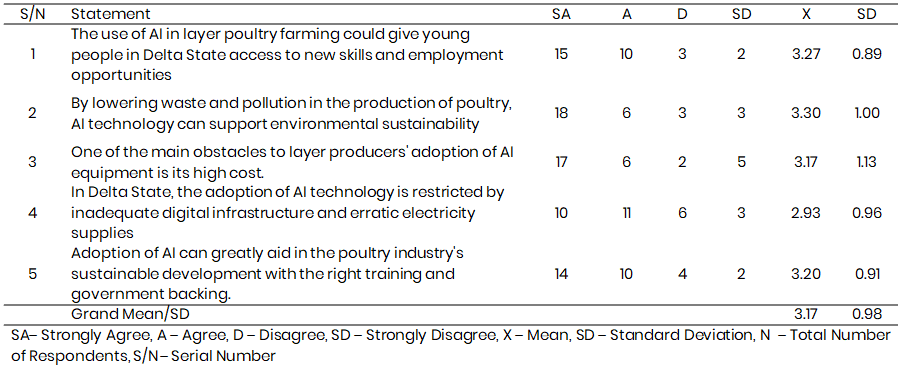
Lastly, the result in Table 4 shows that respondents generally agreed that AI has strong potential for layer poultry farming in Delta State but also faces significant obstacles, with a grand mean of 3.17 (SD = 0.98). The highest mean was recorded for AI’s role in promoting environmental sustainability by reducing waste and pollution (M = 3.30, SD = 1.00), followed closely by the ability to create new skills and employment opportunities for youth (M = 3.27). Respondents also acknowledged that AI adoption could support sustainable development with adequate training and government support (M = 3.20). However, high equipment costs (M = 3.17) and weak infrastructure, especially unsteady electricity and limited digital facilities (M = 2.93), were identified as major barriers. The findings specify that while farmers recognize the transformative benefits of AI, successful adoption relies on addressing affordability and infrastructural challenges through supportive policies and capacity-building initiatives.
Table 4: Mean and Standard Deviation Scores of Response on the potential and obstacles related to implementing AI technology in la
Discussion
The findings of the study indicate that layer farmers in Delta State have a generally favorable but cautious opinion of AI's contributions to poultry production. Respondents consistently indicated in all four tables that artificial intelligence (AI) has clear economic and productivity benefits, especially in lowering mortality, improving grading and packing, reducing veterinary costs, and optimizing feed efficiency. However, they are still skeptical of AI's dependability for specific biosecurity and resource-management tasks and are worried about cost and infrastructure limitations. Table 1 (disease detection and management) demonstrates that respondents were less convinced of AI's role in improving biosecurity and enabling timely diagnosis (M = 2.93 and 2.83, respectively), but they did strongly associate AI with cost savings and lower mortality (highest mean = 3.57 for reduced veterinary costs; M = 3.30 for reduced fatalities and early detection). It is consistent with Petrović et al. (2024) in their applied studies that show high accuracy of computer-vision and sensor systems in controlled or well-resourced settings but report variability when deployed under heterogeneous smallholder conditions (e.g., droppings-based or vision-based detection systems that perform very well in experimental datasets). This pattern reflects confidence in economic outcomes but reluctance to trust diagnostic robustness in field contexts. Also in support is recent research by Xu et al. (2025), which suggests that non-invasive computer vision techniques, for instance, demonstrate encouraging early-warning capabilities but emphasize that sensor placement, data representativeness, and edge processing power all affect field performance.
Two ramifications emerge. First, farmers' trust in AI to lower veterinary costs aligns with the technology's ability to prevent serious epidemics and treatment frequency through early identification. Second, the decreased trust in biosecurity and diagnostics probably stems from real-world issues that impair diagnostic timeliness and reliability in actual deployments, such as power outages, noisy surroundings, and a lack of local maintenance. The larger precision-livestock literature documents these contextual limits and highlights that to provide consistent, real-time benefits, algorithmic accuracy must be matched by strong on-farm systems architecture. As can be
seen from Tables 2 and 3 (quality control, grading, and egg output), respondents believe AI automation would increase productivity and decrease human error (Table 2 grand mean = 3.24; Table 3 grand mean = 3.23). The high degree of agreement that AI improves feed conversion (M = 3.37) and lowers sorting/packing mistakes (M = 3.37) is consistent with research of Sajid et al. (2024) on smart sensors and robotics in poultry farming; applied demonstrations where automated feeders and vision systems provide uniform grading and precisely metered nutrition, increasing uniformity and conversion ratios. According to their experimental research, when used correctly, AI-driven grading and automated feeding can both boost per-bird output and decrease human error.
Respondents, however, showed less faith in AI-controlled water systems (Table 3, M = 2.90) and in the steady increase in egg size and quality (Table 2, M = 3.13). These concerns are understandable given that resource-delivery systems (water, micro-dosing feed) rely heavily on consistent energy, calibrated sensors, and prompt maintenance, all of which are not always present on small farms. Similar limitations are highlighted in the literature on precision agriculture for smallholders: many sensor or actuator systems function well theoretically but falter in the absence of supply chains, maintenance services, or dependable electricity (Mizik, 2022). Therefore, even though automation promises to increase productivity, farmers' decreased confidence in water control and certain quality outcomes represents real implementation difficulties in settings with limited infrastructure.
Table 4 (socio-economic potential and barriers) shows that farmers acknowledge the potential of AI to provide employment/skill possibilities for young (M = 3.27), as well as environmental benefits (M = 3.30), which is consistent with the research of Patil et al. (2024). However, they also cite cost (M = 3.17) and inadequate digital/electric infrastructure (M = 2.93) as significant barriers. These conclusions are substantially supported by regional evaluations of the adoption of precision agriculture, which consistently point to high upfront expenditures, restricted financial resources, and infrastructure deficiencies (such as connectivity and electricity) as the main obstacles facing smallholders in Africa and comparable regions (Khaspuria et al., 2024). Without subsidies, customized financing, and investments in rural digital infrastructure, smallholder adoption of AI is expected to lag, concentrating gains among farms with greater resources, according to several policy evaluations (Bagri et al., 2024). Respondents to the study also emphasized the need for government support and training (M = 3.20). This is consistent with previous policy literature of Patil et al. (2024), which encourages public-private partnerships, capacity building, and targeted financial assistance to scale up the adoption of AI in agriculture in an equitable manner. Programs that combine hardware subsidies, specialized training, and extension services, according to analysts, can hasten adoption while reducing the possibility that AI could exacerbate structural disparities between smallholder and commercial producers (Amuda & Rahman, 2024).
Three statements that cut across the four tables are synthesized. First, in line with the global body of research on the main factors influencing the adoption of agricultural technologies, farmers primarily value AI for its economic and operational benefits, such as lower costs, lower mortality, less labor demands, and increased feed efficiency. Second, when technology needs to function reliably in challenging or under-resourced environments (biosecurity diagnostics, water control), trust gaps arise. According to the literature, these trust gaps are caused by both service ecosystem flaws and technical fragilities in the field, such as sensor drift and edge computing restrictions. Third, policies and academic research on smallholder precision agriculture directly support the conclusion that widespread adoption will require multifaceted support, including financial mechanisms to reduce entry costs, investments in rural electrification and connectivity, and extensive training and localized technical support.
Conclusion
Despite AI promises of quantifiable improvements in cost savings, mortality reduction, grading consistency, and operational efficiency, Delta State layer farmers' confidence is hampered by practical adoption barriers such as cost, infrastructure, and service capacity, particularly for tasks requiring consistent, reliable field performance (such as water management and biosecurity diagnostics). It will need a combination of institutional, financial, and technological action to convert favorable impressions into long-term, equitable adoption in Delta State, a strategy that is repeatedly advised by the literature today.
References
Abanikannda, O. T. F., & Leigh, A. O. (2012). Grading of table eggs as a marketing strategy for Nigerian smallholder farmers. International Journal of Livestock Production, 3(4), 43–46. https://doi.org/10.5897/IJLP11.038
Ahmed, A. A., Sulaiman, R. V., Adamu, N., & Musa, Y. (2024). The Role of Artificial Intelligence in Modern Farming System for Achieving Sustainable Agricultural Transformation in Nigeria. Global Sustainability Research, 3(3), 95–113. https://doi.org /10.56556/gssr.v3i3.996
Amuda, Y. J., & Rahman, S. A. (2024). Artificial Intelligence for Food Production among Smallholder Farmers: Towards Achieving Sustainable Development Goals (SDGs) in Nigeria. Journal of Ecohumanism, 4(1), 175–185. https://doi.org/10.62754/joe.v4i1.4202
Bagri, S. C., Paul, D., Goyal, S., & Dutta, S. (2024). Empowering Farmers and Rural Communities by Harnessing AI for Sustainable Livelihoods. Advances in Marketing, Customer Relationship Management, and e-Services Book Series, 163–180. https://doi.org/10.4018/979-8-3693-6468-0.ch006
Chand, N., Satpathi, A., Gehlot, T., & Tripathi, A. (2024). Potential of artificial intelligence to combat challenges in transforming agriculture (pp. 192–201). https://doi.org/10.58532 /v3bcag6p1ch16
Copyright
Open Access: This article is licensed under a Creative Commons Attribution 4.0 International License, which permits use, sharing, adaptation, distribution and reproduction in any medium or format, as long as you give appropriate credit to the original author(s) and the source, provide a link to the Creative Commons license, and indicate if changes were made. The images or other third party material in this article are included in the article’s Creative Commons license, unless indicated otherwise in a credit line to the material. If material is not included in the article’s Creative Commons license and your intended use is not permitted by statutory regulation or exceeds the permitted use, you will need to obtain permission directly from the copyright holder. To view a copy of this license, visit http://creativecommons.org/licenses/by/4.0/.

