

Abstract
The growing challenge of food insecurity in developing nations has stimulated new research into cultivating crops in non-traditional farming environments. Innovative agricultural practices such as aeroponics, vertical farming, hydroponics, and urban agriculture are increasingly gaining global attention. This study investigated the awareness and utilization of digital tools for sourcing and sharing innovative agricultural production practices among sub-urban dwellers in Rivers State, Nigeria. A multistage sampling procedure was employed to select 105 adult respondents, and data were collected through structured questionnaires. The data were analyzed using descriptive statistics - mean, percentage, ranking - and chi-square analysis. Results revealed that 88.6% and 99.8% of respondents were aware of bucket and bag farming, respectively, while less than 42% knew about other innovative production systems. Only about 9% had practiced aeroponics, hydroponics, aquaponics, or vertical farming. Approximately 29.6% of the respondents did not own Android phones. Among digital tools, WhatsApp was the most widely used (72.6%), followed by video calls (18.1%). Inadequate access to farm inputs, facilities, and materials ranked as the major constraint to effective use of digital tools. A significant difference was observed in favor of respondents not utilizing digital tools for information sourcing and sharing. The study recommends that Agricultural Extension Agents intensify awareness campaigns, link farmers to reliable sources of farm inputs, and train them on effective digital engagement. Furthermore, government policies should aim to reduce the costs of power, airtime, data, and agricultural inputs to enhance technology-driven innovation in food production.
Introduction
Among the seventeen Sustainable Development Goals (SDGs) put forward by the United Nations, ending poverty, achieving zero hunger and good health and well-being of all were prioritized as the first three (Sach et al., 2022). The hope of achieving these goals by 2030 seems bleak, especially in many developing nations where advancement in agricultural production appears not to be keeping pace with unabated population growth. In most of those nations, farmers are conservative, ageing and operating at subsistence level of production. The major challenge is that in spite of the fact that youths are characterized by energy, intelligence, innovativeness and risk-taking, the teaming youths (constituting over 45% in some countries), are negatively disposed to and hardly get involvement in agricultural transformation process (Jibowo & Sotomi, 1996; Olatunji, 2017). Aside these, there exist unabated rural-urban migration (especially of youths) and unfavourable land use pattern that do not prioritize agriculture. The combined effects of these are widespread food shortages, hunger, poverty and low standard of leaving among the citizenry (Nwokolo et al., 2023; United Nations, 2017).
Consequently, increasing food insecurity is leading to opening of new frontier of research into how food can be grown even in urban metropolis and sub-urban centres. Hence, several innovative agricultural production practices without the usual traditional planting in the farm have emerged (Ojoma, 2023). These zero acreage farming practices include: Bucket farming, Sack farming, aeroponic, vertical farming, hydroponic, Aquaponic farming, etc. (Naqvi et al., 2022; AlShrouf, 2017). Aeroponic farming is a method of growing plants in the air without soil. Plant roots are suspended in the air misted with solution that is rich in nutrient. Hydroponic farming involves planting crops in containers with the roots submerged in water containing essential nutrients. Aquaponic farming that combines aquaculture and hydroponic farming. Vertical farming involves cultivating crops on inclined surfaces using vertically stacked layers indoors or in a controlled environment.
Focussing and provision of zero-acreage-farming-related agricultural advisory services to urban dwellers will certainly lead to increased food production, hunger reduction and increased standards of living among the citizenry (Ojoma, 2023).
In the last two to three decades, advancement in research has led to significant improvement in Information-Communication Technology. Several hardware and digital tools developed have brought phenomenal changes into the processes of sourcing and sharing information (Kotarba, 2018; Schallmo & William (2018). The traditional use of Town-Criers, radio, television, etc is fast giving way to better, faster and more efficient use of mobile Button-phones, Android phones, Laptops, Tablets, e-mail, WhatsApp, Video conferencing (e.g. Zoom, Google Meet, Skype), Video calls, LinkedIn, Facebook, Instagram, YouTube and others. These digital tools are veritable for urban dwellers to use for sourcing and sharing relevant innovative agricultural practices. Most dwellers in urban centres are literate and not as conservative as most rural farmers (Chapman, 2022). This makes the job of field Agricultural Extension Agents easy. All he has to do is to create awareness about available innovative agricultural extension practices, provide links to digital tools that clienteles may utilize for sourcing and sharing relevant production information. The Extension Agent may be required to present specimen and sometimes demonstrate some of those innovative agricultural extension practices before clienteles.
The primary objective of this study was to assess the awareness and utilization of digital tools for sourcing and sharing innovative agricultural production practices among urban dwellers in Rivers State, Nigeria. The study aimed to explore the extent to which urban residents are informed about and engaged with emerging agricultural innovations that can enhance productivity in non-traditional farming environments. Specifically, the objectives were to determine the level of awareness of selected innovative agricultural production practices among urban dwellers, identify the specific innovative practices that respondents have experimented with, and examine the types of Information and Communication Technology (ICT) devices owned by them. Furthermore, the study sought to identify the digital tools commonly utilized by respondents, as well as the frequency of their use for sourcing and sharing agricultural information. It also aimed to assess the major constraints limiting the effective utilization of digital tools in accessing and disseminating knowledge on innovative agricultural practices.
Two hypotheses were formulated to guide the study: (1) there is no significant difference between the frequencies of respondents who are aware and those who are not aware of selected digital tools; and (2) there is no significant difference between the frequencies of respondents who utilize and those who do not utilize selected digital tools. The findings of this research are expected to provide insight into the digital readiness of urban farmers and highlight the potential of digital platforms in promoting innovative agricultural practices for sustainable food production.
Material and Methods
Multistage sampling procedure was used to select 105 adult males and females the study. First, three sub-urban communities were purposely selected because of their proximity. The second stage involved systematic sampling of one house out of every ten houses. The third stage involved selection of any adult male or female who was ready to willingly participate in the study. Structured questionnaire was designed, validated and administered for data collection. Relevant data were analysed using descriptive statistics (mean, percentage and ranking) and chi-square analysis to test the null hypotheses at 5% level of significance.
Results and Discussion
Awareness of innovative agricultural production practices among households in port harcourt, Rivers state, Nigeria
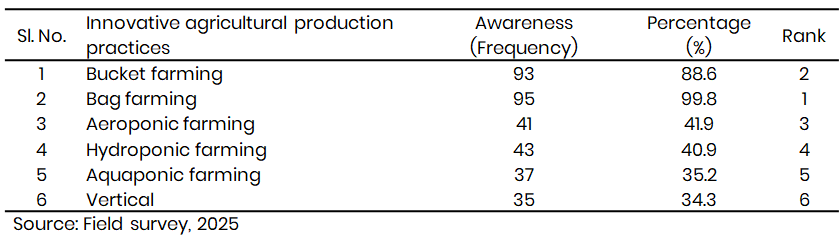
As shown in Table 1, the results of data analysis reveal that majority of the respondents were aware of bag farming (99.8%) and bucket farming (88.6%) respectively. Next to these were aeroponic farming and hydroponic farming of which 41.9% and 40.9% of respondents were aware. Only 34.3% and 35.2% of the respondents are aware about vertical farming and aquaponic farming. It is commendable that majority of the respondents are aware about bag and bucket farming. However, increased extension awareness campaigns are needed to popularize vertical farming and aquaponic farming that most of the respondents. As noted by Rogers (2003) and Oladele (1999), Adoption of agricultural technologies or innovations will be impossible unless information about the innovations are effectively communicated through effective communication channels to potential adopters for awareness, which may engender innovation trial or adoption.
Table 1: Percentage distribution of respondents who were aware of selected innovative agricultural production practices
Selected innovative agricultural production practices that respondents have tried
Data on Table 2 reveal that it is only bucket farming and bag farming that majority off of the respondents have tried at one time or the other. Bucket farming and bag farming ranked first and second with 66.67% and 59.05% respectively in terms of trials. The percentage of respondents who have tried the other innovative practices ranged from 8.57% for vertical farming to the least 1.9% for aquaponic farming in spite of the fact that awareness percentages were above were above 34% for each of them. Constraints to utilization of the digital tools for sourcing and sharing information on innovative farming which respondents reported, may explain, in part, the reasons for abysmally low percentages recorded in terms of trials of these innovative practices. Further research may unveil real and remote reasons for non-trial of these large practices by very percentage of households in this study area.
Pingali, (2021) found that farmers who adopt agricultural innovations had increased productivity and income. Manos and Xydis (2019) explained that the rise in urbanization and the need to achieve food security and sustainability has made innovations in food production and processing imperative for most developing nations. It is important that urban dwellers engage in soil-less farming, especially for its advantages of reduction in pests and diseases, prevention of soil degradation, efficient water usage and increased production.
Table 2: Percentage distribution of respondents who have tried selected innovative agricultural production practices

Basic information-communication tools that respondents possess
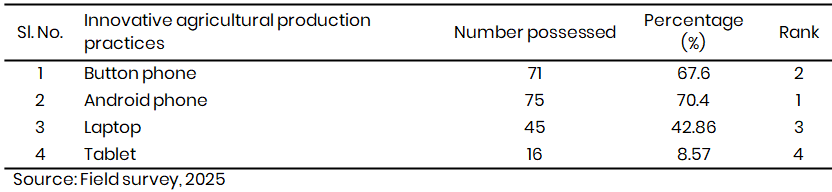
As shown in Table 3, about 67.6%, 70.4%, 42.86% and 8:57% of the respondents possess. Button phone, Android phone, Laptop and Tablets respectively. While it is commendable that 70.6% of respondents have android phones, 28.6% do not have this invaluable tool that is essential for sourcing and sharing internet-based information about innovative agricultural production practices, such as sack faming, Aeroponic farming, aquaponic farming and the like. However, it is worth noting that increasing number of persons are possessing android phones (70.4%) more than button (manual) Phones (67.6%). Abubakar & Abdurahman (2018) found that, although some of their study sample possessed information-communication tools such as radio, television, internet-enabled phones, laptops, etc, they primarily source and share agricultural production information through friends, relatives or co-farmers.
Table 3: Percentage distribution of respondents on the basis of information-communication-tools that they possess.
Respondents' use of digital tools to source and share information on innovative agricultural production practices
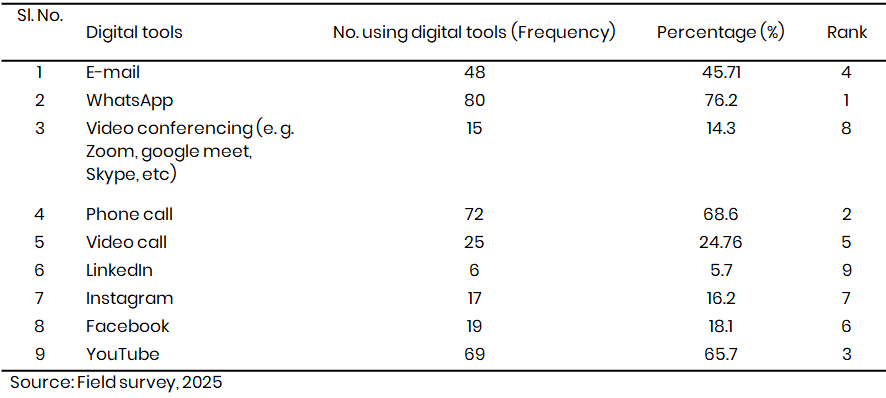
As revealed in Table 4, the digital tools that most of the respondents utilized for sourcing and sharing innovative agricultural production practices is WhatsApp (76.20%). This is followed by Phone calls (2nd rank, 68.6%), YouTube (3rd rank, 65.7%) and e-mail (4th rank, 45.7%). Video call was utilized by 24.76% (5th rank) while the use of Facebook had only 18.1%. The following were the least used digital tools: Instagram (16.2%), Video conferencing (14.37%) and LinkedIn (5.7%). Nnadi, (2014) reported that informal source of information (through friends, neighbours, other farmers, etc and not the use of digital tools) formed the highest means of sourcing and sharing agricultural production information among urban vegetable farmers in Owerri, Imo State, Nigeria. It appears that many of urban dwellers/farmers still rely more on sourcing and sharing innovative agricultural production practices through informal sources.
It is commendable that as high as 65.7% are utilizing YouTube. Agricultural Extension Agents can leverage on this to further promote the use of YouTube for sourcing and sharing innovative agricultural production practices among urban dwellers. YouTube offers excellent stock of videos of innovative agricultural production practices with "how-to-do-it" guidelines.
Table 4: Percentage distribution of respondents who were using various digital tools to source and share information on innovative
Constraints to utilization of digital tools for sourcing and sharing innovative agricultures production practices
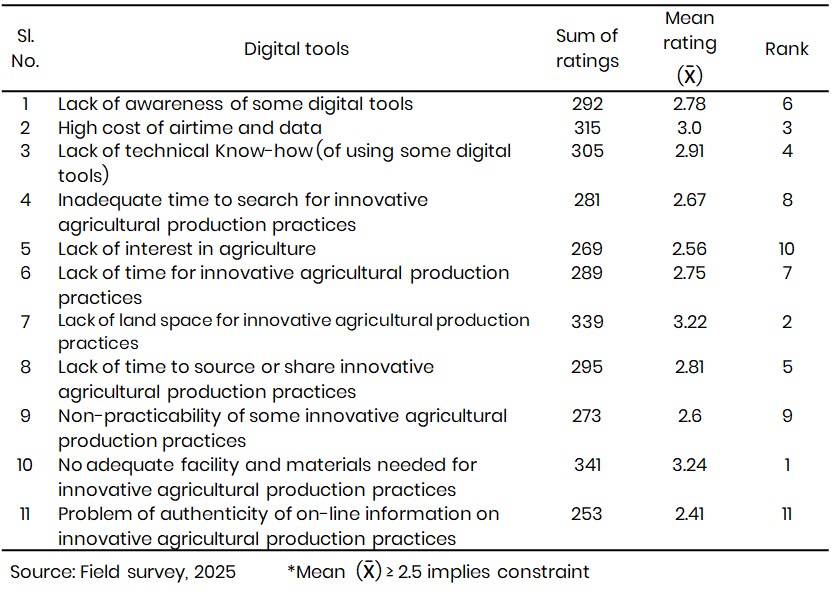
Results of data analyses in Table 5 reveal that all the eleven constraint-related items have mean rating that ranged from the least x̄=2.41 for item 11 (ranked 11th) to the highest x̄=3.25 for item 10 (ranked 1st). The implication is that all the eleven items pose varying degrees of constraints to the respondents. The most serious constraints include: Inadequate facility and materials needed for innovative agricultural production practices (ranked 1st), Lack of land space for innovative agricultural production practices (ranked 2nd), High cost of airtime and data (ranked 3rd), Lack of technical Know-how (of using some digital tools (ranked 4th), Lack of time to source or share information on innovative agricultural production practices (ranked 5th), Lack of awareness of some digital tool (ranked 6th).
Rathra et al. (2020) had also found that high cost of construction of housing, animal feeds and lack of timely insemination facilities were major constraints faced by urban farmers in India.
Field extension agents should effectively refer farmers to where they can procure materials and guide them to improve where necessary. Farmers should also be educated on how to make maximum use of available land. For example, through adoption vertical farming. Government should implement policies that will reduce the cost of data and airtime. Since respondents mentioned lack of technical know-how, Field Extension Agents should embark on effective seminars, demonstrations and use of specimen in teaching. Vigorous awareness campaign should be mounted in every community to bridge the gap in awareness which respondents noted as a serious constraint.
Table 5: Mean distribution of respondents’ rating of constraints to utilization digital tools for source and share informati
Significance of difference between the frequencies of respondents who are aware and those not aware of selected innovative agricultural production practices
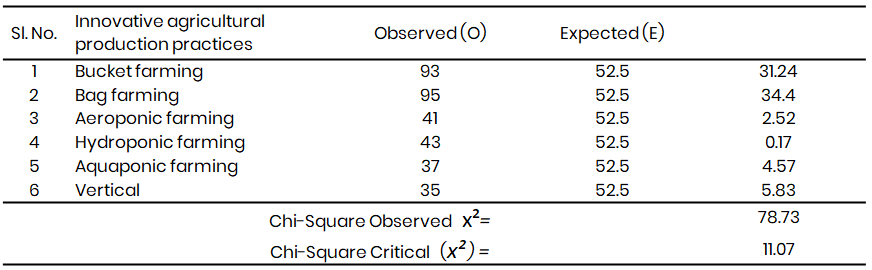
The results of chi-square analysis on Table 6 showed that observed value was 78.73 while critical valve is 11.07. The null hypothesis was rejected. This implies that there is significant difference between the frequencies of respondents who are aware and those not aware of selected innovative agricultural production practices.
The difference was in favour of those who are not aware. Data on Table 2 showed that less than 42% are aware of aeroponic, hydroponic, aquaponic and vertical farming. Rigorous awareness campaigns are needed to bring these practices to the notice of urban-dwellers.
Table 6: Chi-square analysis of frequencies of respondents who are aware of selected innovative agricultural production pr
Significance of difference between the frequencies of respondents who utilize digital tools for sourcing and sharing information on selected innovative agricultural production practices
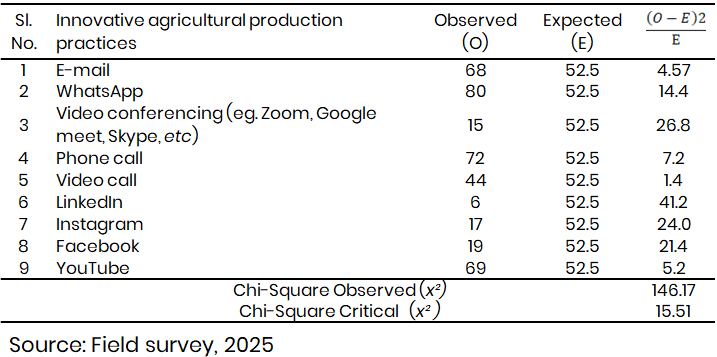
The results of chi-square analysis showed (Table 7) that observed value is 146.2 while critical valve is 15.51. The null hypothesis was rejected. This implies that there is a significance difference between the frequencies of respondents who utilize digital tools for sourcing and sharing information on selected innovative agricultural production practices and those who do not. The observed difference is in favour of those who did not utilize digital tools. It can be seen in Table 4 that the percentage of respondents who used those digital tools was above 50% only in 3 out of 9 items. As noted by Chapman (2022), most dwellers in urban centres are literate and not as conservative as most rural farmers. As such, digital tools would proof invaluable in the hands of urban dwellers to use for sourcing and sharing relevant innovative agricultural practices. Field Extension Agents should promote the use of digital tools that respondents were not utilizing for quick information sourcing and sharing.
Table 7: Chi-square analysis of frequencies of respondents who utilized digital tools for sourcing and sharing information on inno
Conclusion
Urban dwellers are increasingly participating in agriculture as evidenced by majority of the sample for this study Majority of them are both ware and have been practicing bucket farming and bag farming. However, many of them are not aware about aeroponic, hydroponic, vertical farming and aquaponic farming. It is aquaponic that is the strangest to many of them. Many of them have android phones but it appears that majority only use it for entertainment and rarely for sourcing or sharing information related to innovative agricultural practices. Inadequate facility and materials needed for innovative agricultural production practices is the greatest problem they are facing. Others also pointed to lack of land space for innovative agricultural production practices and lack of technical know-how of using some digital tools. Awareness campaign, training and governments’ intervention are paramount to overcome those challenges as the people move towards achieving the first 3 in the list of Sustainable Development Goals (SDGs).
References
Abubakar, M. S., & Abdurahaman, E. M. (2018). Useful plants in traditional control of insect pests. Journal of Herbs, Spices & Medicinal Plants, 6(2), 49–54.
Alshrouf, A. (2017). Hydroponics, aeroponic and aquaponics compared with conventional farming. American Academic Scientific Research Journal for Engineering, Technology, and Sciences, 27, 247–255.
Chapman, J. (2022). Exploring the new urban age: Three trends in literature. Routes, 3(1), 52–63.
Jibowo, A. A., & Sotomi, A. O. (1996). The youth in sustainable rural development: A study of youth programmes in Ogun State, Nigeria. Nigerian Journal of Rural Sociology, 2(1), 1–11.
Kotarba, J. A. (2018). Digital transformation: A data-driven approach. Elsevier, pp. 1–15, 101–120.
Naqvi, S. M. Z. A., Saleem, S. R., Tahir, M. N., Hussain, S., Haq, S. I., Awais, M., & Qamar, S. (2022). Vertical farming – Current practices and its future. Environmental Sciences Proceedings, 23(1), 4, 1–8. https://doi.org/10.3390/ environsciproc2022023004
Nnadi, F. N., Aja, O. O., Nnadi, C. D., Ani, A. O., Anaeto, F. C., Akwiwu, U. N., Agomuo, C. I., & Elei, C. P. C. (2014). Urban farmers’ adoption of improved dry season vegetable production technologies in Owerri Municipal Council of Imo State, Nigeria. Journal of Agricultural Extension, 18(2), 145–150. https://doi.org/10.4314 /jae.v18i2.215
Nwaokolo, C. I., Olatunji, S. O., & Epueke, A. G. (2023). Socio-economic factors influencing the types of agro-enterprises practiced by peri-urban farmers in Port-Harcourt, Rivers State, Nigeria. Agricultural Economics & Extension Research Studies (AGEERS), 11(2), 115–126.
Ojoma, M. (2023). Assessment of awareness of selected innovations in crop production among urban households in Rivers State, Nigeria (Unpublished master’s dissertation). Department of Agricultural Extension and Development Studies, University of Port Harcourt, Rivers State, Nigeria.
Copyright
Open Access: This article is licensed under a Creative Commons Attribution 4.0 International License, which permits use, sharing, adaptation, distribution and reproduction in any medium or format, as long as you give appropriate credit to the original author(s) and the source, provide a link to the Creative Commons license, and indicate if changes were made. The images or other third party material in this article are included in the article’s Creative Commons license, unless indicated otherwise in a credit line to the material. If material is not included in the article’s Creative Commons license and your intended use is not permitted by statutory regulation or exceeds the permitted use, you will need to obtain permission directly from the copyright holder. To view a copy of this license, visit http://creativecommons.org/licenses/by/4.0/.

