

Abstract
The study was conducted at the poultry unit of the Teaching and Research Farm, Rufus Giwa Polytechnic, Owo, to evaluate the effect of air-dried pawpaw (Carica papaya) leaf meal on the carcass and organ characteristics of finished broilers. Ninety-nine (99) Ross 308 broiler chicks were used for the experiment. The birds were brooded for three weeks and later assigned to three dietary treatments in a completely randomized design, with 33 birds per treatment and three replicates of 11 birds each. The dietary treatments consisted of a control diet (T1) with 0% pawpaw leaf meal, T2 with 5 g kg-1 inclusion, and T3 with 10 g kg-1 inclusion. The feeding trial lasted four weeks, during which feed and water were provided ad libitum. Data collected were analyzed using analysis of variance, and treatment means were separated using Duncan Multiple Range Test. Results showed that birds fed 10 g kg-1 air-dried pawpaw leaf meal (T3) recorded the highest live weight, dressed weight, and most carcass cuts compared to the control. However, organ weights such as liver, heart, lungs, kidney, gizzard, and abdominal fat were generally higher in birds fed the control diet. The study concluded that inclusion of air-dried pawpaw leaf meal improved carcass yield but did not enhance organ development. It is therefore recommended that pawpaw leaf meal can be used as a feed additive in broiler diets, while further studies should explore other processing methods to improve both carcass and organ performance.
Introduction
Nigeria’s population is growing at an estimated annual rate of about 3.2%, which exceeds the growth rate of food production, put at roughly 2.0% per year (National Bureau of Statistics, 2013). The disparity between the rate of food production and population growth has resulted in a shortfall in the supply of food, leading to a widening gap between domestic food production and the total demand. This has necessitated an increase in food imports and a significant rise in food prices. Consequently, widespread hunger and malnutrition have become evident in the country (Alabi and Isah, 2012).
According to Adeniji and Balogun (2002), the solution to the issue of low consumption of animal protein among the typical Nigerian is to enhance the production of highly efficient animals with a short time between generations, such as poultry, pigs, rabbits, sheep, and goats. To enhance this condition, it is imperative to promote the production of poultry, particularly broilers. In addition to its short generation interval and prolificacy, Sola-Ojo et al. (2013) found that poultry offers a significant return on investment within a short period of time. It also requires relatively minimal capital for investment and is well accepted in various culinary traditions.
The importance of poultry to the national economy cannot be overstated, as it has gained popularity among small-scale farmers who have made significant contributions to the country's economy. Poultry accounts for around 15 percent of Nigeria's total yearly protein consumption, with each person consuming an average of 1.3 kg of poultry products per year (Ologbon and Ambali, 2012). The poultry sector has become increasingly significant in enhancing employment prospects and the production of animal food in Nigeria. Many countries are now rejecting the use of synthetic feed additives or antibiotics as growth promoters in meat production due to the related health hazards for humans and animals (Gonzalez and Angeles, 2017). The use of phytobiotics, phytogenic feed additives, phytochemical feed additives, and herbal supplements or ingredients as dietary supplements is increasingly being explored as substitutes for synthetic growth promoters (Fallah et al., 2013; Oloruntola et al., 2018).
Parts of several plants that are of medicinal interest had been employed as supplements and or component in poultry production to achieve various goals of performance and health relevance (Oloruntola et al., 2016; Oloruntola and Ayodele, 2017; Oloruntola et al., 2018). One of the phytogenic feed additions gaining significance in poultry feeding to increase their performance and boost their immunological response is pawpaw whose leaf has been previously identified by Oloruntola et al. (2018) as a natural source of papain, chymopapain A and B, and papaya peptidase A. Papain is proteolytic and thus capable of increasing protein digestion (Oloruntola et al., 2018).
Pawpaw is a plant endemic to tropical America. It is popular in the tropics and sub-tropics because of its easy cultivation, rapid growth, quick economic returns and easy adaptation to varied soils and climates (Olubode et al., 2016). Pawpaw latex contains proteolytic enzymes papain, chymo-papain A and B, and papaya peptidase A (Olubode et al., 2016) and chitinase enzyme (Savon, 2005). In addition, the papaya leaf contains broad-spectrum phytochemicals including alkaloids and phenols. Phenolic compounds exhibit significant antioxidant activity and free radical scavenging capability, with the mechanism of blocking enzymes involved for reactive oxygen species generation (Kahkonen et al., 2001). The antibacterial, antifungal, antiviral, neuroprotective and antifertility effects of papaya have also been shown (Kadiri et al., 2016). It is conceivable that the nutritional and phytogenic potentials of the papaya leaf could be exploited as a growth enhancer in broiler chicken feed.
Broiler production gives employment and steady income within the shortest time because to its fast growth and shorter production cycle. However, reasonable return may be assured only when produced at minimum cost, because net profit is a function of gross return and cost of production. Though minimum cost of production is desirable to gain higher return, care must be given so as not to be too strict so that the goal of creating soft, supple and good quality meat is not compromised. According to Asghar et al. (2000), reduced cost of production and higher returns are significant criteria for higher profit in broilers.
It is a general understanding that feed constitute the most and costly input in any livestock operation; notably poultry. Thus, any considerable reduction in the cost of feeds will greatly reduce the entire cost of production and raise the profit margin of the farm. Due to restriction on feed additives (Gonzalez and Angeles, 2017), the priority of nutritional research is shifted towards identifying non-conventional sources and natural replacement feed additives that are locally available with low human needs. One of such natural alternative feed additives sources that might be employed to lower the high cost production in poultry diets is the pawpaw leaf (Carica papaya) meal.
Material and Methods
Experimental site
The experiment was carried out at the poultry unit of the Teaching and Research Farm, Rufus Giwa Polytechnic, Owo, Ondo State, Nigeria the school is located in Owo, Ondo State, the state is situated at the South West part of Nigeria which was derived at savannah zone with an annual mean temperature of 30% and relative humidity of 80%. Area is 330 mm above sea level.
Sources and preparation of the test ingredient
The pawpaw leaves were harvested fresh within the institution; the leaves were air-dried under a shade avoiding the rays from sunlight after which the leaves were milled into powdery form.
Experimental animals and design
Ninety nine (99) day old Ross 308 strains of broiler chicks were procured from a reputable and reliable hatchery (Agrited) at Ibadan, the birds were brooded for three weeks after which they were divided into three (3) treatments with 33 birds per treatment and each treatment have three (3) replicates containing eleven (11) birds. The birds were housed in well ventilated pens while the experimental diets were given to them ad libitum throughout the experiment which lasted for four (4) weeks.
Experimental diet
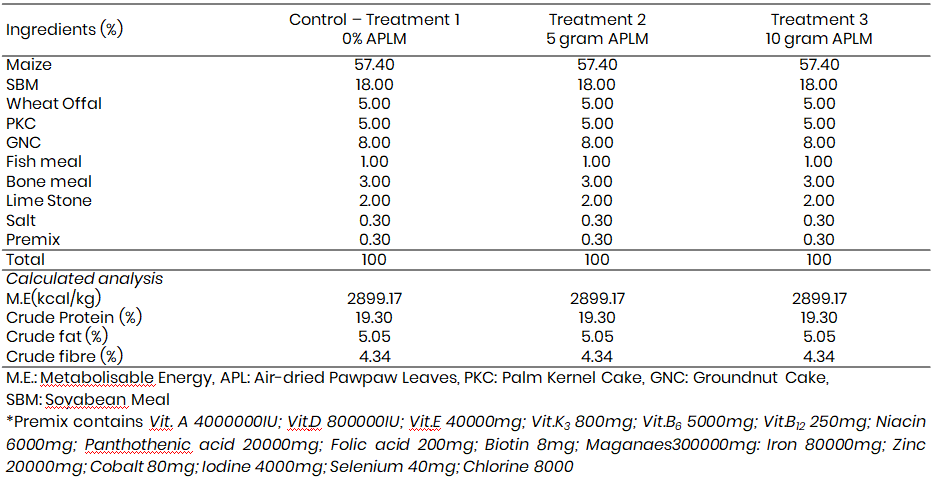
Three dietary treatments (T1-T3) were formulated using air-dried pawpaw leaf meal as an additive (Table 1).
Treatment 1, (T1) was control diet, with no inclusion of air-dried pawpaw leaf meal.
Treatment 2, (T2) contains 5 g kg-1 inclusion of air-dried pawpaw leaf meal.
Treatment 3, (T3) contains 10 g kg-1 inclusion of air-dried pawpaw leaf meal.
Data collection
Carcass weight: At the end of the experiment, the birds were fasted overnight, one bird was randomly selected from each replicate and weighed the following prior to slaughtering. The birds were slaughtered by using sharp knife on the jugular vein, after slaughtering the birds were defeathered, eviscerated and the respective weights were taken. The live, dressed, wings, thigh, drumstick, breast, back, head, neck and shank weight were taken.
Table 1: Percentage (%) composition of the experimental diets
Organ characteristics records: After evisceration the organs; liver, spleen, lung, heart, gallbladder, pancreas, proventiculus, kidney, gizzard and abdominal fat were weighed and recorded.
The value of the parameters were expressed as percentage of live weight
Percentage (%) live weight = (Parameter Weight)/(Live Weight) × 100
Yij=µ+Ti+∑ij
Statistical analysis
Data obtained was subjected to analysis of variance (ANOVA) in a complete randomised design using SAS (2015) significant mean was separated by Duncan’s multiple range test (Duncan, 1955) in all 5% confidence level was set to test statistically. Significant component to variance mean value and standard error was estimated using the following experiment model Where:
Y = Output yield
µ= Population mean
Ti= Effect of air dried pawpaw leaves
∑ij= Residual error.
Results
Effect of air-dried pawpaw leaf meal on carcass weight of broiler chicken
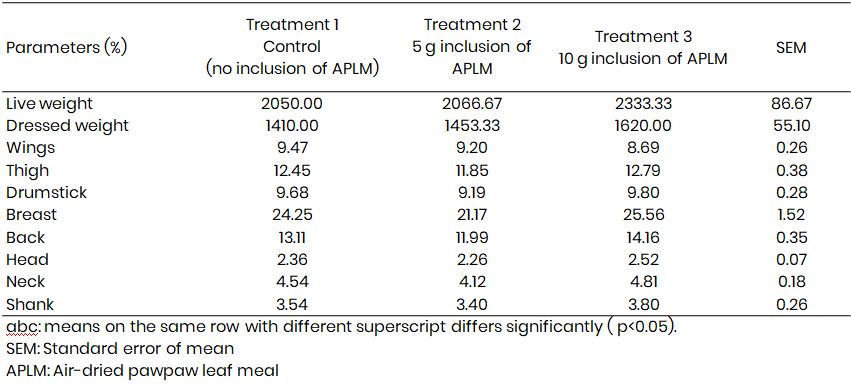
The results showed no significant (p > 0.05) effect across all the parameters studied (Table 2). The highest live weight (2333.33 g) was recorded in treatment 3 (10 g inclusion of APLM), while the lowest (2050.00 g) was observed in the control (no inclusion of APLM). Similarly, for dressed weight, the highest value (1620.00 g) was recorded in treatment 3, whereas the lowest (1410.00 g) was noted in the control diet. In the case of wings, the highest weight (9.47 g) was observed in the control, while the lowest (8.69 g) was recorded in treatment 3. For thigh weight, the highest (12.45 g) and lowest (11.85 g) values were recorded in treatment 3 and treatment 2 (5 g inclusion of APLM), respectively. Drumstick weight was highest (9.80 g) in treatment 3 and lowest (9.19 g) in treatment 2. Breast weight followed a similar trend, with the highest value (25.56 g) in treatment 3 and the lowest (21.17 g) in treatment 2. Back weight was also highest (14.16 g) in treatment 3 and lowest (11.99 g) in treatment 2. For head weight, treatment 3 recorded the highest value (2.52 g), while treatment 2 recorded 2.26 g. Neck weight was highest (4.81 g) in treatment 3 and lowest (3.81 g) in treatment 2. Likewise, shank weight was highest (3.80 g) in treatment 3 and lowest (3.40 g) in treatment 2.
Table 2: Carcass weight of finished broilers fed air-dried pawpaw leaf meal as additive
Effect of air-dried pawpaw leaf meal on organ weight of broiler chicken
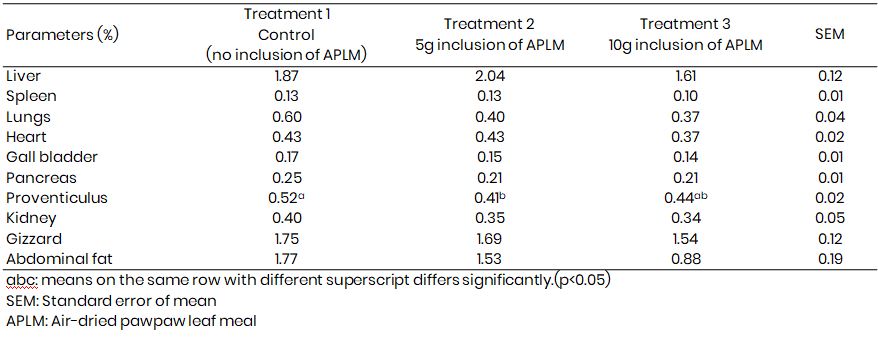
There was no significant (p > 0.05) effect on all the parameters measured except for the proventriculus (Table 3). The proventriculus showed a significant (p < 0.05) effect, with the highest weight (0.52 g) recorded in the control (no inclusion of APLM) and the lowest weight (0.41 g) observed in treatment 2 (5 g inclusion of APLM). For the liver, treatment 2 recorded the highest weight (2.04 g), while treatment 3 (10 g inclusion of APLM) showed the lowest weight (1.61 g). In the case of the spleen, both the control and treatment 2 recorded similar weights (0.13 g), which were higher than that of treatment 3 (0.10 g). For the lungs, the control had the highest weight (0.60 g), whereas treatment 3 had the lowest (0.37 g). Heart weight was highest (0.43 g) in both the control and treatment 2, while the lowest (0.37 g) was observed in treatment 3. The gall bladder showed the highest weight (0.17 g) in the control and the lowest (0.14 g) in treatment 3. For the pancreas, the highest weight (0.25 g) was recorded in the control, while both treatment 2 and treatment 3 showed the lowest weight (0.21 g). Kidney weight was highest (0.40 g) in the control and lowest (0.34 g) in treatment 3. Similarly, gizzard weight was highest (1.75 g) in the control and lowest (1.54 g) in treatment 3. Abdominal fat was also highest (1.77 g) in the control and lowest (0.88 g) in treatment 3.
Table 3: Organ weight of finished broilers fed air-dried pawpaw leaf meal as additive
Discussion
In carcass weight, the result shows increase in all parameters measured as the inclusion of the air-dried pawpaw leaf meal increases except for wings where the result shows highest weight in no inclusion of pawpaw leaf meal, which is in consonance with the research work of Banjoko et al. (2020), whose result shows that the increase in the inclusion levels of pawpaw leaf meal contribute to the weight of carcass cut parts. Also the results of earlier researchers such as Bolu et al. (2009); Oloruntola et al. (2018) also corroborate with the result of this research which showed relative increase in the parameters measured in the treatments with pawpaw (Carica papaya) leaf extract compare with treatment with no papaya leaf extract, and is also in agreement with the result of Moshood and Odunsi (2018), which shows increase in parameters measured in the treatments with inclusion of papaya latex compared to those without inclusion. The superior value revealed across parameters in treatment 3 with 10g inclusion of APLM is an indicator that meat yield from same treatment (treatment 3) is higher than meat yield from other treatments
which shows satisfactory in the weight of the carcass of broiler chicken fed with higher inclusion of air-dried papaya leaf meal, this commemorate with the work of Onyimonyi and Ernest (2009), whose results shows increase in meat yield as the inclusion of PLM increases across the treatment, hence, the use of air-dried papaya leaf meal as additive can be used in the pursuit of optimal performance in the carcass weight of broiler chicken. This result shows that in the nearest future there will be general acceptability of the inclusion of air-dried pawpaw leaf meal in broilers diet to optimise meat treatment.
This result shows no significant (p<0.05) effect in all parameters measured except for proventiculus, which is significantly higher at the treatment without the inclusion of papaya leaf meal in their diet compared to the treatments with the inclusion of air-dried papaya leaf meal, this result however shows that the treatment without the inclusion of air-dried papaya leaf meal has the highest weight in all parameters measured except for liver which had its highest weight at treatment 2, compared to the treatment which had the highest inclusion of air-dried papaya leaf meal which had the least weight. Also treatment 2 with 5% inclusion of air-dried papaya leaf meal has same weight in spleen and heart with the treatment with no inclusion of air-dried papaya leaf meal which is not in agreement with the result of Oloruntola et al (2018) in his findings, which shows that in all his organ parameters (kidney, liver, heart, lung and gizzard) measured, treatment with highest inclusion of papaya leaf meal had the highest weight compared to treatments without papaya leaf meal but indicates slight agreement with the research of Moshood and Odunsi (2018), whose result shows increase in the organ (gizzard and liver) parameters measured at the treatment with the highest inclusion of papaya latex compared to those without such inclusion, but shows decrease in weight of other organs (kidney, lung and heart) measured in treatment with the highest inclusion of papaya latex compared to the treatment without inclusion of papaya latex which is an indicator that much more research work or findings need to carried out so as to find out the most effective processing means that ensures maximum profit through organ weights.
Conclusion
The research finding showed that feeding of finished broiler birds with air-dried papaya leaf as additive favoured the performance of carcass weight but, could not favour organ weight compared to the other feed without air-dried papaya leaf. Since air-dried papaya leaf did not produce the desired result in optimizing better performance level of carcass and organs weight of finished broiler, it is recommended that the use of papaya leaf meal in increasing ration be used, as well, other papaya parts such as papaya bark, papaya seeds and fresh papaya flower should be investigated so as to determine a better performance level of carcass and organ weight of finished broiler.
References
Adeniji, I. A., & Balogun, A. O. (2002). An investigation of technical inefficiency of production of farmers under the National Directorate of Employment in Ondo State, Nigeria. Applied Economic Letters, 6, 111–114.
Alabi, O. O., & Isah, R. G. (2012). Socioeconomic factors affecting poultry farmers in Ejigbo Local Government Area of Osun State. Journal of Human Ecology, 18, 39–41.
Asghar, O. Y., Amata, P. S., & Olayemi, J. K. (2000). An investigation of production efficiency in food crop enterprises, Gombe State, Nigeria. Journal of Rural Economics and Development, 13, 111–122.
Banjoko, O. J., Adebayo, I. A., Osho, I. B., & Olumide, M. D. (2020). Evaluation of varying level of papaya leaf meal on growth performance, haematology parameters and as anticoccidial. International Journal of Livestock Production, 10(8), 192–197. https://doi.org/10.5897 /IJLP2018.0532
Bolu, S. A. O., Sola-Ojo, F. E., Olorunsanya, O. A., & Idris, K. (2009). Effect of graded levels of dried pawpaw (Carica papaya) seed on the performance, hematology, serum biochemistry and carcass evaluation of chicken broilers. International Journal of Poultry Science, 8(9), 905–909.
Copyright
Open Access: This article is licensed under a Creative Commons Attribution 4.0 International License, which permits use, sharing, adaptation, distribution and reproduction in any medium or format, as long as you give appropriate credit to the original author(s) and the source, provide a link to the Creative Commons license, and indicate if changes were made. The images or other third party material in this article are included in the article’s Creative Commons license, unless indicated otherwise in a credit line to the material. If material is not included in the article’s Creative Commons license and your intended use is not permitted by statutory regulation or exceeds the permitted use, you will need to obtain permission directly from the copyright holder. To view a copy of this license, visit http://creativecommons.org/licenses/by/4.0/.

