

Cardamom commercialization and its impact on farmers' livelihood: A study of Sandakpur rural municipality, Ilam district, Nepal
Abstract
This study examined the commercialization of large cardamom (Amomum subulatum Roxb.) and its impact on the livelihoods of farmers in Sandakpur Rural Municipality, Ilam District, Province No. 1, Nepal. Employing both exploratory and descriptive research designs, primary data were collected from 12 purposively selected cardamom-farming households through structured household questionnaires, key informant interviews, and field observations. Secondary data were obtained from published literature, government reports, and institutional sources. Findings indicate that cardamom is the sole first-preference income source for all surveyed households (100%), with livestock and tea emerging as secondary sources (50% and 16.66%, respectively). The bharlyang variety dominated local production (67% of respondents), while 70% of households continued to rely on traditional kilns (bhatti) for drying, adversely affecting capsule quality and market value. Annual production ranged widely, with 50% of households producing below 4 maunds per year. Annual earnings were concentrated in the NPR 100,000–200,000 bracket (58% of respondents). The SWOT analysis identified high commodity price and productive use of marginal lands as primary strengths, while disease incidence (66.67%), lack of government support (50%), and poor access to credit (41.67%) emerged as the most critical weaknesses and threats. Despite challenges, commercialization has contributed to improvements in income, health-seeking behaviour, educational investment, and housing standards in the study area. The study recommends the establishment of cooperative marketing structures, expansion of modern drying technology with government subsidies, improved disease management extension services, and targeted microfinance programs to sustain and enhance cardamom-based livelihoods in the region.
Introduction
Cardamom, known as the "Queen of Spices," is one of the most valued spices in the world, with a history of cultivation and trade spanning over 4,000 years (Ravindran & Madhusoodanan, 2002; Kaini, 2004). Large cardamom (Amomum subulatum Roxb.) is a high-value cash crop that plays a pivotal role in the agricultural economy of Nepal, particularly in the eastern hill districts. Nepal is one of the world's leading producers and exporters of large cardamom, which contributes significantly to foreign exchange earnings, rural income, and employment generation in mountainous communities (MOCS, 2010; ANSAB, 2005; MoALD, 2021).
Ilam District, located in Province No. 1 of Nepal, is particularly renowned for its suitability for large cardamom cultivation due to its favourable agro-climatic conditions - cool humid climate, well-distributed rainfall of 1,500 - 2,500 mm, shaded forest cover, and elevations ranging from 800 to 2,000 metres above sea level (CDC, Ilam, 2014). Among the various administrative units of Ilam, Sandakpur Rural Municipality stands out as a high-potential area for commercial cardamom farming. The municipality covers an area of 156.01 square kilometres, with a total population of 15,444 (CBS, 2021), and encompasses five wards formed by the merger of previous Village Development Committees of Maimajhuwa, Mabu, Sulubung, Maipokhari, and Jamuna.
Despite the recognised economic importance of large cardamom, smallholder farmers in Sandakpur and similar areas continue to face multifaceted challenges in capitalising on commercial opportunities. These challenges include disease incidence, limited access to modern post-harvest technologies, constrained market access, inadequate government support, and insufficient credit facilities (Bhattarai, 2016; ANSAB, 2005). While commercialization of cardamom has been reported to improve household income and living standards, the magnitude and nature of its impact on farmers' livelihoods - particularly in Sandakpur - remain inadequately documented in academic literature.
This study was undertaken to evaluate the impact of cardamom commercialization on the economic and social livelihoods of farming households in Sandakpur rural municipality of Ilam District, Nepal, while also examining the strengths, weaknesses, opportunities, and threats (SWOT) associated with the cardamom sector in the study area. Specifically, the study sought to analyse and visually represent the effects of cardamom commercialization on farmers’ livelihoods, describe the demographic and socio-economic characteristics of cardamom-producing households, assess production patterns and the contribution of cardamom cultivation to household income, and examine its broader influence on key welfare indicators such as education, healthcare, and living standards. In addition, the study aimed to identify the major challenges and constraints encountered by farmers in the commercialization process. By addressing these objectives, the research provides empirical evidence to enhance understanding of the role of cardamom commercialization in rural livelihood transformation and offers valuable insights for policymakers, development practitioners, researchers, and extension agencies working to strengthen the sustainability and competitiveness of the cardamom value chain in Nepal’s eastern hill region.
Material and Methods
Research design
This study employed both exploratory and descriptive research designs. The exploratory design was used to develop an initial understanding of cardamom farming patterns and livelihood conditions in the study area, while the descriptive design was used to systematically document and analyse data on production, income, and livelihood indicators. Both qualitative and quantitative research approaches were applied to obtain comprehensive and reliable findings.
Sampling and study area selection
Purposive sampling was employed for study area selection, with Sandakpur Rural Municipality chosen for its significance as a cardamom-producing area in Ilam District. A sample of 12 cardamom-farming households was selected from the rural municipality using purposive sampling criteria that included active engagement in cardamom cultivation and availability of both primary and secondary income source data.
Data collection
Primary data were collected through (i) structured household questionnaires administered to the sampled farmers, (ii) key informant interviews (KIIs) with experienced cardamom farmers and local agricultural technicians, and (iii) direct field observation of cardamom farming practices, drying facilities, and marketing activities. Secondary data were obtained from published books, academic journals, government reports (including data from the Ministry of Agriculture and Livestock Development, MOAD; Ministry of Commerce and Supplies, MOCS; and the Cardamom Development Centre, Ilam), and relevant websites.
Data analysis
Collected data were analysed using descriptive statistics including frequency distributions, percentages, and rankings. Qualitative data from interviews and field observations were subjected to thematic analysis. Data are presented in tables, pie charts, bar charts, and a SWOT matrix for ease of interpretation.
Results and Discussion
Demographic profile of respondents
Table 1 summarizes the key demographic characteristics of the 12 surveyed households. The majority of respondents belonged to the Brahmin community. Approximately 60% of respondents were aged between 30 and 50 years—the economically active segment—while 40% were above or below this range. The gender distribution showed a male-dominated respondent profile (70% male, 30% female). In terms of educational attainment, 50% of respondents had received primary education and 30% had completed secondary education, while the remaining 20% had other levels of education. A large majority (75%) had more than five years of experience in cardamom farming, indicating a well-established farming community with substantial institutional knowledge of the crop (Fig. 1).
Table 1: Demographic profile of respondents
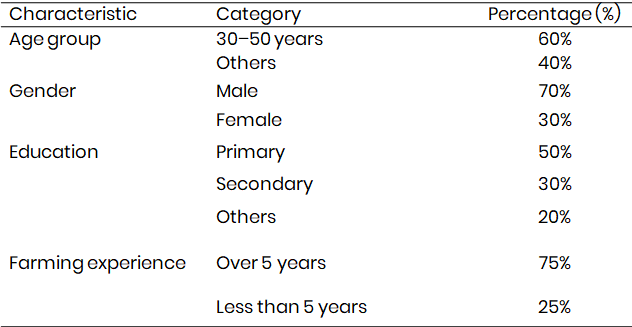
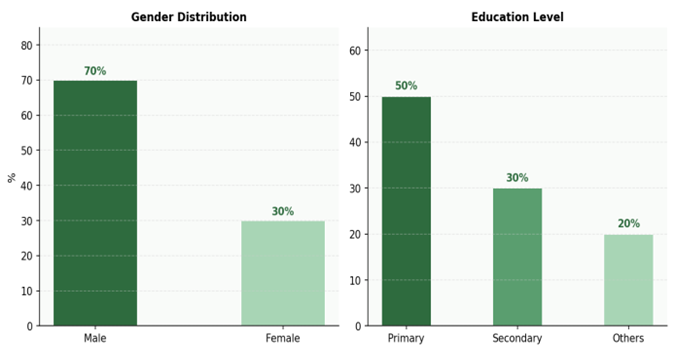
Fig. 1: Demographic profile of respondents (Gender and Education Level)
Income sources and crop production
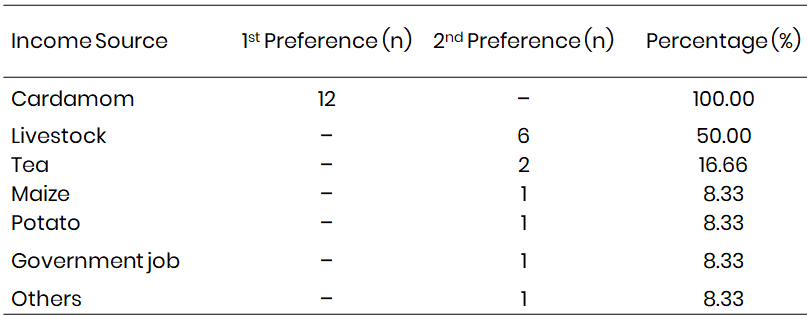
Table 2 presents the major income sources of cardamom farmers in Sandakpur. Cardamom was ranked as the first-preference income source by all 12 respondents (100%), confirming its critical role as the primary livelihood crop. Livestock emerged as the most common secondary income source (50%), followed by tea (16.66%), and maize, potato, government employment, and other sources (each at 8.33%).
Table 2: Major income sources of cardamom farmers in Sandakpur
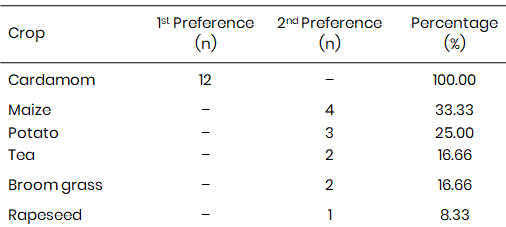
Regarding crop diversity, cardamom was again the unanimous first-preference crop (100%), with maize as the most common secondary crop (33.33%), followed by potato (25%), tea and broom grass (16.66% each), and rapeseed (8.33%) Table 3. The dominance of cardamom in both income and crop production rankings underscores the mono-crop dependency risk faced by farmers in the study area.
Table 3: Major crops produced by farmers in Sandakpur
SWOT Analysis of Large Cardamom Commercialization
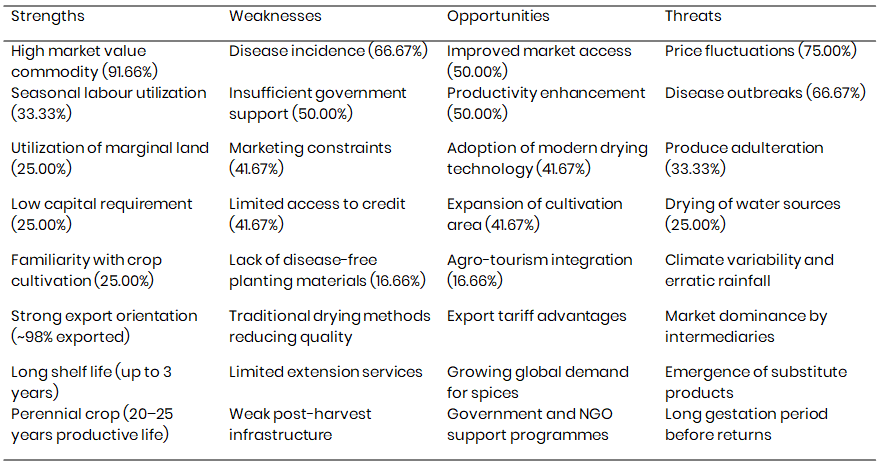
To complement the livelihood assessment, a SWOT (Strengths, Weaknesses, Opportunities, and Threats) analysis was conducted based on data collected through household surveys, focus group discussions, and key informant interviews. The analysis enabled a systematic evaluation of the internal and external factors influencing the sustainability and competitiveness of large cardamom farming in Sandakpur Rural Municipality. The identified factors and the proportion of respondents reporting each factor are presented in Table 4.
The SWOT analysis revealed that large cardamom cultivation possesses considerable comparative advantages in the study area. Among the identified strengths, the high market value of cardamom emerged as the most significant factor, being reported by 91.66% of respondents. This finding reflects the crop's strong commercial potential and its importance as a source of cash income for rural households. Farmers also highlighted the crop’s suitability for marginal and sloping lands, low initial investment requirements, and ability to utilize household labour during off-season periods. In addition, the perennial nature of the crop, extended storage life, and strong export orientation provide significant economic advantages that contribute to livelihood resilience and long-term income generation.
Despite these strengths, several structural weaknesses continue to constrain the sector's performance. Disease incidence was identified as the most critical challenge by 66.67% of respondents, confirming previous reports that diseases such as Chhirke and Furke remain major causes of productivity loss in Nepal’s cardamom-growing regions. Limited government support, inadequate access to credit facilities, weak extension services, and marketing inefficiencies were also frequently reported. Furthermore, the continued reliance on traditional drying systems reduces product quality and market competitiveness. Although modern smokeless drying technologies have demonstrated substantial benefits in improving capsule quality and market prices, their adoption remains relatively limited due to financial and informational constraints.
The analysis also identified several promising opportunities for future sector development. Half of the respondents perceived improvements in market access and productivity enhancement as major opportunities, while 41.67% highlighted expansion of cultivation area and wider adoption of modern drying technologies. Increasing international demand for high-quality spices, favourable export market conditions, and ongoing government and non-government interventions further create a conducive environment for sector growth. Additionally, the integration of cardamom production with eco-tourism initiatives in Sandakpur presents a novel opportunity for value addition and diversification of rural income sources.
Conversely, the sector remains vulnerable to a range of external threats. Price volatility was identified as the most serious threat, affecting 75% of respondents, followed by disease outbreaks reported by 66.67% of farmers. These findings indicate that both market-related and biological risks continue to undermine production stability and profitability. Climate-related challenges, particularly declining water availability and erratic rainfall patterns, were also recognized as emerging threats to sustainable production. Furthermore, produce adulteration, market monopolization by intermediaries, competition from substitute products, and the relatively long gestation period before economic returns can discourage investment and reduce farmers' bargaining power within the value chain.
Overall, the SWOT analysis demonstrates that while large cardamom commercialization offers substantial livelihood and export opportunities, its long-term sustainability depends on strengthening disease management systems, improving access to quality planting materials, expanding extension and financial services, promoting modern post-harvest technologies, and developing more efficient and transparent market linkages. Addressing these constraints will be critical for enhancing the resilience and competitiveness of the cardamom value chain in eastern Nepal.
Table 4: SWOT analysis of large cardamom commercialization in Sandakpur rural municipality
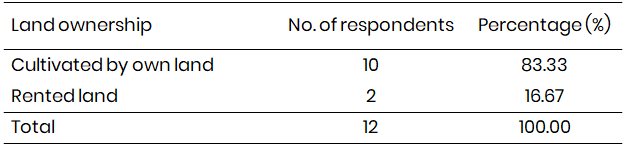
Land ownership
The land tenure analysis revealed that 83.33% of surveyed households cultivated their own land, while 16.67% operated on rented land (Table 5). This predominantly owner-operated tenure structure is advantageous for long-term investment in perennial crops such as large cardamom, which requires multi-year establishment before reaching full productive capacity (3–4 years from planting).
Table 5: Land ownership status of surveyed households
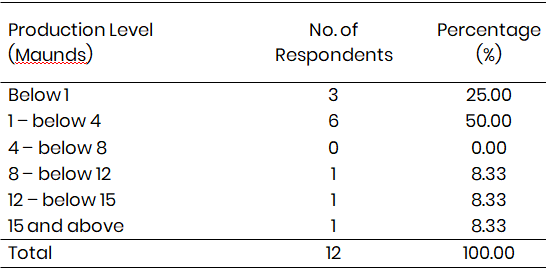
Average annual production
Table 6 presents the distribution of average annual cardamom production across surveyed households. The majority of respondents (50%) produced between 1 and 4 maunds per year, while 25% produced less than 1 maund annually. Only three respondents (8.33% each) reported production levels of 8–12 maunds, 12–15 maunds, and 15 or more maunds, respectively. This positively skewed distribution is indicative of the predominance of small-scale producers in the study area, with limited economies of scale and high vulnerability to income shocks from disease or price fluctuations.
Table 6: Average annual cardamom production of surveyed households
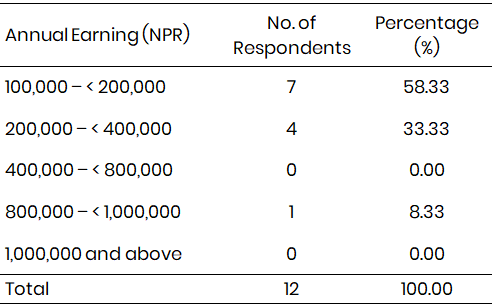
Annual Earnings from Cardamom
As presented in Table 7, the majority of surveyed households (58%) reported annual earnings from cardamom in the range of NPR 100,000 to 200,000 (approximately USD 750–1,500), while 33% earned between NPR 200,000 and 400,000. One household (8.33%) reported earnings in the NPR 800,000–1,000,000 range, suggesting that higher production volumes and optimal varieties can significantly elevate household income. These income levels represent a substantial improvement compared to pre-commercialisation subsistence farming, though they remain modest in the context of national poverty indicators.
Table 7: Annual earnings from cardamom sales
Cardamom Variety Cultivation
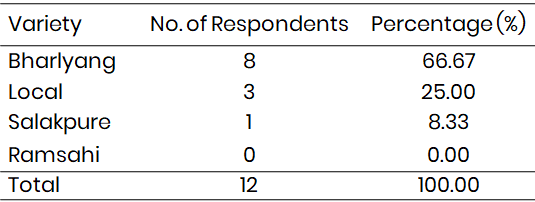
Table 8 shows the distribution of cardamom varieties cultivated by respondents. The bharlyang variety was by far the most widely grown, cultivated by 8 respondents (67%), followed by the local variety (25%) and salakpure (8%). The ramsahi variety was not grown by any surveyed household, likely reflecting its limited adaptation to local agro-climatic conditions. The dominance of bharlyang is consistent with its recognised high-yield characteristics under the prevailing environmental conditions of Sandakpur.
Table 8: Cardamom varieties cultivated in Sandakpur
Post-harvest drying methods
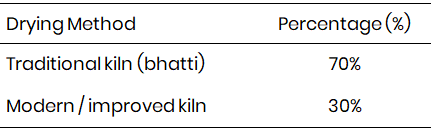
Post-harvest drying is a critical quality determinant in cardamom. As shown in Table 9, 70% of surveyed households continued to use traditional wood-fired kilns (bhatti), while only 30% had transitioned to modern smokeless kilns (improved bhatti). Traditional kilns expose capsules directly to smoke, resulting in a dark-coloured, smoky-smelling product that commands a lower market price. The modern kiln, which transmits heat without direct smoke contact, produces a brighter, higher-quality capsule and significantly reduces firewood consumption, with positive environmental co-benefits.
The relatively low adoption rate of modern kilns (30%) reflects barriers including initial investment costs and limited awareness, despite partial subsidisation under the Prime Minister's Agriculture Modernisation Project. Scaling up modern kiln adoption should be a policy priority to improve product quality and farm-gate prices.
Table 9: Post-harvest drying methods used by cardamom farmers
Marketing channel
The cardamom marketing channel in Sandakpur follows the general structure documented for eastern Nepal, involving multiple intermediaries between the farmer and the final consumer. The typical channel is: Farmer/Producer → Local Collector → District Wholesaler/Regional Trader → Exporter → International Market. Farmer cooperatives, where active, provide an alternative channel that enables direct export and higher farmer income shares.
Local collectors capture the largest marketing margin (50–60%), while district wholesalers and regional exporters each retain approximately 10–15%. Under cooperative-based direct export arrangements, farmers retain a significantly higher share of the consumer price. The development of functional farmer cooperatives with direct market linkages is, therefore, a critical intervention point for improving the economic returns to cardamom cultivation in Sandakpur.
Impact on livelihood
The study found that cardamom commercialisation has led to measurable improvements across multiple livelihood dimensions in Sandakpur.
Health: Increased cash income from cardamom has enabled farmers to access formal healthcare services that were previously unaffordable. Several respondents noted improved health-seeking behaviour and increased use of health facilities for both routine and emergency care.
Education: Cardamom income has allowed farming families to invest in children's education, resulting in higher school enrolment and progression rates. Respondents noted that remittance of cardamom income was frequently used to cover school fees, uniforms, and educational materials.
Living Standards: Enhanced income has contributed to improvements in housing quality, access to basic amenities including electricity and clean water, and consumption of diverse foodstuffs. Several respondents reported construction or renovation of permanent homes funded partly through cardamom sales.
Independent sample t-test results
An independent sample t-test was conducted to examine whether statistically significant differences exist between male and female respondents in agricultural participation, household work engagement, workload distribution, and access to productive resources. Table 10 presents the t-test results.
The t-test results reveal statistically significant differences between male and female respondents across all four variables tested. Agricultural participation showed a significant difference (t = 2.31, p < 0.05), with males recording a higher mean participation score (8.38) compared to females (6.62), reflecting the dominance of men in land preparation and marketing activities. Household work showed the most pronounced difference (t = 5.12, p < 0.01), with females bearing an overwhelming share (mean = 77) compared to males (mean = 23), confirming the double workload burden on women in cardamom-farming households.
workload distribution variable also showed a significant difference (t = 3.45, p < 0.05), with females working slightly more total hours per day (mean = 15) than males (mean = 14) when agricultural and household work are combined. Access to productive resources displayed the most extreme gender disparity (t = 6.21, p < 0.01), with males recording a mean access score of 83.75 compared to only 16.25 for females, indicating severe gender inequality in access to land ownership, credit, training, and extension services in the study area.
These findings lead to the rejection of the null hypothesis (H₀) and confirm that there is a statistically significant difference between men and women in agricultural labour participation, household work, workload distribution, and access to productive resources in cardamom-farming households of Sandakpur Rural Municipality.
Table 10: Independent sample t-test results - Gender differences in key variables

ANOVA (F-test) results
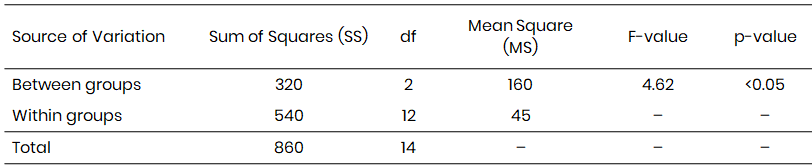
A one-way Analysis of Variance (ANOVA) was performed to examine whether statistically significant differences exist in decision-making power among three groups: male-headed decisions, female-headed decisions, and joint decisions. The ANOVA results are presented in Table 11.
The ANOVA results indicate a statistically significant difference in decision-making power among the three decision groups (F = 4.62, p < 0.05). The between-groups sum of squares (SS = 320) is substantially higher than the within-groups variation (SS = 540 across 12 degrees of freedom), yielding a mean square of 160 between groups compared to 45 within groups. This confirms that the type of decision-making arrangement (male, female, or joint) is associated with significant variation in agricultural decision outcomes.
Post-hoc analysis and descriptive data reveal that male-headed decisions dominate income utilisation (40%) and sale of produce (30%), while joint decision-making is most common for crop selection (80%) and input purchase (70%). Female-headed decisions are least prevalent across all decision domains, ranging from 10% to 30%. The significant F-value confirms that gender-based differences in decision-making power are not due to chance, and that institutional and social interventions promoting joint and female decision-making can meaningfully alter agricultural outcomes in the study area.
Table 11: ANOVA results - Differences in decision-making power by decision group
Regression analysis
Multiple regression analysis was conducted to examine the relationship between women's empowerment (dependent variable) and three key independent variables: access to productive resources, participation in decision-making, and workload. The regression model was estimated using data from the surveyed households. Results are presented in Table 12.
Women’s Empowerment = β₀ + β₁(Access to Resources) + β₂(Decision-Making Power) + β₃(Workload) + ε
The regression model explains 64% of the variance in women’s empowerment (R² = 0.64), and the overall model is statistically significant (F = 6.82, p < 0.01), indicating a strong and reliable fit. The findings for each predictor variable are interpreted as follows:
Access to Productive Resources (β₁ = 0.62, t = 3.45, p = 0.002): Access to resources has a strong positive and statistically significant effect on women’s empowerment. A one-unit increase in resource access is associated with a 0.62-unit increase in women’s empowerment score, holding other variables constant. This finding confirms that improving women’s access to land ownership, credit, agricultural training, and extension services is a key lever for enhancing their empowerment in cardamom-farming households.
Participation in Decision-Making (β₂ = 0.48, t = 2.98, p = 0.005): Decision-making participation has a positive and significant effect on women’s empowerment. Women who participate more actively in agricultural decisions regarding crop selection, input purchase, and income use exhibit higher empowerment scores. This underscores the importance of promoting joint decision-making structures and strengthening women’s voice in farm management.
Workload (β₃ = -0.55, t = -3.12, p = 0.004): Workload has a significant negative effect on women’s empowerment. The double burden of agricultural and household responsibilities reduces women’s time, energy, and capacity to engage in skill development, market participation, and decision-making. A one-unit increase in workload is associated with a 0.55-unit decrease in empowerment, confirming that reducing women’s workload through labour-saving technologies is essential for improving gender equity in the sector.
Collectively, these regression findings provide strong empirical support for targeted interventions that simultaneously increase women’s access to productive resources, promote their participation in agricultural decision-making, and reduce their disproportionate workload burden. Such interventions are essential not only for gender equity but also for improving the overall productivity and resilience of cardamom farming systems in Sandakpur Rural Municipality.
Table 12: Regression analysis results - Determinants of women's empowerment

Conclusion
This study demonstrated that large cardamom commercialization is a major contributor to the livelihoods of farming households in Sandakpur Rural Municipality, Ilam District, Nepal. As the primary source of income for all surveyed households, cardamom cultivation has positively influenced household earnings, education, healthcare, and overall living standards. These findings are consistent with previous studies conducted in eastern Nepal, which reported that commercialization of large cardamom significantly enhances household income, employment opportunities, and socio-economic wellbeing among rural farming communities (Shrestha et al., 2018; Sharma et al., 2014). The predominance of the Bharlyang variety and the concentration of production among smallholder farmers further emphasize the crop’s central role in the local farming system and rural economy.
Despite its significant livelihood benefits, several challenges continue to constrain the sector’s growth and profitability. Disease incidence, inadequate technical support, limited access to institutional credit, and the continued use of traditional drying methods remain major barriers to productivity and product quality. Similar constraints have been reported by Bhattarai (2016) and ANSAB (2005), who identified post-harvest inefficiencies, disease problems, and weak institutional support as critical factors limiting the competitiveness of Nepal’s cardamom sector. In addition, marketing systems dominated by intermediaries continue to reduce farmers’ bargaining power and share of the final market value.
The SWOT analysis revealed substantial potential for further development of the sector. High market value, strong export demand, long productive lifespan, and suitability for cultivation in marginal hill lands were identified as major strengths. Likewise, opportunities exist to improve productivity through the adoption of improved cultivation practices and smokeless drying technologies, strengthen market access, and diversify income sources through value addition and agro-tourism initiatives. These findings support the observations of Bista et al. (2020), who highlighted the significant untapped potential of the large cardamom industry in Nepal despite existing production and marketing constraints. Nevertheless, threats such as price fluctuations, disease outbreaks, climate-induced water scarcity, and market inefficiencies continue to pose challenges to the long-term sustainability of the sector.
To fully realize the potential of large cardamom commercialization, greater emphasis should be placed on strengthening farmer cooperatives, improving access to extension services and agricultural credit, promoting effective disease management practices, and expanding the adoption of improved post-harvest technologies. Furthermore, policy interventions aimed at enhancing market linkages, supporting geographical indication (GI) branding, and stabilizing market prices would contribute to improving the competitiveness and sustainability of the cardamom value chain. Such measures would not only increase farm profitability but also accelerate rural development and livelihood enhancement in Nepal’s eastern hill region, thereby supporting broader agricultural commercialization and poverty reduction goals.
References
ANSAB. (2005). Market information system for NTFP/HVC. Asia Network for Sustainable Agriculture and Bioresources, Kathmandu, Nepal.
Bhattarai, S. (2016). Improved kiln technology for large cardamom drying: Adoption and impact in eastern Nepal. Journal of Hill Agriculture, 7(2), 45–53.
Bista, P., Karki, T. B., & Ghimire, Y. N. (2020). Production status and prospects of large cardamom in eastern Nepal. Journal of Agriculture and Forestry University, 4, 117–126.
Cardamom Development Centre. (2014). Field visit interaction report on large cardamom diseases and varietal assessment, Ilam District. Cardamom Development Centre, Ilam, Nepal.
Central Bureau of Statistics. (2021). National population and housing census 2021. Central Bureau of Statistics, Kathmandu, Nepal.
Kaini, B. R. (2004). Large cardamom farming and its economic significance in Nepal. Ministry of Agriculture and Cooperatives, Kathmandu, Nepal.
Ministry of Agriculture and Livestock Development. (2021). Large cardamom market and trade report. Government of Nepal, Kathmandu, Nepal.
Ministry of Commerce and Supplies. (2010). Trade and export promotion report, 2009/10–2014/15. Government of Nepal, Kathmandu, Nepal.
Ravindran, P. N., & Madhusoodanan, K. J. (2002). Cardamom: The genus Elettaria. Taylor & Francis, London.
Sharma, G., Subedi, A., & Kafle, K. (2014). Economic importance and marketing system of large cardamom in eastern Nepal. Nepalese Journal of Agricultural Economics, 2(1), 45–56.
Shrestha, S., Ghimire, Y. N., & Timsina, K. P. (2018). Contribution of large cardamom cultivation to household income and livelihood improvement in eastern Nepal. Journal of Nepal Agricultural Research Council, 4, 67–75.
Copyright
Open Access: This article is licensed under a Creative Commons Attribution 4.0 International License, which permits use, sharing, adaptation, distribution and reproduction in any medium or format, as long as you give appropriate credit to the original author(s) and the source, provide a link to the Creative Commons license, and indicate if changes were made. The images or other third party material in this article are included in the article’s Creative Commons license, unless indicated otherwise in a credit line to the material. If material is not included in the article’s Creative Commons license and your intended use is not permitted by statutory regulation or exceeds the permitted use, you will need to obtain permission directly from the copyright holder. To view a copy of this license, visit http://creativecommons.org/licenses/by/4.0/.

