

Abstract
This study examined the effects of formal and informal land ownership systems on the economics of rice farming in Dadin kowa irrigation scheme. A multi-stage sampling procedure was adopted in the study and 312 respondents were selected randomly. Data were collected using questionnaires and analyzed with descriptive statistics and stochastic frontier production model. The findings revealed a mean household size of 10 persons, mean farming experience of 19 years, mean irrigation experience of 11 years, farm size of less than 1 hectare for formal system and more than 5hectares for informal system with a mean of 4 hectares and mean annual income of ₦78,093.25. The result further revealed the effect of land ownerships on the productivity of rice farming as, farm size (P<0.01), family labor (P<0.01), Hired labor (P<0.01), agrochemicals (P<0.01), organic fertilizer (P<0.01), seed (P<0.01) and rent (P<0.05) significantly influence the technical efficiency of rice farmers and their output, while, for informal system, farm size (P<0.05), Family labor (P<0.05), Agrochemical (P<0.01), Organic fertilizer (P<0.01) and Seed (P<0.01) significantly influences the technical inefficiency of rice farmers. The major constraints affecting rice production in the study area include; high cost of input (4.3), incident of pest and disease (3.4) and farmers/herders conflicts (3.2). It was concluded that rice production based on formal and informal systems is highly profitable. The study recommended that government and other relevant agencies should provide adequate security to cope the menace of farmers/herders clashes in the study area so as to allow farmers to maximize their productivity.
Introduction
Land is a distinctive factor of production and is inclusive of all naturally occurring goods such as water, air, soil, minerals, flora and fauna that are used in the creation of products. Land is recognized as a primary source of wealth, social status, and power, the basis for shelter, food, and economic activities (Ayoola et al., 2023). It is an institutional framework within which decisions are taken about the use of land, embodying that legal or customary arrangement whereby individuals or groups or organizations gain access to economic and social opportunities through land (Udo, 2003). The land system is also constituted by the rules and procedures which govern the right and responsibilities of both individuals and groups in the acquisition, use and control of land.
Nigeria has the ambition of diversifying her economy from crude petroleum dependency. The country also faces a looming food security crisis with a growing population that is increasingly dependent on imported foods. Insecure land tenure, scarcity of funds and credit, labour scarcity despite overall high unemployment and stagnant technology have crippled its further development. Until today, a wide range of policies, programmes and projects have had limited impact in ameliorating these problems. Given the choice, young people from the rural areas rather try their luck in urban centres. Climate change compounds the challenges confronting agriculture. The sector is dependent on the natural resource base and thus faces risks such as desertification, rising temperatures, changing rainfall patterns and sea level rise, leading to “degraded agriculture” and exacerbating conflict (Nwajiuba, 2020).
Rice (Oryza sativa) is a cereal which has become a staple food of considerable importance which is widely consumed in many countries of the world. In Nigeria, it one of the few food items whose consumption has no cultural, religious, ethnic or geographical boundary (Issa et al., 2016). Rice accounts for over 20% of global calorie intake and has been an important food commodity for most people in Sub- Saharan Africa particularly, West African region. In Nigeria, rice has assumed a strategic position in the food basket of rural and urban households (Oyinbo et al., 2013). As rice can provide a nation’s population with nationally required food security minimum of 2,400 calories per person per day (Bamidele et al., 2010). Many local dishes are prepared with rice because of its relative ease in terms of storage and preparation. In terms of local production, rice is now one of the main cereals produced by Nigerian farmers; it is cultivated in virtually all the agro-ecological zones of Nigeria. It covers both the upland and the swamps, depending on the variety (Mohammed, 2013). There is therefore dearth of literatures on the effect of formal and informal land ownership systems on rice productivity in Dadin-kowa irrigation scheme which is one of the largest rice-producing irrigated areas in the North-eastern Nigeria. Hence, this study aimed to improve the productivity and technical efficiency of rice farmers in Dadin-kowa irrigation scheme and to address the effects of land ownership systems on the economic performance of rice farming in Dadin-kowa irrigation scheme area of Gombe State. Addressing these challenges would be a step towards improving productivity of rice farmers in this area.
The broad objective of the study is to analyze the effects of formal and Informal land ownership systems on the economics of rice farming in Dadin-kowa irrigation scheme in Gombe State. While the specific objectives are to describe the socio-economic characteristics of rice farmers in the Dadin-kowa irrigation scheme; to determine the effect of land ownership on productivity of rice farming and to identify the constraints affecting rice production in the study area.
Material and Methods
The study area
The study was conducted in Yamaltu-deba Local Government Area of GombeState and Bayo Local government Area of Borno State. Gombe State lies between Latitude 10° 16' and 11° 00' North of the equator and Longitude 11° 00' and 11° 11' E of the Greenwich meridian distance above the sea level within the Sudan Savannah ecological zone of Nigeria. It shares boundary with Bauchi in the west, Taraba and Adamawa in the south west, Borno in the east and Yobe in the north. Gombe State covers a land area of 158,998,569 m2 with a population of 2,365,040 inhabitants based on 2006 National Population Commission (NPC) census with a 2.8 percent annual growth rate. The climatic condition of the State is characterized by two distinct season’s dry and wet seasons. The wet season begins from April and ends in October, while the dry season starts in November and last up to March. The annual rainfall ranges from 600 mm to 1200 mm, with the minimum and maximum temperature of 22.7 °C and 33.5 °C, respectively. The major economic activities of the people are agriculture (farming and livestock production), trading and public service. Major irrigated vegetables grown in the State includes onion, spinach, amaranths, okra, tomatoes, pepper, pumpkins, cabbage, lettuce, water melon and sweet melon (DKIS, 2020).
Sampling procedure and sample size
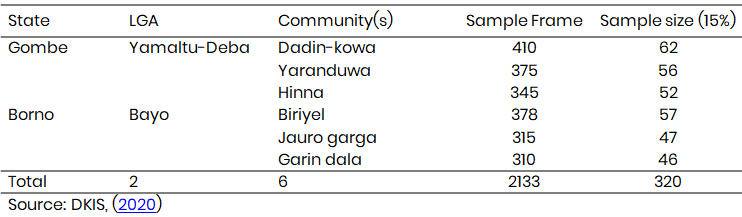
A multistage sampling procedure was employed in the selection of rice farmers in Dadin-kowa irrigation scheme (Table 1). Stage 1: this involves the purposive selection of 2 Local Government Areas (LGAs) 1 from the Gombe State and another from Borno State. This is based on their participation in irrigated rice production and prevalence of water in the area. Stage 2: These involve purposive selection of 6 villages based on the intensity of rice farmers in the area. Stage 3: involve random selection of 15% rice farmers from the sample frame as provided by GSADP to make a total sample of 320 rice farmers.
Table 1: Sample size selection plan
Data collection
Primary data were collected using structured questionnaires. The structured questionnaires were administered to 320 rice farmers with the help of enumerators. The enumerators were well trained and a pre-test analysis was conducted in other to test the reliability of the instrument for data collection. Out of 320 questionnaires that were distributed, the total number of 312 questionnaires were completed, retrieved and were subjected to analysis.
Data analysis
Data were analysed using descriptive statistics to describe the socio-economic characteristics of rice farmers and constraints affecting rice production; while, the inferential statistics used the Cobb-Douglas functional form to determine the effect of land ownership on productivity of rice farming.
The explicit form of the model is as follows;
lnYij = β0 + β1lnX1ij + β2lnX2ij + β3lnX3ij + β4lnX4ij + β5lnX5ij + β6lnX6ij + Vij- Uij ………..… (1)
where;
ln = Logarithm to base e
Yij = Output of rice (kg)
X1 = farm size (hectare)
X2 = Family labor ( mandays)
X3 = Hired labor ( mandays)
X4 = Agrochemical (Litre/hectare)
X5 = Inorganic fertilizer (kg/hectare)
X6 = Seeds (kg/hectare)
X7 = Cost of rent per season (₦)
Results and Discussion
Socio-economic characteristics of rice farmers
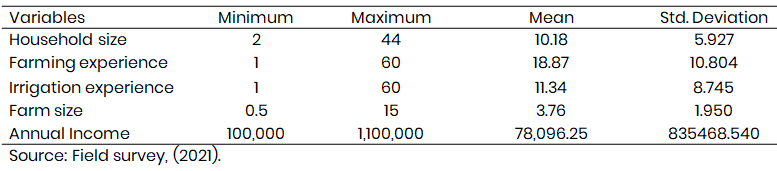
The result from Table 2 revealed that the households had a minimum number of 2 persons and the maximum number of 44 persons with the mean of 10 persons. The large household size may serve as a source of cheap and readily available farm labor supply depending on the compaction and very likely increased output (Ndanitsa et al., 2021). The finding agrees with Mustapha et al. (2012) and Olumba (2014) who reported that large family size could be as a result of polygamous nature of the rural farmers. He further opined that this could be linked to the fact that most rural farmers look at large household size as a good and economical way of maximizing farm returns by using family labor.
The result also revealed that the household had a minimum and maximum farming experience between 1 and 60 years, respectively, and had a mean of 19 years. Gomina (2015) and Ndanitsa et al. (2021) posited that farming experience is used as a measure of efficiency in management i.e. the more experience a farmer was, the more s/he had the ability to manage farm resources effectively and efficiency, which is expected to translate in to higher returns for entrepreneurs. The result further shows that majority of the farmers had mean experience of 11 years. The rice farmers in the study had a minimum and maximum irrigation experience between 1 and 60 years, respectively. The years of irrigation experience were reflected in more effective production capacity and high output level of rice. This finding is similar to that of Issa et al. (2016) who found high irrigation experience of 10 years and above among maize farmers.
The result of the analysis depicts that the minimum and maximum farm size used by rice farmers were 0.5 and 15 hectares with a mean of approximately 4 hectares. This implies that rice production in the study area is mainly practiced by small-scale farmers under formal system. The average farm size for formal land ownership system was less than 1 hectare, while for the informal land ownership system was 15 hectares. This result is in line with Mohammed (2015), Tijjani and Bakari, (2014) who reported that 85 percent of the farmers in the area are small-scale farmers cultivating less than five hectares of land. Similarly, the result revealed the minimum and maximum annual income of formal and informal rice farmers to be ₦100,000 and ₦1,100,000, respectively with an annual mean of ₦78,096.25. This implies that farmers earned low annual farm income which could be as a result of constraints that associated with rice farming such as high cost of fertilizer, pest and disease, high cost of transportation, lack of improved seed varieties.
Table 2: Descriptive statistics of socio-economic variables of rice farmers (n=312)
Effects of formal and informal land ownership on productivity of rice farming
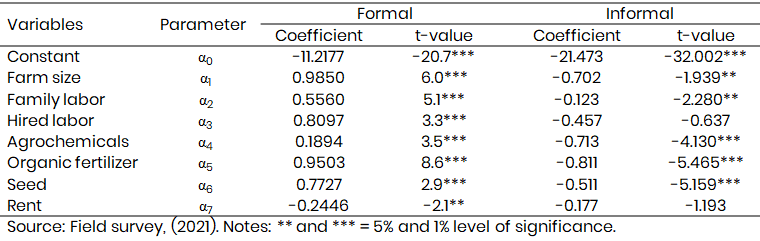
The result of maximum likelihood estimate on efficiency of rice farmers revealed that for the formal system, farm size (P<0.01), family labor (P<0.01), Hired labor (P<0.01), agrochemical (P<0.01), organic fertilizer (P<0.01), seed (P<0.01) and rent (P<0.05) significantly influences the technical efficiency of rice farmers (Table 3). The coefficient of farm size was positive and statistically significant related to technical efficiency at (P<0.01), this implies that increase in farm size by 1%, the output of rice related to technical efficiency will increase by 0.9850. This implies that increase in farm size will increase the output of rice farmers.
The coefficient of family labor was positive and statistically significant related to technical efficiency at (P<0.01), this implies that the technical efficiency of rice farmers who used family labor is efficient to increase the output of rice farmers. This means that family labor was enough to boost rice production because they are adequate. This result disagrees with the findings of Kareem (2016); Shittu (2014) and Abaoba (2020) who reported that households are inefficient in terms of labor use. Similarly, the coefficient of hired labor was positive and statistically significant related to technical efficiency at (P<0.01), this indicated that the technical efficiency of rice farmers who also used hired labor tends to increase the output of rice farmers by 0.8097. This implies that increase in number of hired labor would increase the output of rice farmers. This means that, hired labor influences the yield of rice production as compare with family labor.
The coefficient of agrochemical was positive and statistically significant related to technical efficiency at (P<0.01), this implies that if the quantity of agrochemical increases by 1%, the output of rice farmers will increase by 0.1894 related to technical efficiency. This is so because insect pest infestation and weed were serious challenges facing rice farmers and efforts to eliminate insect pests and weed chemically will increase the output of rice farmers. This result emphasizes the importance of agrochemical in agricultural production and this is consistence with the finding of Aboaba (2020) who reported that there exist a relationship between agrochemical and the output of rice in Ogun State. The coefficient of organic fertilizer was positive and statistically significant related to technical
efficiency at (P<0.01), this implies that if the quantity of organic fertilizer increases by 1%, the output of rice farmers will increase by 0.9503. This indicated that the higher the quantity of organic fertilizer, the higher will be the output of rice farmers. The coefficient of seed was positive and statistically significant related to technical efficiency at (P<0.01), this implies that if the quantity of seed increases by 1%, the output of rice farmers will increase by 0.7727. This indicated that the higher the quantity of seed sown, the higher the output of rice. This result is in line with the findings of Ambali et al. (2012) and Okello et al. (2019) who reported a positive relationship between the quantity of seed and the output of rice. The coefficient of rent was negative and statistically significant related to technical efficiency at (P<0.05), this implies that if land rent cost increases by 1%, the total cost of land rent will decrease by 0.2446. This is so because land is a particularly vital resource used in production and any attempt to raise its rental cost will decrease the total production cost.
Furthermore, the result of maximum likelihood estimate on efficiency of rice farmers for informal system revealed that farm size (P<0.05), Family labor (P<0.05), Agrochemical (P<0.01), Organic fertilizer (P<0.01) and Seed (P<0.01) influences the output of rice farmers. The coefficient of farm size was negative and statistically significant at (P<0.05), this implies that 1% increase in the area under cultivation of rice will result in decreased output of rice by 1.939. This indicated that as the size of the farm increases, output of rice decreases and this result disagree with Ndanitsa et al. (2021) and Abdulahi (2021) who reported that farm size significantly determines the output of water melon and maize respectively at (P<0.01) in Niger and Katsina States, respectively. The coefficient of family labor was negatively significant at (P<0.05), this implies that 1% increase in family labor; the output of rice will decrease by 2.280. This means that, family labor was insufficient in production process of rice thereby decreasing the output of rice. The coefficient of agrochemical was negative and statistically significant at (P<0.01), this implies that 1% increase in agrochemical will result to decrease in output of rice by 4.130. This indicated that, increase in level of agrochemical in rice farms will lead to decrease in output of rice there by affecting the technical efficiency of rice farmers. The coefficient of organic fertilizer was negative and statistically significant at (P<0.01), this implies that 1% increase in organic fertilizer will decrease the output of rice by 5.465. This means that organic fertilizer decreases the level of rice output if it is applied in abundant, it will destroy the rice plant thereby reducing the yield. The coefficient of seed was negative and significant at (P<0.01), this indicated that 1% increase in the quantity of seed sown will lead to decrease in output of rice. This implies that if the quantity of seed sown increases there will be overpopulation among the crops, competition will arise in terms of sunlight, air, water and fertilizer thereby harboring pests and diseases which will lead to decrease in output and yield of rice in the area. This will greatly affect the technical efficiency of rice output in the area.
Table 3: Effect of formal and informal land ownership on the productivity of rice farming
Constraints affecting rice production
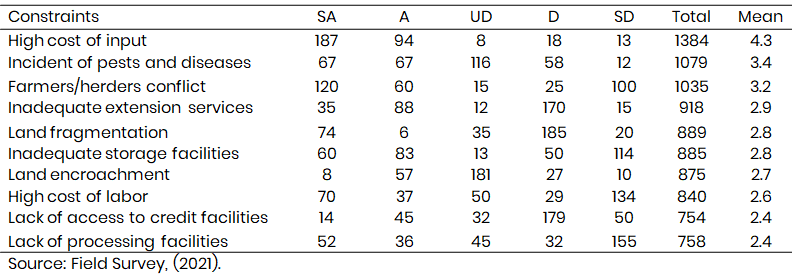
Table 4 shows the constraints affecting rice production in Dadin-kowa irrigation scheme. The result revealed that high cost of input, incident of pest and diseases and farmers/herders conflicts were the major challenges faced by rice farmers in the study area. Others include inadequate extension services, land fragmentation, inadequate storage facilities, land encroachment and high cost of labor were also some the challenges faced by rice farmers. These constraints are believed to have serious negative implication on farmer’s production efforts and farm income due to their discouraging effects.
Table 4: Distribution of farmers according to constraints affecting rice production
Conclusion
The study concluded that the major constraints affecting rice production in the Dadin-kowa irrigation scheme were the high cost of farm inputs, incidence of pests and diseases, and farmers–herders conflicts. Other challenges identified by farmers included inadequate extension services, land fragmentation, inadequate storage facilities, land encroachment, and high labor costs, all of which negatively affected production efforts and farm income. These constraints discouraged farmers and limited their productivity and standard of living.
Based on the findings, the study recommended that the government and relevant agencies should provide adequate security to address farmers–herders clashes in the study area, thereby enabling farmers to maximize productivity. It also recommended exploring alternative methods of land acquisition beyond inheritance to increase land available for rice cultivation and expand production. In addition, improving farmers’ technical efficiency through credit facilities was suggested as a means of sustaining rice production. Finally, the study emphasized the need for timely provision of farm inputs and supplies such as machinery, improved seeds, agrochemicals, and fertilizers at affordable prices to enhance productivity, income, and the overall standard of living of farmers.
Acknowledgement
This is to acknowledge the financial support of Transforming Irrigation Management in Nigeria Project (TRIMING) to the conduct of this research. We equally, acknowledge the support and encouragement of the Research Panel of Experts (RPoEs) that lead to the successful completion of the study.
References
Abaoba, K. O. (2020). Economic Efficiency of Rice Farming: A Stochastic Frontier Analysis Approach. Journal of Agribusiness and Rural Development, 4(58): 423-435. http://dx.doi.org /10.17306/J.JARD.2020.01377
Abdulahi, Z. (2021). Profitability and Technical Efficiency of Melon Egusi Production under Sole and Mixed Cropping System in Niger State, Nigeria. Unpublished M. Sc. Thesis submitted to the Department of Agricultural Economics and Farm management, Federal University of Technology, Minna, Niger State, Nigeria
Ambali, O.I., Adegbite, D.A., Ayinde, I.A., Awotide, D.O. (2012). Analysis of production efficiency of food crop farmers in Ogun State, Nigeria. ARPN J. Agric. Biol. Sci., 7(9): 680–688.
Ayoola, J. B., Sani, R. M., Ayoola, G. B., Dzever, D. D., Zaman, E. Y., Sani, M., Adoka, T., Moses, A.U., Yunusa, M. Y., Abu, G. A., and Abu, O. (2023). Variability of Land Tenure, Land Rights and Land Acquisition Methods among Male and Female Farmers in Irrigation Sector of Gombe and Bornu States, Nigeria. Research Square. pp.1-19.
Bamidele, F. S., Abayomi, O. O. and Esther, O. A. (2010). ‘Economic Analysis of Rice Consumption Patterns in Nigeria’, Journal of Agricultural Science Technology, 12: 1–11.
Copyright
Open Access: This article is licensed under a Creative Commons Attribution 4.0 International License, which permits use, sharing, adaptation, distribution and reproduction in any medium or format, as long as you give appropriate credit to the original author(s) and the source, provide a link to the Creative Commons license, and indicate if changes were made. The images or other third party material in this article are included in the article’s Creative Commons license, unless indicated otherwise in a credit line to the material. If material is not included in the article’s Creative Commons license and your intended use is not permitted by statutory regulation or exceeds the permitted use, you will need to obtain permission directly from the copyright holder. To view a copy of this license, visit http://creativecommons.org/licenses/by/4.0/.

