

Abstract
The study examined the impact of poultry manure and different mulching materials on tomato growth and yield in the School of Agriculture and Food Sciences. However, experiment was laid out in a Randomized Complete Block Design (RCBD) in a split plot arrangement, replicated three times with a gross plot size was 187m2 (17 m × 11 m) the bed size of (5 m × 3 m) 15 m2. Five different levels of poultry manure (0 t ha-1, 5 t ha-1, 10 t ha-1, and 15 t ha-1, and 20 t ha-1) and four different mulching materials (Elephant grass, Plastics mulch, and Rice straw) were used for the experiment. However, the physical and chemical properties show that the soil is a sandy loam as it contains more than 50% of sand with essential nutrients, which are N, P, K as well as organic matter, are all very low which indicate that the soil was in a poor state especially when the pH is low (acidic soil pH 4.45). The positive correlation between the soil factors and characteristics and some quality characters of tomato indicates that for the crop to effectively produce a high yield, the soil factors that significantly influence yield must be taken into consideration during the production process. Similarly, result shows statistically significant (P<0.05) variation due to the effects of treatments and mulching materials the vegetative growth and yield of tomato. In the study, 20 t ha-1 significantly outperformed in terms of plant height, leaf number, vine branches, leaf area which resulted in the production of higher number of flower, fruit number, fruit weight and total yield of fruit. In conclusion, the findings shows that poultry manure at 20 t ha-1 should be applied using rice straw materials as mulch for smallholder and commercialized farmers in order to achieve rapid growth and yield of tomato in Sierra Leone.
Introduction
Tomato (Solanum lycopersicum L.) is one of the most popular and widely grown vegetable crops in the world. The tomato began its history in the coastal highlands of Western parts of South America (Khetarpal and Sehgal, 2004). Today, tomatoes are grown commercially in 159 countries. It’s well-known that a healthy diet is important for preventing chronic diseases such as cancer, cardiovascular disease, cognitive function, and osteoporosis, as well as improving antioxidant levels and controlling body weight (Ali et al., 2020). Tomato requires warm, clear dry conditions and an altitude ranging between 700 and 2000 meters above sea level. The optimum growing temperature in the central lowlands of Ethiopia ranges between 24 °C and 28 °C during the day and 14 °C and 17 °C at night. High temperatures above 40 °C during the day and 22 °C at night can cause flower drops. Friable and sandy loam soil with a pH of 5.8-6.8 is favorable for high fruit yield (Lemma, 2002). However, despite the importance of tomato in Sierra Leone diet, yet the production is still low. Soils of Sierra Leone have inherently low fertility and do not receive adequate nutrient replenishment. With many farmers typically applying insignificant amounts of fertilizers, coupled with continuous cropping, soil degradation and declining soil fertility continue to pose major threat to sustainable food production by smallholders (MAFFS, 2009). Coupled with other constraints including soil moisture stress, low nutrient capital, erosion risks, low pH with aluminium (Al) toxicity, high phosphorus (P) fixation, low levels of soil organic matter, poor farming methods and a loss of soil biodiversity, food security may not be achieved in the near future unless urgent intervention measures are undertaken (WFP, 2009).
Being resource limited, most smallholders cannot afford the conventional soil fertility management strategies dominated by high use of inorganic fertilizers and agrochemicals considering their escalating prices. Therefore, many of these farms are dependent on short-term natural fallow to maintain soil fertility. Crop production is mainly rainfed on the uplands and the low lands support short duration crops and vegetables in the dry season. With the majority of soils being Oxisols and Ultisols that contain oxides of iron and aluminium and are acid, the most serious crop production problems on these soils are that of deficiencies in plant available phosphorus and low inherent fertility. High level of deforestation, poor management and lack of inputs has led to a decline in productivity, soil erosion, and loss of vegetation (MAFFS, 2009). Soil fertility plays an important role in sustaining crop productivity of any area, particularly in situations where input of nutrients application differs and the information on the nutritional status can go a long way to develop economically viable alternatives for management of deficient nutrients in the soil. Deficiencies of available major and micronutrients are widespread in soils of Sierra Leone.
Tomato is cultivated mostly on subsistence basis in rural areas. Mineral fertilizers are commonly applied by growers to maximize yields. However, in Nigeria, most rural farmers avoid the use of fertilizers, including N.P.K. 15:15:15, on their tomato farms. This is because fertilizers are scarce and expensive. Also, the price of tomato is usually low, partly because of lack of an affordable and effective means of preservation. The low price discourages the use of high cost fertilizer input. Rural farmers prefer, instead, to use fertilizers for other crops like yam, maize, cassava where the investment makes economic sense (Ogunwole et al., 2006).
Organic fertilizers are farmyard manure (FYM), sheep manure (SM), poultry manure (PM), and compost among others has been used for crop production for centuries. The use of these forms of fertilizers certainly pre-date chemical (mineral) fertilizers, which is of more recent development in comparison with organic fertilizers. Organic fertilizers are more environmentally friendly, since they are of organic sources. Contrary, observations show that continuous use of mineral fertilizers creates potential pollution effect on the environment (Oad et al., 2004).
The use of mulches offers great hope because of their moisture-conserving ability and also, their moderate soil temperature (Ogundare et al., 2015). Mulching serves various purposes, increases soil temperature, reduces water evaporation, enhances fertilizer efficiency, improves solar light irradiation efficiency, improves soil physical and chemical properties, and improves soil microbial activity (Van Der Zee et al., 2017). The application of chemical fertilizers is currently one of the most commonly used methods in intensive agriculture (Da Costa et al., 2013). However, the long-term application of chemical fertilizers can cause many negative effects. For example, most of the nutrients added to the soil are not absorbed by plants. Studies have shown that more than 50% of the nitrogen and 90% of the phosphorus in chemical fertilizers are lost to the atmosphere or water sources (Simpson et al., 2011), resulting in greenhouse gas emissions, water eutrophication, and other environmental issues (Lam et al., 2017).
Chemical fertilizers are not the most appropriate solution to overcome these constraints, Use of chemical fertilizers is also expensive and a threat to human health (Zulfiqar et al., 2019). To maximize the efficiency of photosynthesis and minimize the risk of disease, each tomato leaf must have plenty of room and be supported up off the ground (Gopinath et al., 2017). The use of organic fertilizers is environmentally friendly since they are from organic sources and the best solution for increasing tomato yield is to use organic fertilizers (Oyewole et al., 2012). In general, the role of mulching, and organic fertilizer on tomato growth and yield properties has not been studied in the study area. Hence, this study was conducted with the objectives of evaluating the influence of mulching, and organic manures application on the growth and yield component of tomatoes in the study area.
Material and Methods
Experimental setup
The study was conducted in the School of Agriculture and Food sciences research site of the Njala University during the second planting seasons 2024. Njala University is located on an elevation of 54 m above sea level on latitude 8ᵒ6N and longitude 12ᵒW of the equator. The effects of mulching, and organic manure were investigated using the tomato variety of Plum Tomato. The experiment was laid out in a Randomized Complete Block Design (RCBD), a factorial experiment, replicated three times. The gross plot size was 187 m2 (17m × 11m) the bed size of (5m × 3m) 15 m2. The recommended rate of poultry manure (10 t ha-1), cow dung (20 t ha-1), were used for the experiment.
The treatments consist four treatment combination including control. The transplanted tomato seedlings were planted directly with a spacing of 70 cm × 30 cm within rows and between plants. The spacing between blocks and plots was 1m and 0.5 m apart, respectively.
Statistical analysis
All data collected were subjected two-way analysis of variance (ANOVA) using the STATISTICA software version 12 (Stat Soft Inc., Tulsa, OK, USA) and means were separated using the DUNCAN MULTIPLE RANGE TEST (DMRT) at 0.05 level of significant.
Results and Discussion
Physical-chemical properties of soil sample of the experimental site
Both the physical and chemical properties of the soil used in the study were analyzed and shown in Table 1. The physical properties show that the soil is a sandy loam as it contains more than 50% of sand. The content of the essential nutrients, which are N, P, K as well as organic matter, are all very low. These conditions generally indicate that the soil was in a poor state especially when the pH is low (acidic soil pH 4.45).
Table 1: Physiochemical properties of the soil (0-30 cm)

Relationship between soil fertility parameters and yield and quality of tomato
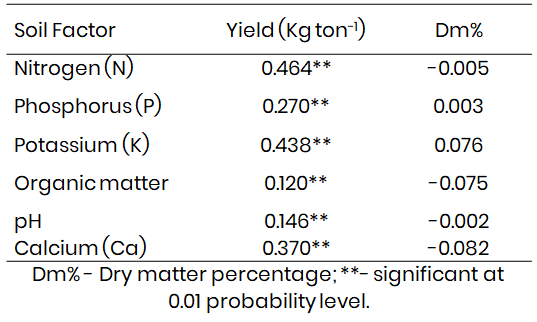
Relationships among the various elements that determine soil fertility and the yield and certain quality characteristics of tomato are given in Table 2. From the table, it could observe that tomato yield has a highly significant correlation with most of the factors that determine soil fertility which include nitrogen percent, phosphorus percent, potassium percent, organic matter content, calcium percent and pH. The positive correlation between the soil factors and characteristics and some quality characters of tomato indicates that for the crop to effectively produce a high yield, the soil factors that significantly influence yield must be taken into consideration during the production process.
Table 2: Correlation among soil factors with yield and quality components
Effect of different rate of poultry manure and different mulching materials on the growth of tomato
From Table 3 below, the result below shows statistically significant (P<0.05) variation due to the effects of treatments on the plant height, vine length, leaf number, and leaf area at 4 weeks after transplanting. The maximum plant height (16.76 cm), higher vine length (1.11), leaf number (10.6) and broader leaf area (16.83) while the least value was obtained from 0t/ha control. This agreed with the work of Direkvandi et al. (2008) and Ayeni (2014) who reported a significant increase in plant height and number of branches as a result of the application of poultry manure. The result further shows that the use of mulches offers great hope because of their moisture-conserving ability and also, their moderate soil temperature (Ogundare et al., 2015). The present investigation also agreed with the findings of Ilodibia and Chukwuma (2015) who reported a significant increase in plant height, number of branches, and number of leaves as a result of the application of poultry manure. Higher soil temperatures increase nutrient availability, enhance nutrient uptake by roots, increase the number and activity of soil microorganisms, and speed up plant germination and growth (Farias-Larios et al., 1998). Similar results were obtained by Kayum et al. (2008), that mulching had significant effects on plant growth components. However, result shows a significant (P<0.05) differences on the use of different mulch materials on the growth of tomato at different growth stage. At 4WAT, tomato plant mulch with rice straw materials recorded higher plant height (8.67), highest vine branches (8.57), higher leaves per plant (10.47) and broader leafs (9.37) followed all planted mulch with white plastic which recorded the second taller plant, leaves number, higher vine branches and broader leaf compared to control treatment with no mulch which recorded the least at 4WAT. It has been shown that straw mulching can improve the net photosynthetic rate (Pn) of functional leaves of winter wheat (Zhai et al., 2021).
Table 3: Growth response of tomato as influence by organic manure and mulching application at 4WAT

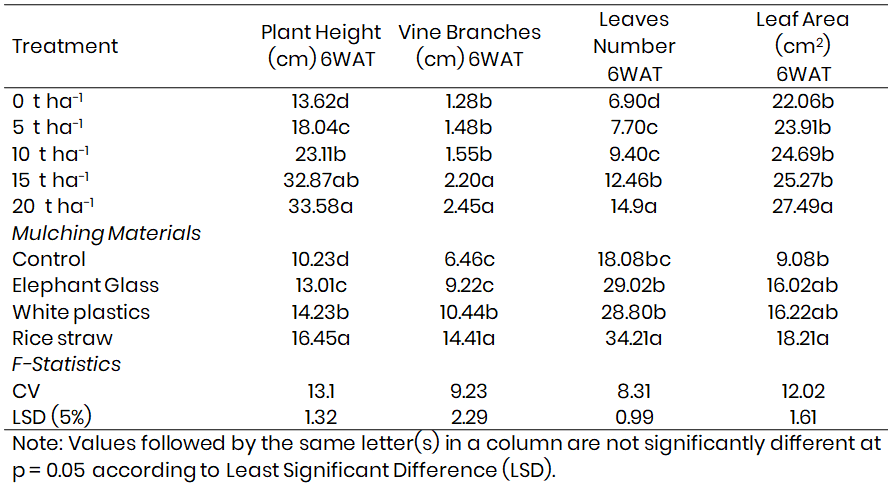
However, at 6 weeks after transplanting, result shows a significant (P<0.05) variation due to the effects of treatments and mulch applied on the plant height, vine branches, number of leaves, and leaf area per plant at 4, 6 and 8 Weeks after transplanting. From the result, 20 t ha-1 of poultry manure has higher plant height 33.58 cm, higher vine branches 2.45, higher number of leaves recorded per plant 14.9, and broader leaf area 27.49 cm2 (Table 4). The result further shows that the use of mulches offers great hope because of their moisture-conserving ability and also, their moderate soil temperature (Ogundare et al., 2015). This has also been demonstrated by several researchers that use of organic inputs such as crop residues, manures and compost has great potential for improving soil productivity and crop yield through improvement of the physical, chemical and microbiological properties of the soil as well as nutrient supply (Dauda et al., 2008; Bakht et al., 2009). Similar studies carried by Murmu et al. (2013) and Tomati et al. (1988) on vermicompost, an organic manure indicated that apart from major elements and trace elements that are necessary for the plant growth, organic manure also provides plant growth regulators and humic acid, which enhance the plant growth. Similar results were obtained by Hedau et al. (2010) that among mulches. Singh et al. (2017) concluded that application of 1.75 kg ha-1 PSB, 1.5 t ha-1 vermicompost, 12.5:10:12.5 kg ha-1 RDF and 3 t ha-1 FYM significantly increase the plant height (53.05 cm), leaves length (42.55 cm), root length (15.25 cm) as compared to control. However, among the different mulch materials applied shows a statistically significant (P<0.05) different on the growth of tomato at different growth stage. In regards, all plant mulched with rice straw out performed in terms of plant height 16.45 cm, number of vine branches 14.41, number of leaves 34.21 and leaf area 18.21 cm2 of tomato at the different growth stages.
Table 4: Growth response of tomato to organic manure and mulching application at 6WAT
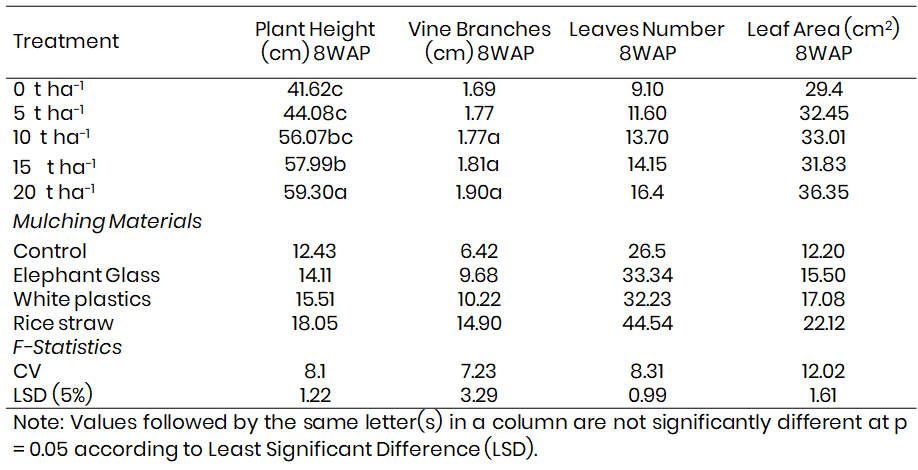
Interestingly, the findings observed a significant a significant (P<0.05) variation due to the effects of treatments and mulch applied on the plant height, vine branches, number of leaves, and leaf area per plant at 8 Weeks after transplanting (Table 5). Similarly, the used of 20 t ha-1 of poultry manure shows a great constituency with regards to all parameters in the vegetative growth, showing higher plant height 359.30 cm, more vine branches 1.90, higher number of leaves recorded per plant 16.4, and broader leaf area 36.35 cm2, followed by plant treated with 15 t ha-1 of poultry manure which outperformed both 10 t ha-1, 5 t ha-1 and the control treatment. Notably, result shows a significant (P<0.05) differences with regards to the different mulch materials on the growth of tomato at different growth stage. In regards, all plant mulched with rice straw out performed in terms of plant height 18.05cm, number of vine branches 14.90, number of leaves 44.54 and leaf area 22.12 cm2 of tomato at the different growth stages.
Table 5: Growth response of tomato as influence by organic manure and mulching application at 8WAT
Yield component of Tomato
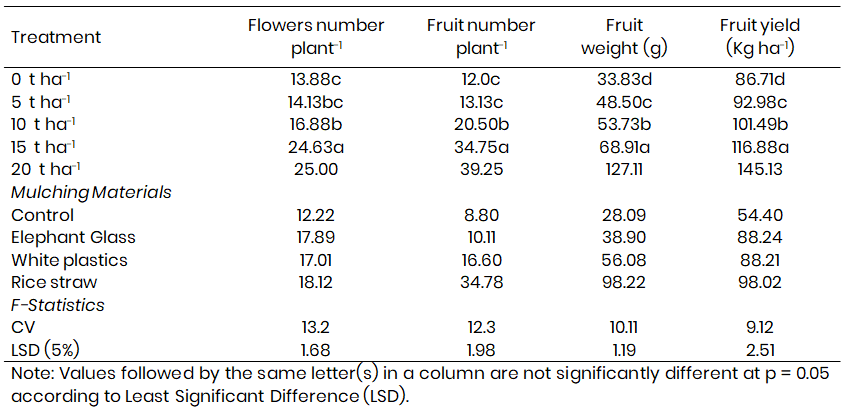
Statistically significant (P<0.05) variation was found due to the effects of treatments on the Number of flowers, Fruit number plant-1, Fruit Weight plant-1 (g), and Yield (kg ha-1) (Table 6). The highest number of flowers (25.00), was found in tomatoes planted using 20 t ha-1 while the minimum flower produced per plant, fruit number, fruit weight and yield was obtained from those plant treated with 0 t ha-1 (control). The average maximum number of fruits (39.25) was obtained from plant treated with 20 t ha-1 while the average minimum fruit number was given in control. However, the tomatoes planted using 20 t ha-1 recorded heavier (127.11 g), and maximum marketable yield (235.13 t ha-1) with the minimum fruit weight recorded from control plot. This is in line with the findings of Ghorbani et al. (2008) who reported that tomato fruit weight. This may be attributed to the sufficient release of nutrients particularly N, P, and K contained in the poultry manure applied, as these nutrients improve the yield of tomato. This agreed with the finding of Agbede et al. (2019) who reported that fruit and fruit quality is improved as a result of the application of poultry manure. Al-Amin et al. (2017) reported that yield and yield-related traits are affected by mulching and the application of organic manure. All treatment with mulching produced significantly higher fruit yield and number of fruits per plant than organic mulches and no mulch this might be the result of weed free field, less nutrient loss through leaching favourable soil temperature and moisture, these findings are in agreement with and Kashyap et al. (2009). Nikolic et al. (2012) have also reported similar results that highest number of fruits per plant was recorded in the plants grown on the plastic mulch than those on organic mulches and control (no mulch). Similar findings were also obtained mulched and non-mulched plots by Hudu et al. (2002), Aruna et al. (2007), Nagalakshmi et al. (2002). Interestingly, among the different mulch materials applied in the study, rice straw mulching outperformed in terms of flower number (18.12), fruit produced per plant (16.60) fruit weight (56.08 g) and fruit yield (88.21 kg ha-1) respectively.
Table 6: Yield response of tomato as influence by organic manure and mulching application.
Fresh, Dry shoot and Roots weight
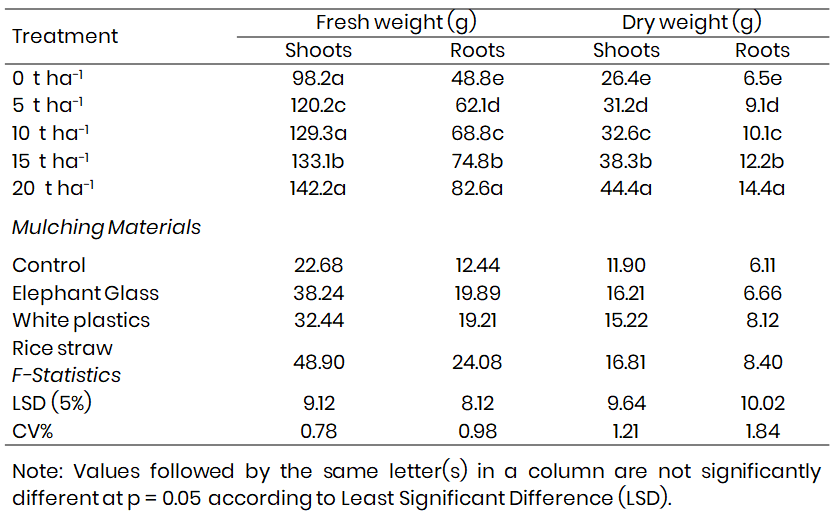
The analysis of variance results showed that the effect of organic manure and mulching has a significant influence on tomato yield was significant (P< 0.05). Data presented in (Table 7) illustrated the positive effect of organic manure and different mulching materials. It was obvious that the used of 20 t ha-1 has heavier fresh and dry weights of tomatoes shoots and roots (142.2 g, 82.6 g and 44.4 g, 14.4 g ) while control treatment had the lowest effect among them. On the other hand, the application of rice straw as mulching material shows a significant impact on the fresh and dry weight of shoot and roots.
Table 7: Fresh, Dry shoot and Roots weight of tomato as influence by organic manure and mulching application.
Conclusion
There was a strong linear relationship between growth rate and fruit yield of tomato with regards to manure application rates and the used of different mulching materials. It was concluded that poultry manure application together with effective mulching had effects on tomato growth rate and fruit yield in terms of plant height, leaf number, vine branches, leaf area, as well as the fruit yield. Poultry manure application rate of 20 t ha-1 gave the highest growth rate and fruit yield of tomato hence could be adopted by resource poor smallholder tomato farmers in the country where the manure is readily available. Overall, these findings suggest that the used of 20 t ha-1 of poultry manure alone with rice straw mulching have the potential to significantly improve crop productivity and sustainability, thereby contributing to sustainable food production.
Acknowledgment
We like to acknowledge the Department of Crop Science for support in carrying out this research; also we like to give thanks to the School of agriculture and Food Sciences staffs for his support towards the research. Finally we like to acknowledge Njala University for strengthen research activities and there support towards the research.
References
Agbede, T. M., Adekiya, A. O., Ale, M. O., Eifediyi, E. K., & Olatunji, C. A. (2019). Effects of green manures and NPK fertilizer on soil properties, tomato yield and quality in the forest–savanna ecology of Nigeria. Experimental Agriculture, 55(5), 793–806. https://doi.org /10.1017/S0014479718000376
Al-Amin, M. A., Hasan, A. K., Ali, M. H., Nessa, S., & Islam, M. N. (2017). Effect of mulching and organic manure on growth and yield performance of wheat. Archives of Agriculture and Environmental Science, 2(3), 134–140.
Ali, M. Y., Sina, A. A. I., Khandker, S. S., Neesa, L., Tanvir, E. M., Kabir, A., Khalil, M. I., & Gan, S. H. (2020). Nutritional composition and bioactive compounds in tomatoes and their impact on human health and disease: A review. Foods, 10(1), 45. https://doi.org/10.3390/foods10010045
Aruna, P., Sudagar, I. P., Manivannan, M. I., Rajangam, J., & Natarajan, S. (2007). Effect of fertigation and mulching for yield and quality in tomato cv. PKM-1. Asian Horticulture, 2(2), 50–54.
Ayeni, L. S. (2014). Effect of manufactured organic fertilizers on soil chemical properties and yield of tomato (Lycopersicum lycopersicon) in Alfisol, Southwestern Nigeria. Molecular Soil Biology, 5(5).
Bakht, J., Shafi, M., Jan, M. T., & Shah, Z. (2009). Influence of crop residue management, cropping system and N fertilizer on soil N and C dynamics and sustainable wheat (Triticum aestivum L.) production. Soil and Tillage Research, 104(2), 233–240. https://doi.org/10.1016 /j.still.2008.10.007
Da Costa, P. B., Beneduzi, A., de Souza, R., Schoenfeld, R., Vargas, L. K., & Passaglia, L. M. (2013). The effects of different fertilization conditions on bacterial plant growth promoting traits: Guidelines for directed bacterial prospection and testing. Plant and Soil, 368(1–2), 267–280. https://doi.org/10.1007/s11104-012-1513-z
Dauda, S. N., Ajayi, F. A., & Ndor, E. (2008). Growth and yield of watermelon (Citrullus lanatus) as affected by poultry manure application. Journal of Agriculture and Social Sciences, 4(3), 121–124.
Direkvandi, S. N., Ansari, N. A., & Dehcordie, F. S. (2008). Effect of different levels of nitrogen fertilizer with two types of bio-fertilizers on growth and yield of two cultivars of tomato (Lycopersicon esculentum Mill.). Asian Journal of Plant Sciences, 7(8), 757–761.
Farías-Larios, J. M., Orozco-Salcedo, G., & Pérez, J. (1998). Effect of plastic mulch, floating row covers, and microtunnels on insect population and yield of muskmelon. Proceedings of the National Agricultural Plastics Congress, 27, 76–83.
Copyright
Open Access: This article is licensed under a Creative Commons Attribution 4.0 International License, which permits use, sharing, adaptation, distribution and reproduction in any medium or format, as long as you give appropriate credit to the original author(s) and the source, provide a link to the Creative Commons license, and indicate if changes were made. The images or other third party material in this article are included in the article’s Creative Commons license, unless indicated otherwise in a credit line to the material. If material is not included in the article’s Creative Commons license and your intended use is not permitted by statutory regulation or exceeds the permitted use, you will need to obtain permission directly from the copyright holder. To view a copy of this license, visit http://creativecommons.org/licenses/by/4.0/.

