

Haematological indices and serum biochemistry of exotic finishers turkey fed flashed-dried Cassava pulp as a replacement for Maize
Abstract
One hundred and twenty (120) day-old British United Turkey (BUT) poults were purchased from a reputable farm in Nigeria to evaluate haematological indices and serum biochemistry of exotic finisher turkeys fed graded levels of flashed-dried cassava pulp (FDCP) as a replacement for maize. Finisher turkeys were carried over from starting phase to finishing phase and randomly assigned into four (4) dietary treatments in a completely randomized design (CRD). Thirty (30) turkeys were apportioned into four (4) treatments and replicated six (6) times with five (5) turkeys per replicate. The test diets (FDCP) were formulated to partially replaced maize at level of 0, 5, 10 and 15%. Water and feed were supplied ad-libitum. At 15th weeks of the research, 3 mls blood sample was collected via the wing vein into vials containing ethylene diamine tetra-acetic acid (EDTA) for determination of haematological indices. Another set (3 mls) blood sample was collected into heparinized tubes for serum analysis using standard procedures. Data were analyzed by using SPSS, (2021). The Higher (56.00%) significant (p<0.05) packed cell volume (PCV), 14.75 g dl-1 haemoglobin (Hb), and 4.05 × 10¹² l red blood cell (RBC) were observed from finisher turkeys fed with 5% FDCP while the least (39.50%), 11.25 g dl-1 and 3.20 × 10¹² l were noticed from 10% FDCP. The highest (3.90%) albumin was observed from both 5% and 10% FDCP while the lowest (3.30%) was observed from turkeys placed on (0% FDCP). Turkeys on 10% FDCP had highest 178.00 (mg dl-1), 138.00 (mg dl-1) and 12.05 mg dl-1 triglyceride, cholesterol and uric acid while those on 0% FDCP had least 124.10 mg dl-1, 84.10 mg dl-1 and 10.25 mg dl-1 respectively. The highest 146.00 (U/L) aspartate transaminase (AST) was obtained from turkeys fed on 10% FDCP while the least value of 133.50 (U/L) was obtained from 5% FDCP. This finding indicate that incorporating FDCP up to 15% in turkey diets did not negatively impact the blood profiles of turkeys during the finishing stage, therefore, addition of FDCP up to 15% level in the diets of turkey finisher and finding beyond 15% level of inclusion are recommended.
Introduction
Non-conventional feedstuffs include feed resources that are not usually used in commercial poultry nutrition. Examples of non-conventional feedstuffs include perennial crop seeds, waste products of seeds/animals, industrial waste from agro-allied industries, and by-products of plant and animal sources (Amandeep, 2016; Adelowo et al., 2019). Utilization of inexpensive and readily available unconventional feed ingredients as substitute or replacement for conventional feedstuffs is becoming increasingly common, is being researched and documented as a promising and sustainable way to reduce and increase the prices of products to benefit of poultry farmers and make more affordable poultry products available to customers (Uchegbu et al., 2017).
Maize, an energy ingredient in domesticated animal feed is expensive due to high demand for human consumption and commercial use (Bot et al., 2013). Consequently, the advantage of cassava as a main ingredient in both small-scale and commercial livestock production has recently increased over the use of maize (FAO, 2013; Oppong, 2013). Cassava is a perennial, tuberous woody plant from the Euphorbiaceous family. There are two types of cassava; the sweet type, which is consumed by humans and animals, and the bitter type, which has high levels of hydrogen cyanide (HCN) and is not suitable for human consumption (Ogbuewu et al., 2017). Global estimates by FAO (2013) showed that about 2,762,000 tonnes of cassava was used as animal feed.
According to PWC (2020), the supply and demand for cassava starch and high quality cassava flour in Nigeria is 290,000 tonnes annually. This corresponds to an annual production of 485,000 tonnes of cassava pulp and an estimated 870,000 tonnes of waste. Undoubtedly, this poses a serious environmental risk to the communities surrounding the production sites. Developing appropriate technologies to integrate cassava starch by-products into livestock feeding programs are therefore essential (Aro et al., 2010).
Material and Methods
Experimental area
The experiment was carried out at the Poultry Unit of the Directorate of University Farms (DUFARMS), Federal University of agriculture, Abeokuta, Ogun-State, Nigeria. The farm is located in the tropical rainforest vegetation zone of South-Western Nigeria.
Sourcing of the flashed-dried cassava pulp (FDCP)
The FDCP (test ingredient) was obtained from Psaltry industry, a starch processing industry along Maya Ado-Awaye Road, Iseyin Local government area, Oyo-State, Nigeria.
Experimental diets and design
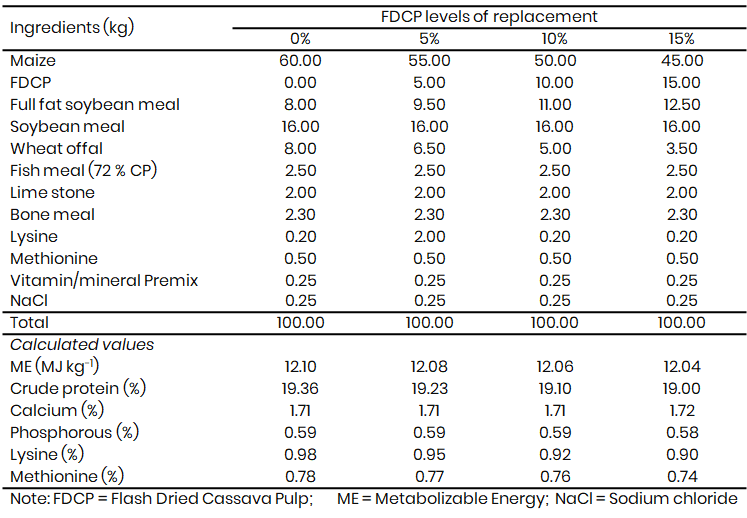
Four iso-proteinous and iso-caloric starter diets were formulated, such that FDCP replaced maize at 0, 5, 10 and 15% levels in diets 1, 2, 3, and 4 respectively. The experiment was arranged in a Completely Randomized Design (CRD). The gross composition of the experimental diet is presented in Table 1.
Table 1: Gross composition (%) of experimental diets for finishing turkeys (13–16 weeks)
Experimental design and turkeys’ management
One hundred and twenty (120) day-old British United Turkey (BUT) poults were sourced from a reputable farm in Nigeria and were brooded for twenty eight (28) days by using commercial pre-starter turkey. At the end of 28-day brooding period, thirty (30) growing turkeys were assigned per treatment and replicated six (6) times with five (5) growing turkeys per replicate, experimental turkey starters were randomly assigned into four (4) dietary treatments in a completely randomized design (CRD) and carried over to finishing phase. Brooding was done on deep litter pens, each pen (dimension 2.0 m × 1.5 m) containing 5 birds. Electricity and charcoal pots were the sources of heat. Birds were provided water and feed ad libitum. Vaccination and medication protocols were strictly followed.
Data collection
At 15th weeks of the experiment, 3 ml blood sample was collected via the wing vein into vials containing ethylene diamine tetra-acetic acid (EDTA) as anti-coagulant for the determination of haematological parameters, another 3mls blood sample was obtained through the same route into plain bottle without EDTA for serum biochemistry assay.
Statistical analysis
One-way analysis of variance (AOAC) was performed on all collected databy using SPSS 2021. Duncan's multiple range test (1955) was used to differentiate significant (p<0.05) means between variables.
Statistical models
One-way Yij = µ+Ti+Ԑij
where:
Yij = Observed value of dependent variable
µ = Population mean
Ti = Effect of treatment (0, 5, 10, 15%)
Ԑij = Random residual error
Results and Discussion
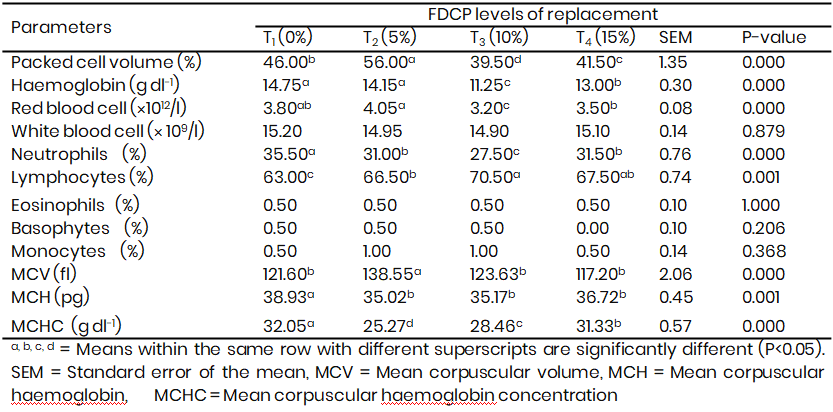
Haematological parameters of turkeys finisher fed experimental diets (13-16 weeks) are presented in Table 2. Flash-dried cassava pulp diet showed a significant (p<0.05) differences in packed cell volume, haemaglobin, red blood cells (RBC), neutrophils, lymphocytes, mean corpuscular volume (MCV), mean corpuscular haemoglobin (MCH) and mean corpuscular haemoglobin concentration (MCHC) while white blood cells, eosinophils, basophytes and monocytes were not affected (p>0.05). Packed cell volume showed the highest (56.00%) significant (p<0.05) difference with finisher turkeys fed with 5% FDCP while the lowest (39.50%) was observed on 10% FDCP. Haemoglobin showed the highest (14.75 g dl-1) significant (p<0.05) difference from finisher turkeys placed on 0% FDCP, 5% FDCP were statistically (p>0.05) equivalent with 0%FDCP, conversely, finisher turkeys fed 10% FDCP showed the least (11.25g dl-1) significant (p<0.05) difference. Turkeys finisher fed on 5% FDCP showed a highly (4.05 × 10¹² L) significant different (p<0.05) in the RBC while 10% FDCP showed the lowest (3.20 × 10¹²/l). Neutrophils showed a highly (35.50%) significant (p<0.05) effect from 0% FDCP while the least (27.50%) was observed from 10% FDCP. Lymphocytes recorded the highest (70.50%) significant difference (p<0.05) from finisher turkeys fed 10% FDCP while the least (63.00%) significant different (p<0.05) was recorded from finisher turkeys fed 0% FDCP. MCV had the highest (138.55 fl) significant effect (p<0.05) in the finishing turkeys fed with 5% FDCP, while the lowest (117.20 fl) significant impact (p<0.05) was observed at 15% FDCP but 0% FDCP, 10% FDCP and 15% FDCP showed statistically (p>0.05) similar values. The highest (38.93 pg) significant (p<0.05) difference MCH was obtained on 0% FDCP while the lowest (35.02 pg) was noticed on 5% FDCP and a similar (p>0.05) difference was noticed on 10% FDCP, 15% FDCP and 5% FDCP. MCHC showed the highest (32.05 g dl-1) significant change (p<0.05) on finisher turkeys fed 0% FDCP while the least (25.27 g dl-1) was obtained from 5% FDCP.
Table 2: Haematological indices of finisher turkeys fed experimental diets (13-16 weeks)
Discussion
Finishing turkeys fed 10% FDCP recorded lower PCV, Hb and RBCs. Adejumo (2004) discovered an association between nutritional status, diet quality and their haematological traits, particularly PCV and Hb. Daramola et al. (2005) stated that PCV is useful for determining amount of protein and predicting the quality of protein supplementation in various physiological states.
The PCV, Hb and RBC across dietary treatments in this finding fluctuated and within standard values reported by Adedokun et al. (2017). The normal ranges of PCV, Hb, and RBC of finishing turkeys fed varying levels of FDCP diets in this study is an indication of the cell’s enhanced capacity to transport oxygen, which results in improved nutrient availability, growth and productivity of the finishing turkeys and showed absence of deleterious effect by consumption of FDCP diets up to 15% inclusion levels. But heamoglobin and red blood cells observed were contradicted with the report of Makinde and Inuwa (2015), who reported insignificant differences when turkeys were subjected to agro industrial by-products.
Neutrophils are part of white blood cell, one of the most important haematological parameters for assessment of the health status of a healthy bird (Ukoha et al., 2022). This study showed that the health of turkeys’ improved during the finishing phase and that the FDCP diet had the nutrients and capacity to fight against invasive disease.
The observed lymphocyte levels ranged from 63.00–70.50% and fell in the range of 66.67-70.67% in healthy birds as opined by Ukoha et al. (2022). Average erythrocyte size is calculated using the MCV and hemoglobin content per blood cell is assessed using the MCH while MCHC is used to calculate the haemoglobin content of red blood cells in relation to their size. The MCV, MCH and MCHC values were within standard values of 90-140 fl, 33-47 pg cell-1 and 26-35 g dl-1 reported by Bounous and Stedman, (2000). As a result, finishing turkeys in this study did not experience adverse health effects from graded levels of FDCP feed.
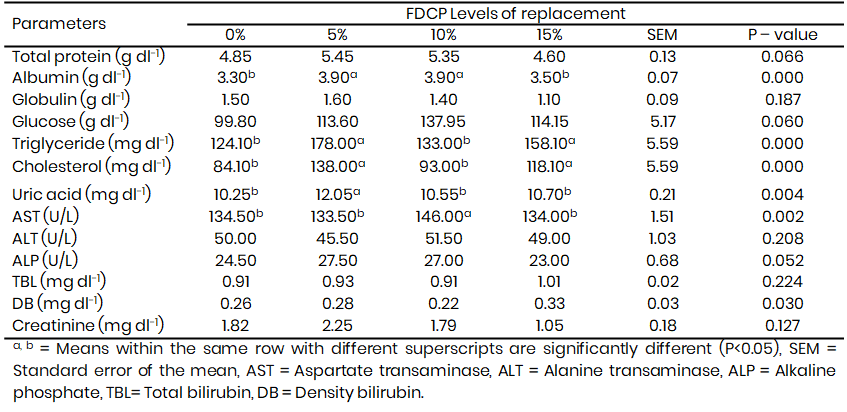
Table 3 displays significant (p<0.05) differences in albumin, triglyceride, cholesterol, uric acid, aspartate transaminase (AST) and density bilirubin while globulin, glucose, alanine transaminase (ALT), total bilirubin and creatinine did not significantly (p>0.05) altered. The highest (3.90 g dl-1) significant (p<0.05) albumin was recorded from finisher turkeys fed with 5% FDCP and 10% FDCP while the least was recorded from 0% FDCP and statistically (p>0.05) similar with those turkeys fed with 15% FDCP. Turkey on 5% FDCP recorded the highest (178.00 mg dl-1) triglyceride while the least (124.10 mg dl-1) was obtained from turkeys fed with 0% FDCP. The highest (138.00 mg dl-1) significant (p<0.05) cholesterol was observed from turkey fed with 5% FDCP but not significant affected (p>0.05) with turkeys placed on 15% FDCP while the least (84.10 mg dl-1) was obtained from 0% FDCP and was statistically (p>0.05) similar with those turkeys fed on 10% FDCP. Uric acid from finisher turkeys fed 0% FDCP, 10% FDCP and 15% FDCP was statistically equivalent (p>0.05) but significant lower (p<0.05) than the values (12.05 mg dl-1) obtained from 5% FDCP. Finisher turkeys fed 10% FDCP revealed highest (146.00 U/L) significant (p<0.05) aspartate transaminase while 0% FDCP, 5% FDCP and 15% FDCP were statistically (p>0.05) similar, with least (133.50 U/L) found from the finisher turkeys fed on 5% FDCP.
The albumin values (3.30-3.90 g dl-1) of finishing turkeys obtained were within the normal values of 3.00-5.50 g dl-1 reported by Jeanetter, (2020) but higher than values of 2.39–2.44 g dl-1 opined by Okrathok et al. (2018) when laying hens were fed fermented cassava pulp as a replacement for maize. The albumen concentration observed in finishing turkeys fed control diet was statistically comparable to that of turkeys fed 15% FDCP, suggesting that the turkeys’ nutritional needs and overall health were met by the amount of protein in their experimental diets during the last phases of their lives.
Triglycerides found in this finding are in consistent with the results of Sugiharto et al. (2019) who obtained elevated triglycerides in broilers fed fermented cassava pulp at finishing phase. Cholesterol values (84.10–138.00 mg l-1) obtained from finishing turkeys was higher than established values of 75.00-89.25 mg dl-1 by Okrathok et al. (2018) who reported a non-significant different when replaced maize with fermented cassava pulp in the laying hens’ diet. Uric acid is waste product of protein metabolism and high value is toxic to the body. The uric acid observed in this study showed that finisher turkeys
fed on varied FDCP diets were favorably with those turkeys on 0% FDCP except turkeys placed on 5% FDCP diet. The higher uric acid revealed by finisher turkeys on 5% FDCP could not be traced to FDCP diets used for this finding but other environmental factor. There was no discernible trend in the creatinine levels across the dietary treatment groups. The amount of muscle waste was indicated by a higher creatinine level, this shows that the experimental turkeys in this research survived at the expense of their body reserves, which may have led to weight loss. FDCP diets are better than the control diets due to the quality of total protein, albumin, glucose, triglyceride and cholesterol obtained at finishing phase of the experiment. Improved values observed with finishing turkeys fed varied FDCP indicated that the finishing turkeys were making good use of the sufficient quantity of protein in the experimental diets.
Serum enzymes levels are important for determining if the liver is working properly (Ambrosy et al., 2015) and have proven to be of great value in the assessing clinical and experimental liver injury (Olawale, 2019). An increase in the concentrations of serum enzymes could be caused by damage or injury to the liver. The AST values determined in this study (133.50–146.00 U/L) were below values of 164.75–191.25 (U/L) reported by Okrathok et al. (2018) when cassava was substituted for maize in the diets of laying hens. But fell within normal range values of 50.00–270.00 (U/L) established by Coles, (2007). An increase in AST value above the normal range indicates liver injury, shock or chronic liver problems (Basten, 2010), hence, AST observed in this finding showed normal liver function. ALP is an indicator of liver health and can also be used to assess renal function (Basten, 2010). It can be found in the bile, bone and kidney. ALP levels (23.00–27.50 U/L) from this finding were lower than normal range values (568-831 U/L) opined by Meluzzi et al. (1992). This could be due to the age of the finishing turkeys, as ALP levels were reported to be higher in young animals due to rapid bone growth (Kaneko et al., 2010). Thus, varying FDCP diets used in this research did not injure liver of the finishing turkeys, therefore, this suggest that FDCP can be used in the diets of turkeys at finishing phase with little or no risk of toxicity to the liver.
Table 3: Serum biochemistry of finisher turkeys fed experimental diets (13-16 weeks)
Conclusion
This finding suggests that using flashed-dried cassava pulp at levels up to 15% in turkey diets is safe and does not compromise the health status of the turkeys at the finishing stage.
Studies investigating the effects of flashed-dried cassava pulp inclusion above 15% in turkey finisher diets are needed to determine optimal substitution levels for maize and potential impacts on performance and health.
References
Adedokun, O. O., Eburuaja, S. A., & Onunkwo, D. N. (2017). Growth performance, haematological and serum biochemical indices of broiler chickens fed cassava (Manihot esculenta Crantz var. UMUCASS 36) composite meal. Nigerian Journal of Animal Science, 2, 123–131.
Adejumo, D. O. (2004). Performance, organ development and hematological indices of rats fed sole diets of graded levels of cassava flour and soybean flour (Soygari) as substitutes for energy and protein concentrates. Tropical Journal of Animal Science, 7(1), 57–63.
Adelowo, O. V., Oshibanjo, D. O., & Tangshwan, L. S. (2019). Proximate composition of raw-dried and heat-treated Canarium schweifurthii (Atili) fruit as non-conventional ingredient in broiler diet. In J. O. Oyedeji, A. A. Adeniji, R. Oluwafemi, A. J. Amuda, S. E. Alu, P. O. Fakalode, & M. A. Popoola (Eds.), Repositioning livestock industry for sustainable economic development in a diversifying economy (pp. 284–287). Proceedings of the Nigerian Society for Animal Production 44th Annual Conference, Abuja, Nigeria. ISSN 1596-5570.
Amandeep, S. (2016). Non-conventional feedstuffs for nutritional security of animal aerial parts of Canarium schweinfurthii (Engl.). American Chemical Science Journal, 11(3), 1–11.
Ambrosy, A. P., Dunn, T. P., & Heidenreich, P. A. (2015). Effect of minor liver function test abnormalities and values within the normal range on survival in heart failure. The American Journal of Cardiology, 115(7), 938–941.
Aro, S. O., Aletor, V. A., Tewe, O. O., & Agbede, J. O. (2010). Nutritional potentials of cassava tuber wastes: A case study of a cassava starch processing factory in south-western Nigeria. Livestock Research for Rural Development, 22(44), 1–10.
Basten, G. D. (2010). Introduction to clinical biochemistry: Interpreting blood results. Ventus Publishing.
Bot, M. H., Bawa, G. S., & Abeke, F. O. (2013). Replacement value of maize with African locust bean (Parkia biglobosa) pulp meal on performance, haematological and carcass characteristics of broilers. Nigerian Journal of Animal Science, 15, 59–70.
Bounous, D., & Stedman, N. (2000). Normal avian hematology: Chicken and turkey. In B. F. Feldman, J. G. Zinkl, & N. C. Jain (Eds.), Schalm's veterinary hematology (pp. 1147–1154). Wiley.
Coles, E. H. (2007). Veterinary clinical pathology (4th ed.). W.B. Saunders Company.
Copyright
Open Access: This article is licensed under a Creative Commons Attribution 4.0 International License, which permits use, sharing, adaptation, distribution and reproduction in any medium or format, as long as you give appropriate credit to the original author(s) and the source, provide a link to the Creative Commons license, and indicate if changes were made. The images or other third party material in this article are included in the article’s Creative Commons license, unless indicated otherwise in a credit line to the material. If material is not included in the article’s Creative Commons license and your intended use is not permitted by statutory regulation or exceeds the permitted use, you will need to obtain permission directly from the copyright holder. To view a copy of this license, visit http://creativecommons.org/licenses/by/4.0/.

