

Hematological and serum biochemical responses of weaner rabbits fed millet hydroponic fodder
Abstract
This study investigated the haematological and serum biochemical responses of weaner rabbits fed diets supplemented with varying levels of millet hydroponic fodder (MHF). Forty rabbits were randomly assigned to five dietary treatments in a Completely Randomized Design: T1 (100% conventional diet), T2 (75% conventional diet + 25% MHF), T3 (50% diet + 50% MHF), T4 (25% diet + 75% MHF), and T5 (100% MHF). Blood samples were collected to determine packed cell volume (PCV), red blood cell (RBC), white blood cell (WBC) counts, haemoglobin concentration, cholesterol, total protein, albumin, and globulin. Results showed that all haematological and biochemical parameters remained within the normal physiological ranges for rabbits, indicating no adverse health effects from MHF inclusion. PCV and haemoglobin values were comparable across treatments, while WBC counts suggested maintained immune competence. Serum protein fractions were enhanced in rabbits fed intermediate levels of MHF, reflecting improved protein utilization. It is concluded that MHF can serve as a viable alternative to conventional feed ingredients without compromising health status. The findings support the potential of hydroponically grown millet as a sustainable feed resource for smallholder rabbit production.
Introduction
The growing demand for animal protein, driven by rapid population growth, necessitates the expansion of sustainable livestock production systems. Rabbits have increasingly been recognized as a valuable contributor to bridging the protein gap because of their high prolificacy, fast growth rate, short generation interval, adaptability to diverse environments, and ability to efficiently convert forages into quality meat (Ahamefule et al., 2008). Rabbit production also requires relatively low capital investment and space, making it a promising avenue for improving household nutrition and food security.
Nutrition plays a central role in rabbit production, influencing growth performance, health, and product quality. However, the high cost and competition for conventional feed ingredients such as maize and soybean meal pose a significant constraint to intensive rabbit farming. To overcome these challenges, there has been increased interest in evaluating unconventional and locally available feed resources that can serve as affordable and nutritionally viable alternatives (Nkwocha et al., 2014; Offor, 2014). Among such feed options are tree forages and hydroponically grown fodders, which are gaining attention due to their year-round availability, reduced land use, and potential to enhance nutrient intake.
Blood biochemical and haematological indices are widely employed as reliable indicators of the physiological and nutritional status of livestock. These parameters provide critical insights into the effect of diet on the immune system, protein metabolism, and general health of animals (Belewu & Ogunsola, 2010). Parameters such as packed cell volume (PCV), haemoglobin concentration, red blood cell (RBC) and white blood cell (WBC) counts, serum proteins, and cholesterol levels are useful in evaluating feed quality, diagnosing anemia, assessing protein adequacy, and identifying feed-related toxicity (Etim et al., 2014). Establishing baseline values for rabbits under different feeding regimes is essential for improving productivity while safeguarding animal welfare.
Hydroponic fodder production, which involves sprouting cereal grains in controlled environments without soil, has been proposed as a sustainable feeding strategy for small livestock. Hydroponically grown fodders such as barley, maize, and sorghum have been shown to provide high-quality, digestible nutrients while reducing dependence on conventional feed ingredients (Fazaeli et al., 2012). Millet hydroponic fodder (MHF), in particular, offers promise due to millet’s resilience, high nutrient profile, and wide availability in arid and semi-arid regions. Despite this potential, limited research has been conducted on its nutritional implications for rabbits, particularly with respect to their haematological and serum biochemical responses.
Therefore, this study was designed to evaluate the effect of graded levels of millet hydroponic fodder on the haematological and serum biochemical indices of weaner rabbits. The findings are expected to provide baseline data on the use of MHF as an alternative feed resource for sustainable rabbit production.
Material and Methods
Experimental site
The experiment was conducted at the Rabbit Unit of the Teaching and Research Farm of Abubakar Tafawa Balewa University, Bauchi.
Establishment of hydroponic system
The hydroponic system composed of wooden frame and shelves with the rectangular shaped aluminum trays put on the shelved wooden frames. In addition, each shelf of the system unit carried 4 planting trays. Aluminum trays with a length of 3m, a width of 2m, and a depth of 3cm were used for growing seeds to produce green fodder. These trays were obtained from the local aluminum artisan.
Source, treatment and planting of seeds for the experiment
Maize grains were purchased from Muda Lawal Market in Bauchi Metropolis. Maize seeds were cleaned of debris and other foreign materials. The cleaned seeds were washed well. The seeds were soaked in tap water for 20 hours. Later water was drained, and the seeds were kept in gunny bags for 24 hours for germination as described by Jemimah et al. (2018). After germination, seeds were placed onto different trays. The seeds were irrigated manually twice daily (early in the morning and late in the afternoon) with enough tap water to keep the seeds/ seedlings moist. The maize seeds were grown under hydroponic system and used as experimental materials during the study. The maize plants were allowed to sprout for 8 days, after which the fodder was harvested, weighed and then fed to rabbits.
Experimental diets, animals and management
Forty (40) weaner rabbits were used for the experiment which lasted for six (6) weeks. The weaner rabbits were subjected to one-week acclimation whereby they were treated against internal and external parasites by subcutaneous injection of Ivermectin and broad spectrum antibiotic.
The experiment had five (5) treatments and four (4) replications with two (2) weaner rabbits per replication arranged in a Completely Randomized Design (CRD). The rabbits were placed on concentrate feed (grower’s mash and groundnut haulms mixed together) for one week before assigning them to the experimental diets. Feed and water were provided ad libitum. Subsequently feed offered and left over was weighed and recorded on a daily basis (Table 1 and 2).
Table 1: Composition of diet
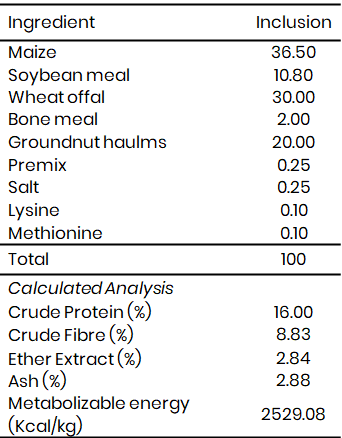
Table 2: Feeding procedure of sorghum hydroponic fodder

Feeding trail
Sorghum hydroponic fodder was used to replace the diets of weaner rabbits. The trial had five
treatment groups namely, diet 1 (100% diet mixture), diet 2 (75% diet + 25% sorghum hydroponic fodder), diet 3 (50% diet + 50% sorghum hydroponic fodder), diet 4 (25% diet + 75% sorghum hydroponic fodder) and diet 5 (100% sorghum hydroponic fodder).
Data collection
The following data was collected for each experiment:
Blood samples
Three rabbits were selected from each treatment group and blood samples were collected by puncturing the ear vein using sterile syringes to allow free flow of blood into universal bottles, one half of the blood samples was mixed with anticoagulant Ethylene Diamine Tetra Acetic Acid (EDTA) to determined haematological and serum biochemical parameters i.e. packed cell volume (PCV), red blood cell (RBC), white blood cell (WBC) counts, haemoglobin concentration, cholesterol, total protein, albumin and globulin according to Davice and Lewis (1991) procedure.
Data analysis
Data collected was subjected to analysis of variance in completely randomised design using SPSS package, differences between means was separated using Duncan’s Multiple Range Test.
Results and Discussion
Haematological and serum biochemical indices of weaner rabbits fed varying levels of millet hydroponic fodder
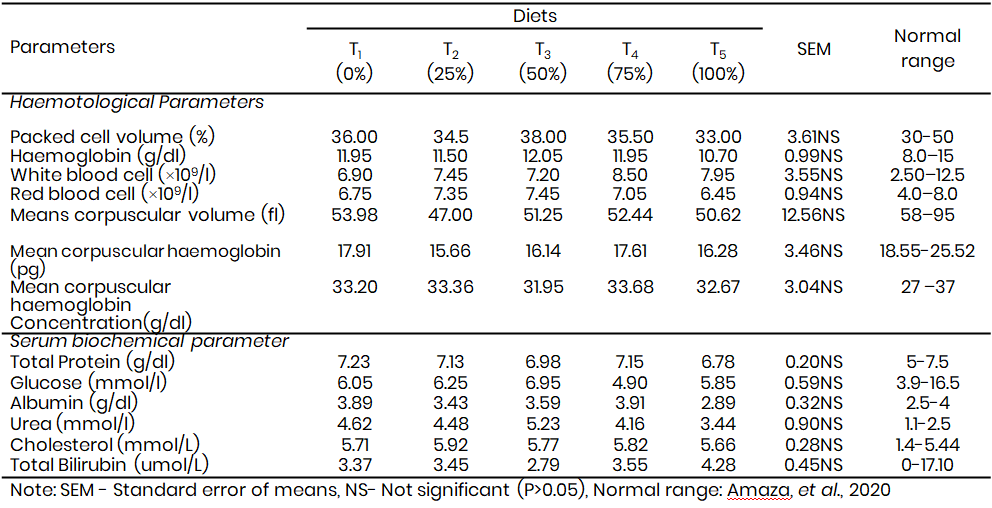
Blood parameters are vital indicators of the physiological and immunological status of animals. In this study, all the values observed for the haematological parameters were within the normal range reported for rabbits (Amaza et al., 2020), suggesting no adverse effects on the health of the rabbits (Table 3). The packed cell volume (PCV) ranged from 33.00% in rabbits fed 100% MHF to 38.00% in the 50% MHF group. While there were no significant differences among the groups (p>0.05), the slight decrease in PCV at the highest inclusion level may indicate mild dilution effects due to the high moisture content of MHF, as previously reported by Fazaeli et al. (2012). PCV is an essential indicator of oxygen-carrying capacity and overall health. Values within the normal range (30-50%) suggest that the inclusion of MHF up to 100% did not compromise blood health or oxygen transport (Lambe et al., 2024).
The haemoglobin (Hb) (10.70-12.05g/dl) values obtained were in agreement with the reports of Jatutu et al. (2024) and Ibrahim et al. (2014) but lower than reported values of 12.90-14.00 g/dl by Ogbuewu et al. (2010) for rabbits fed different levels of neem (Azadirachta indica) leaf meals. Nutritional status in animals can be indicated by blood properties, particularly PCV and Hb, as noted by Adejumo (2004). According to Adamu et al. (2006), diet has a meaningful impact on blood values. Further research by Etim et al. (2014) indicates that alterations in blood parameters can be used to evaluate stress resulting from nutritional factors or other causes. The observed values of PCV, Hb, WBC, and RBC in this study indicate that incorporating millet hydroponic fodder into the rabbits' diets had no adverse effects on their health and did not induce any nutrition-related stress, as reflected in the results obtained.
White blood cells play a crucial role in the immune defense system of animals (Audu et al., 2018). A lower-than-normal WBC count signifies a weakened immune response, making the body more susceptible to infections (Etim et al., 2014), while an elevated WBC count suggests enhanced disease resistance (Audu et al., 2018). In this study, the recorded WBC values (6.90-8.50×10⁹/L) align with the findings of Amaza et al. (2020) for rabbits, supporting the notion that the diets did not compromise immune function.
The MCV values recorded in this study (47.00-53.98 Fl) were comparable to those reported by (58-95 Fl) Amaza et al. (2020) (59-67 Fl). Similarly, the observed MCH values (15.66-17.91 Pg) aligned with the findings of Audu et al. (2018). Additionally, the MCHC values (29.00-30.00%) fell within the range documented for rabbits by Audu et al. (2018). As noted by Njidda et al. (2006), MCV, MCH, and MCHC serve as key indicators for diagnosing anemia, making them crucial in assessing hematological health. The values obtained in this study suggest that the rabbits were not anemic.
The total protein and albumin concentrations observed with the inclusion of hydroponic fodder may be attributed to the high digestibility of crude protein (Mehrez et al., 2018). According to Chavan et al. (2019), soaking and sprouting seeds trigger complex qualitative changes that transform stored proteins in cereal grains into albumins and globulins, thereby enhancing protein quality and increasing plant enzyme content (Shipard, 2005). During germination, protease enzymes become active, breaking down protein polymers into amino acids and small peptides (Shewry, 2007).
These enzymes facilitate the conversion of complex protein compounds into albumin and globulin, improving protein quality and boosting lysine content in grains (Chavan et al., 2019). Blood biochemical parameters serve as reliable indicators of an animal's health, physiological condition, and nutritional status. Overall, plasma parameter values obtained in this study fell within the normal range reported by Amaza et al. (2020).
Table 3: Haematology and serum biochemistry of weaner rabbits fed millet hydroponic fodder
Conclusion
The inclusion of millet hydroponic fodder in rabbit diets had no detrimental effects on haematological and serum biochemical indices. Parameters such as PCV, haemoglobin, RBC, WBC, and serum proteins remained within established physiological ranges, suggesting that MHF neither impaired oxygen transport capacity nor immune function. The results further indicated that intermediate levels of inclusion enhanced protein metabolism, reflecting the nutritional value of sprouted millet fodder. Thus, millet hydroponic fodder represents a safe and nutritionally beneficial alternative feed resource for rabbits.
References
Adamu, S., Thomas, A., Iseh, N. M., Fatihumi, M. Y., & Esieno, K. A. N. (2006). Normal values of haematology of Nigeria adopted albino rats (Rattus norvegicus) in Zaria. Proceedings of the 31st Annual Conference of the Nigerian Society for Animal Production, 112-119.
Adejumo, D. O. (2004). Performance, organ development and haematological characteristics of rats fed sole diets of graded levels of cassava flour and soybean flour (Soygari) as substitutes for energy and protein concentrates. Tropical Journal of Animal Science, 7, 57-63.
Ahamefule, F. O., Obua, B. E., Ukweni, I. A., Oguike, M. A., & Amaka, R. A. (2008). Haematological and biochemical profile of weaner rabbits fed raw or processed pigeon pea seed meal-based diets. African Journal of Agricultural Research, 3(4), 315-319.
Amaza, I. B., Maidala, A., & Isidahomen, C. E. (2020). Haematological and serum biochemical indices of growing rabbits fed graded levels of yam peel meal as replacement for maize. Nigerian Journal of Animal Production, 47(4), 167-175.
Audu, R., Tijjani, A., Ibrahim, A. A., Amin, A. B., Gumel, I. A., & Suleiman, A. T. (2018). Evaluation of haematology and serum biochemistry of weaner rabbits fed diets containing Ficus sycomorus and Parkia biglobosa leaf meals. Nigerian Journal of Animal Production, 45(5), 30-38.
Belewu, M. A., & Ogunsola, F. O. (2010). Haematological and serum indices of goats fed fungi-treated Jatropha curcas kernel cake in a mixed ration. Journal of Agricultural Biotechnology and Sustainable Development, 2(3), 35-38.
Chavan, J. K., Kadam, S. S., & Beuchat, L. R. (2019). Nutritional improvement of cereals by sprouting. Critical Reviews in Food Science and Nutrition, 28, 401-437.
Davice, J. U., & Lewis, S. M. (1991). Practical haematology (8th ed., pp. 22–28). Longman.
Etim, N. N., Williams, M. E., Akpabio, U., & Offiong, E. E. A. (2014). Haematological parameters and factors affecting their values. Agricultural Science, 2(1), 37-47.
Fazaeli, H., Golmohammadi, H. A., Tabatabayee, S. N., & Asghari-Tabrizi, A. G. (2012). Productivity and nutritive value of barley green fodder yield in hydroponic system. World Applied Science Journal, 16(4), 531-539.
Copyright
Open Access: This article is licensed under a Creative Commons Attribution 4.0 International License, which permits use, sharing, adaptation, distribution and reproduction in any medium or format, as long as you give appropriate credit to the original author(s) and the source, provide a link to the Creative Commons license, and indicate if changes were made. The images or other third party material in this article are included in the article’s Creative Commons license, unless indicated otherwise in a credit line to the material. If material is not included in the article’s Creative Commons license and your intended use is not permitted by statutory regulation or exceeds the permitted use, you will need to obtain permission directly from the copyright holder. To view a copy of this license, visit http://creativecommons.org/licenses/by/4.0/.

