

Effect of different phosphorus dose application on nutrient composition of Soybean (Glycine max L.)
Abstract
The type and amount of nutrient applied to the soil are key factors in crop production. An experiment was conducted in 2022 at research station of the institute of Agricultural Research and Training (IAR&T) Ikenne, Ogun State to examine the effect of different phosphorus concentrations on nutrient composition of soybean. The experiment was laid out in the Randomized Complete Block Design (RCBD) with three replicates. Each replicate measured 11.2 × 2 m2 was divided into four plots of 2 × 2.4 m2 separated by 0.5 m. The treatments were different rates of phosphorus fertilizer at 0 kg ha-1, 20 kg ha-1, 40 kg ha-1 and 60 kg ha-1. Soybean variety used was TGX 1440 – IE. Cultural practices were carried out and data taken. At maturity soybean grains were harvested, threshed and weighed in kg/ha. The grains were analyzed for proximate and mineral composition. The result showed that application of 60 kg P ha-1 significantly (p<0.05) gave the highest grain yield of 190.76 kg ha-1 than other treatments. Proximate analysis result showed that soybean treated with 60 kg/ha of phosphorus had the highest protein content (39.50%). While crude fat, was not affected by application of phosphorus. Phosphorus at zero levels gave high values of iron and calcium content (18.01 mg kg-1 and 324.02 Cmol kg-1 respectively) while 20 kg ha-1 level of phosphorus gave highest value for magnesium content (338.74 Cmol kg-1). Application of Phosphorus at the rate of 60 kg ha-1 for optimum soybean grain yield with high protein content is therefore recommended.
Introduction
Soybean (Glycine max L.) is a widely consumed agricultural commodity around the world in many forms, such as the whole soybean, soy oil and soy meal (Fearnside, 2001). Soybean as described is known as “miracle bean” or the “golden bean” because it is a cheap, protein rich grain with a high protein content of about 40% which is superior to all other plant foods and it has a good balance of the essential Amino acids (Omotayo et al., 2007 and Zarei et al., 2012)
Soybean contains approximately 37-41% protein, 18-21% oil, 30-40% carbohydrate and 4-5 Ash research has shown that (Morrison et al., 2000). Generally, soybean is regarded as a highly versatile and multipurpose agricultural product that has about three hundred and sixty-five (365) application in the formulation of both human, animal foods and other industrial uses; soybean has the highest protein content of all field crops and is the second only to groundnut in terms of oil content among the food legumes. (Hungria et al., 2015). Soybean has therefore been recognized as one of the premier agricultural crops today, thus it is the best source of protein and oil, and now been recognized as potential supplementary source of nutritious food (Wilcox & Shibbles, 2001).
A major constraint for Soybean production on disturbed soil is Phosphorus (Ferguson et al., 2006). Phosphorus nutrition has strong impact on photosynthesis and yield quality of Soybean (Singh et al., 2014).
Soybean quality and protein content is influenced by nutrient availability and phosphorus has a positive effect upon its protein content. Phosphorus application is necessary for high protein and yield of soybean grains (Shah et al., 2001) and yield components like the straw (Chieizey, 2001).
Phosphorus has significant implications on growth and yield of soybean attributes (Kumaga and Ofori, 2004). Small quantity of phosphorus in the soil is a key obstacle to the growth as well as yield of soybean. Soybeans thrives well on a relatively well – drained loamy soil rich in phosphorus with a pH range of 4.5 to 8.5, but performs badly on drought stressed soils and water soaked soils and soil lack of phosphorus (MOFA, 2006).
Phosphorus is the main nutrient contributing protein in soybean, phosphorus from the soil is imperceptible, it is the most nutritive nutrients that soybean productivity comes from; phosphorus deficiency in soybean can limit the nodule formation while the Phosphorus fertilization does not only overcome the deficiency but also promote nutrient uptake and eventual yield of the crop (Carsky et al., 2001).
Phosphorus application is also necessary for high protein and oil yield from Soybean grains (Shah et al., 2001). Damodar et al. (2000) and Manna et al. (2007) reported that manure application along with Phosphorus inorganic fertilizer is an effective strategy to help improve soybean nutrient like iron, calcium and magnesium also phosphorus in the soil. It has been reported that, Phosphorus application through Single Super Phosphate significantly increased the grain yield and oil content in the crop (Tanwar & Shaktawat, 2003).
Nutrient availability inflrences the quality of soybean with phosphorus having a positive impact on Soybean nutrient composition (Borges & Mallarino, 2000). Several researchers have pointed out that the use of Phosphorus significantly improves the content of Soybean nutrient composition (Brennan & Bolland, 2004). It becomes imperative therefore to determine the quantity of phosphorus level that should be applied to soybean to obtain optimum nutrient quality in soybean; hence, this study.
Material and Methods
Experimental site
The experiment was carried out at the out-station of the Institute of Agricultural Research and Training (IAR&T) Ikenne, Ogun State. (Latitude 6o 51' 21.11'', Longitude 3o 42' 20.23''), altitude 228.0 m above the sea level). Ikenne is in the rain forest Agro ecology of Nigeria with mean annual temperature range 27-35 oC and mean annual rainfall ranging from 1500 – 2000 mm. It has distinct wet and dry seasons. The wet season has double rainfall peaks during June and September with short break in between called August break. The experimental plot measuring 11.1 m × 8 m was prepared by ploughing and harrowing and laid out into 12 plots of 2.4 m × 2 m
Experimental design and treatment application
The experiment was laid out in the randomized complete Block Design (RCBD) with three replicates. Each replicate measures 11.1 × 2 m2 separated by 1m apart and each replicate was divided into 4 plots of 2 × 2.4 m2 separated by 0.5 m. Phosphorus (SSP) fertilizers (P) at different rates were incorporated into the soil a week before planting. The different rate of phosphorus fertilizer is 0 kg ha-1, 20 kg ha-1, 40 kg ha-1, 60 kg ha-1.
Planting material and procedures
The soybean (Glycine max L.) seed used was early maturing TGX 1440 - IE which was obtained from the seed store of the Institute of Agricultural Research and Training (IAR&T) Moor Plantation, Ibadan.
Soybean seeds were sown in the month of June of the cropping season at the rate of two seeds per stand, agronomic practices such as weed control was carried out. Weeds were controlled by using metaphox pre-emergence herbicide with glyphosate as an active ingredient at the rate of 3 litres ha-1 immediately after sowing and manually, using traditional hoe at six (6) and nine (9) weeks after emergence.
Data collection and analysis
Data were collected on growth and yield parameters. At maturity, when the soybean pods were dried (in November of the same year), soybean seeds were harvested, threshed and weighed and weight recorded in kg ha-1. Then the seeds were taken to the laboratory for proximate analysis and mineral composition analysis. The data collected were subjected to statistical analysis using ANOVA to test the level of significance of treatment on the measured parameters and the significant means were compared and separated using least significant difference (LSD) at 5% levels of probability.
Results and Discussion
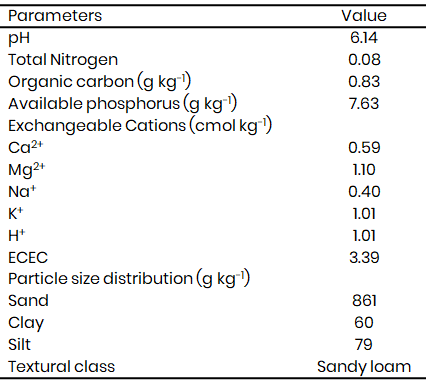
The result of physical and chemical properties of the pre cropping soil is presented in Table 1. It showed that the soil was slightly acidic with a pH of 6.14. Total nitrogen was very low (0.083%), compared to the standard value of (1-1.5), available phosphorus (7.63 mg kg-1) compared to the standard value of (7 - 7.20) and organic carbon (0.83%) compared to the standard value of (1.0 - 1.4) were low. Exchangeable base: potassium, calcium, magnesium and sodium of the soil range from 0.29–1.10 and 0.40 cmol kg-1, the texture of the soil was sandy loamy soil with sand, silt and clay content of 861, 79 and 60 g kg-1 respectively.
Effect of phosphorus concentration on soybean yield (kg ha-1)
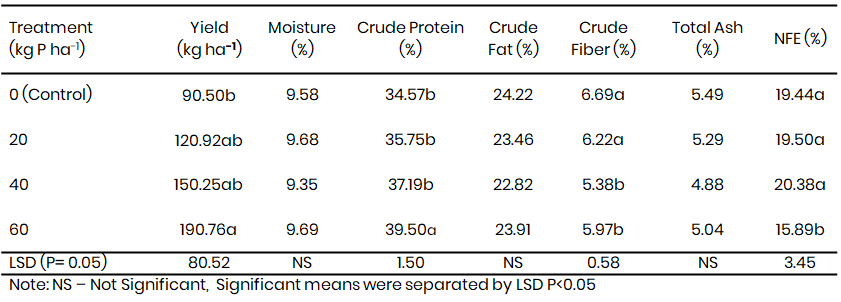
The effect of treatment on the yield of soybean is presented in Table 2, The yield of soybean was significantly (p<0.05) higher with the application of 60 kg P ha-1 than other levels of P with a yield difference of 52.56% for zero application, 21.24 and 36.6 % for 40 and 20 P respectively. This study buttresses the fact that phosphorus, an essential mineral nutrient is required in relatively large amount to maintain growth and play a vital role in improving soybean yield and quality (Jack & Sara, 2001) and that it has strong impact on photosynthesis and yield quality of soybean grains (Singh et al., 2014).
Table 1: Physical and chemical characteristics of experimental soil
Effect of phosphorus concentration on proximate analysis of soybean seeds
The result of proximate analysis of soybean is also presented in Table 2. It was observed that treatment effect was not significant on moisture content of soybean; while it was significant for crude protein. Soybean treated with 60kg of phosphorus had the highest value of protein content 39.50% which was significantly higher than other treatments. This result corroborates the work of Tanwar & Shaktawat (2003) who also opined that phosphorus application significantly increased the seed protein content (SPC) of soybean. Bilal et al. (2020) also discovered that 60 kg P ha-1 produced high protein content of (42%) in soybean. Treatment effect was not significant on crude fat. This is in contrast to the work of Brennan & Bolland (2004) who submitted that, phosphorus significantly improves the oil content of many oil seed crops also in contrast with Bilal et al. (2020) who discovered that increase in phosphorus increased the oil content in soybean.
The study however support the findings of Rogerio et al. (2013) who stated that different levels of phosphorus in oil seed crops (Crambe) does not significantly increased oil content of the crop. Considering the crude fiber content, the control (0 P) was significantly higher than other treatments except that of 20 P. Meanwhile, there was no significant difference between the crude fibre content of soybean at 20 P and 60 P application. This indicates that enough crude fibre content can still be derived with the application of 60 kg P ha-1 which also supports optimum yield and protein content in soybean for total ash there was no significant difference among the treatments.
Significant difference was observed among the treatments for nitrogen free extract in which soybean treated with 40 P was significantly higher than those treated with 60 P but was comparable to those of 0 phosphorus and 20 phosphorus statistically. This is also an indication that application of phosphorus for soybean supports the availability of free nitrogen extract. This is consistent with the findings of Malik et al. (2006) who also discovered that nitrogen is one of the main yield related characters in soybean which of course is made more available with application of phosphorus.
Table 2: Effect of phosphorus concentration on yield and proximate analysis of soybean
Effect of phosphorus concentration on mineral composition of soybean
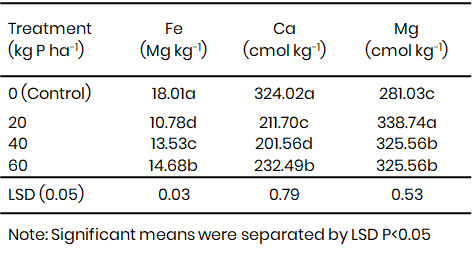
The result of treatment effect on mineral analysis of soybean is presented in Table 3. The result revealed that, there was significant differences in iron content among all the treatment, soybean with no treatment (Control) had the highest iron content of 18.01%, which was significantly higher than other treatments. This indicates internal inactivation of iron by the phosphorus this is because, phosphorus deficiency has been shown to result in increased iron concentration (Liao et al., 2006). Likewise, for calcium content there were significant differences across the treatments. Soybean not treated with phosphorus (Control) had the highest calcium content of 324.02%, while the soybean treated with phosphorus were significantly lower in calcium content, with 40 kg P ha-1 having the least followed by 20 P then 60 P. These results showed that application of Phosphorus fertilizer to the soil in soybean field has nothing to do with the iron content and calcium content in soybean. These minerals can be gotten by soybean from other sources. Meanwhile, effect of treatment on magnesium content of soybean seed showed that there were significant differences among the treatments in which soybean treated with 20 kg of phosphorus had the highest magnesium content of 338.74% which is comparable statistically with those 40 and 60 level of phosphorus while the 0 level of phosphorus had the least value of magnesium content of 281.03% different from those of 40 and 60 level of phosphorus.
Table 3: Effect of phosphorus concentration on mineral composition analysis of soybean
Conclusion
Phosphorus concentration of 60 kg ha-1 gave the highest soybean yield of 190.76 kg ha-1 and high protein content (39.50%). Mineral content like magnesium also responds to application of phosphorus in soybean. However, crude fat does not response to phosphorus application in soybean. Also with zero phosphorus fertilizer application to soybean, enough minerals like iron and calcium which are beneficial to humans can be derived from the crop.
Selective phosphorus concentration can be used in precision soybean cultivation to improve target nutrients in soybean. This will encourage the production of soybean selectively rich in predetermined class of nutrients. Soybean production is targeted to make protein for man hence, the applications of 60 kg ha-1 of phosphorus is recommended to achieve optimum yield and high protein content in soybean which does not however affect the availability of oil in the crop adversely.
References
Bilal, A. K., Ali, H., Asad, E., Mohammed, A., Muhammed, M. A., Muhammed, D. T., Amir, A., Muhammed, K. S., Abdul, W., & Rehan, A. (2020). Effect of phosphorus on growth, yield and quality of soybean (Glycine max L.). International Journal of Applied Research, 6(8), 1–6.
Borges, R., & Mallarino, A. P. (2000). Grain yield and early growth and nutrient uptake of no-till soybean as affected by phosphorus and potassium placement. Agronomy Journal, 92, 380–388.
Brennan, R. F., & Bolland, M. D. A. (2004). Wheat and canola response to concentration of phosphorus and calcium in a sandy soil. Australian Journal of Experimental Agriculture, 44, 1025–1029.
Carsky, R. J., Singh, B. B., & Oyewole, R. (2001). Contribution of early-season cowpea to late-season maize in the savanna zone of West Africa. Biological Agriculture & Horticulture, 18, 301–315.
Chiezey, U. E. (2001). Pod abortion and grain yield of soybean (Glycine max (L.) Merrill) as influenced by nitrogen and phosphorus nutrition in the Northern Guinea Savanna Zone of Nigeria. Tropical Oil Seeds Journal, 6, 1–10.
Damodar Reddy, D., Subba Rao, A., & Rupa, T. R. (2000). Effects of continuous use of cattle manure and fertilizer phosphorus on crop yields and soil organic phosphorus in a vertisol. Bioresource Technology, 75, 113–118.
Fearnside, P. M. (2001). Conservation biology in soybean (p. 368). São Paulo, Brazil: Author. ISBN 978-85-211-0193-2.
Ferguson, R. B., Shapiro, C. A., Dobermann, A. R., & Wortmann, C. S. (1987). Fertilizer recommendation for soybean (Revised August 2006, pp. 87–859). University of Nebraska.
Hungria, M., Nogueira, M. A., & Araujo, R. S. (2015). Co-inoculation of soybeans and common beans with rhizobia and Azospirilla: Strategies to improve sustainability. Biology and Fertility of Soils, 49(7), 791–801.
Jack, W., & Sara, G. S. (2001). Correcting potassium deficiency reduces rice stem diseases. Better Crops, 85(1), 7–9.
Copyright
Open Access: This article is licensed under a Creative Commons Attribution 4.0 International License, which permits use, sharing, adaptation, distribution and reproduction in any medium or format, as long as you give appropriate credit to the original author(s) and the source, provide a link to the Creative Commons license, and indicate if changes were made. The images or other third party material in this article are included in the article’s Creative Commons license, unless indicated otherwise in a credit line to the material. If material is not included in the article’s Creative Commons license and your intended use is not permitted by statutory regulation or exceeds the permitted use, you will need to obtain permission directly from the copyright holder. To view a copy of this license, visit http://creativecommons.org/licenses/by/4.0/.

