

Effects of subsidized inputs on rice production under value chain development programme in Benue and Niger States, Nigeria
Abstract
This study examines the effects of subsidized agricultural inputs on rice farmers’ productivity and livelihood outcomes under Value Chain Development Programme (VCDP) in Benue and Niger States, Nigeria. A multistage sampling technique was used to select programme beneficiaries, and data were analysed using descriptive statistics, logit regression, t-test, and propensity score matching. The results obtained shows that rice farmers in the study area were mostly males (85.4%) and (57.5%) and formally educated (70.8% and 85.6%) with an average age of 42 years among rice farmers in Benue and Niger states respectively. Findings show that subsidized inputs such as improved seeds (92.0% and 95.0%), fertilizers (89.0% and 93.0%), herbicides and mechanization support (71.0% and 81.1%) significantly increased rice yield from pre-VCDP average of 2.9 t ha-1 to 5.1 t ha-1 among rice farmers in Benue and Niger states respectively. Farmers’ income, food security, and livelihood assets improved, consistent with VCDP’s programme theory. Determinants of subsidy access included cooperative membership, extension contact, education, and farm size. The study concludes that subsidies under VCDP enhanced rice productivity and household welfare. Recommendations include timely input delivery, expansion of mechanization services, youth inclusion strategies, and digitalized subsidy management.
Introduction
Rice production is central to Nigeria’s agricultural transformation agenda, contributing to food security, rural employment, and household income (IFAD, 2022). Despite rising domestic demand, national supply remains insufficient due to low productivity, limited access to modern inputs, climate-related risks, and institutional inefficiencies (World Bank, 2019). To address these challenges, the Federal Government and IFAD introduced the Value Chain Development Programme (VCDP), targeting rice and cassava farmers in selected states including Benue and Niger. VCDP supports farmers through input subsidies such as improved seeds, fertilizers, herbicides, land development services, and mechanization delivered through cooperatives using matching grant modalities (IFAD, 2022). Subsidies are designed to stimulate the adoption of improved technologies, enhance productivity, reduce production costs, and strengthen market participation (FMARD, 2021). However, empirical evidence of how these subsidized inputs translate into measurable productivity gains and livelihood improvements at the farmer level remains limited, particularly within structured value chain programmes.
Rice occupies a crucial space in household food expenditure. Importantly, it is a staple food with rich cultural identity. In Thailand, rice is described as the essence of life. In China, it is referred to ‘life’ and generally the root of Asian civilization. In addition, rice has a rich nutritive value that provides more than 15 essential vitamins and minerals including folic acid, B vitamins, potassium, magnesium, selenium, fiber, iron and zinc (Onwuka, 2021). Considering the nutritional value of rice in the body, there is hardly any country in the world where it is not utilized in one form or the other. In Nigeria, rice is one of the few food items whose consumption has no cultural, religious, ethnic or geographical boundary (Ibitoye et al., 2017).
According to Fosu (2017), Nigeria’s enormous agricultural potentials are yet to be fully exploited. FAO (2018) opined that utilization of production knowledge and use of technology makes the real value of productivity that boost Nigeria’s’ economy. Thus, if well managed, the sector has potential to contribute substantially to GDP, employment and revenue generations. It is in this regard, that the Nigerian government positions agricultural sector as one of the driving forces for the anticipated economic growth that is required to reduce poverty (World Bank, 2019).
Prior programme assessments noted increases in farmers’ adoption of improved seeds, access to extension, and participation in market linkages (VCDP, 2021). Yet, the magnitude of productivity gains and livelihood outcomes attributable to subsidized inputs is not well documented in peer-reviewed studies. Understanding these dynamics is vital for sustaining and scaling agricultural subsidy interventions. This study contributes to knowledge by empirically analysing the effects of subsidized inputs on rice farmers’ productivity, income, and livelihood outcomes in Benue and Niger States. It also identifies socio-economic predictors of subsidy access among programme beneficiaries. Findings will guide policymakers, development partners, and practitioners in designing and sustaining inclusive agricultural input support programmes.
Material and Methods
This study was conducted in Benue and Niger States, Nigeria. Niger State was created out of the former Northwestern State and became a fully autonomous State on 3rd February 1976, with headquarter at Minna. Niger State is in the North-central part of Nigeria and lies in between longitude 3° 30' and 7° 20' East of the Greenwich Meridian and latitude 8° 20' and 11° 30' North of the equator. The State presently comprises of 25 Local Government Areas (LGAs) and it is made up of three major ethnic groups which are the Nupe, Gbagyi and Hausa. However, the total inhabitants in the State are over 3,954,772 people during the 2006 population census. But, going by the annual population growth rate of 2.5% in Nigeria, the population of Niger State was projected to be 5,556,200 in the year 2016 (National Bureau of Statistics, 2020). However, Benue State falls within Longitude 7°47ʹ E to 10°0ʹ E and Latitude 6°25ʹ N, 8°8ʹ N. It is borded in the North by Nasarawa state and in the East by Taraba and Cross- River States. The State covers an estimated land area of 34,059 km2 and the total inhabitants in the State was 4,219,244 people during the 2006 population census. However, going by the annual population growth rate of 3.4% in Nigeria, the population of Benue State was projected to be 6,514,513 people in the year 2022 (NBS, 2020).
A multistage sampling technique was used. VCDP-implementing LGAs were purposively selected, followed by random selection of Farmer Organisations (FOs). Rice farmers participating in VCDP were then randomly sampled using Yamane’s formula to select sample size from sampling frame as obtained from Value Chain Development Programme data base. Thus, a total of 331 rice farmers formed the sample size for the study. Structured questionnaires were used to collect primary data analysis was conducted using descriptive statistics (mean, frequency distribution, and percentage) and inferential statistics (Ordered Logit regression model) was used to examine the determinant of rice farmers access to inputs subsidies under VCDP was specified as follows:
Ordered Logit Regression model - involves the relationship between a dependent variable and a collection of independent variables. The value of dependent variable is defined as a combination of independent variables plus error term.
Y = f(X1, X2, X3……......…………...…….. Xn, ei)
The implicit form of the ordered logit regression model is given as:
Y = f(X1+X2+X3+X4+X5+X6+X7+X8+X9+X10+ X13+e)------------------------ (1)
The explicit form is specified as follows:
Y = β0+ β1X1+ β2X2+ β3X3+ β4X4+ β5X5+ β6X6+ β7X7+ β8X8+ β9X9+ e -----------------(2)
Y = Level of access to inputs subsidies (high=3, moderate=2, low=1).
X1 = Age (Age of farmers)
X2 = Household size (numbers of people in the household)
X3 = Educational status of farmers (Years of schooling)
X4 = Farming experience (Number of years involved in farming)
X5 = Marital status (married =1, otherwise = 0)
X7 = Farm size (Hectares)
X8 = Extension contact (number of visit)
X9 = Access to credit (amount of credit received)
X10 = Major occupation (farming= 1, otherwise = 0)
X11 = Income (in Naira)
X12 = distance to redemption centre (km)
X13 = Cooperative membership (yes=1, no=0)
ß0 = Intercept
ß1 – ß13 = Regression coefficients
ei = error term.
Results and Discussion
Socio-economic characteristics of the respondents
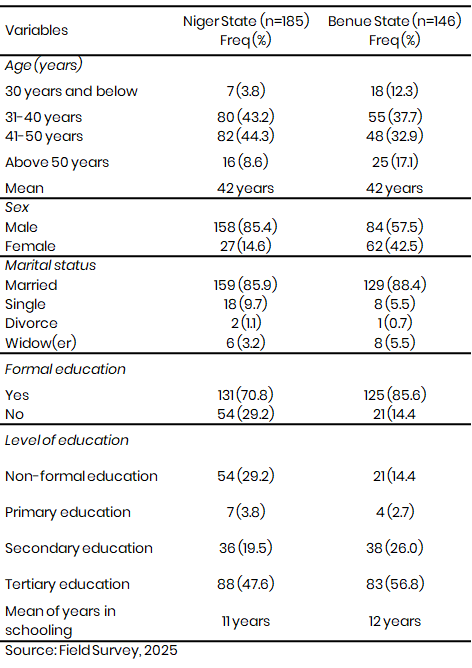
Age of the respondents: Entries in Table 1 revealed that majority (70.6%) of the respondents Benue state and (87.5%) of the respondents in Niger state were between the age bracket of 31-50 years with average age of 42 years respectively. This implies that, farmers in the study area were still within their active and productive age, i.e strong, energetic and full of innovative ideas that could be advantageous in efficient use of inputs subsidies given for rice production. At this age, farmers should be able to withstand the pressure and rigours involved in rice production from pre-planting operation till harvesting and post-harvesting operation respectively. This finding agreed with Okunola et al. (2018) who stated that majority of the farmers were within the youthful age group regarded as economically active age, innovative and productive age to carry out farming activities efficiently.
Sex of the respondents: Results in Table 1 showed that majority (57.5%) and (85.4%) of the respondents in Benue and Niger States were male respectively. This finding revealed that there are more male respondents than female respondents in the study area. This also might be due to the tedious, labourious and strenuous activities involved in rice production that could only be handled by men and restrict women to only domestic chores or as farm labourer in the study area. This is similar to the findings of Osanyinlusi and Adenegan, (2017) who found that men were dominant in rice production compared to female farmers.
Marital status of the respondents: Table 1 showed that the majority (88.4%) of the respondents in Benue State and (85.9%) of the respondents in Niger State were married. This implies that farmers in the study area had the motivation to cater for their family needs such as provision of nutrition while also using family members as source of cheap labour for rice production activities. The result is in line with Okpe et al. (2019) who pointed out that, married persons were more involved in crop production due to higher food demand in the household.
Educational level of the respondents: The results in Table 1 showed that majority of the respondents (85.6%) in Benue State and (70.8%) of the respondents in Niger State had one form of formal education or other involving attending primary, secondary and tertiary institutions with an average school year of 11 years and 12 years in Niger and Benue States respectively. Indicating a high literacy level, with high percentage of the rice farmers at tertiary level of formal education. Given that there is high level of literacy, it is expected that extension agents may disseminate information on good agronomic practices with ease among farmers in the study area. This result is in line with that of Bello et al. (2016) who reported that farmers in rural Northern Nigeria had formal education with average of 6 years in school thus, influencing the adoption of rice production technology among the farmers.
Table 1: Distribution of respondents according to socio-economic characteristics
Access to subsidized inputs
The result in Fig. 1 shows that subsidies rice seed (92.0%), subsidies fertilizer (89.0%) and subsidies herbicides (75.0 %) were the major input subsidies benefited among the respondents in Benue state. The high percentage of beneficiaries accessing subsidized rice seed (92.0 %) under the VCDP indicates that most rice farmers in Benue State received improved seed varieties. Access to quality seed likely enhanced germination rates, crop uniformity, and resistance to pests and diseases, thereby contributing to higher yields.
The high percentage of rice farmers benefiting from subsidized fertilizer (89.0 %) under the VCDP reflects strong support for soil fertility management in Benue State. Fertilizer provision at reduced cost enabled farmers to apply adequate nutrients particularly nitrogen, phosphorus, and potassium at recommended rates and timings. This likely improved plant vigour, enhanced tillering, promoted uniform grain development, and increased overall yields. The substantial percentage of beneficiaries accessing subsidized herbicides and mechanization support (71.0 %) indicates that weed management was effectively supported under the VCDP. This reduced the labour required for manual weeding, ensured timely weed control, and minimized competition for water and nutrients between rice plants and weeds. This assertion agrees with Okpe et al. (2022), who found that access to seed, fertilizer and agrochemicals were the farm subsidies benefited by the crop farmers in Southern Nigeria.
Furthermore, subsidies seed (95.0 %), subsidies fertilizer (93.0 %) and subsidies herbicides and mechanization (81.1 %) were the major input subsidies benefited among the respondents in Niger State. Similarly, to Benue State, the high uptake in Niger state reflects the programme’s strong focus on providing essential production inputs that directly enhance yield potential. Access to improved seed varieties likely improved germination rates, crop uniformity, and resistance to pests and diseases, enabling farmers to achieve higher and more stable yields. In addition, subsidized fertilizer provision allowed farmers to meet the nutrient requirements of their rice crop at reduced cost, promoting vigorous growth, better tillering, and improved grain filling. Subsidized herbicides and mechanization reduced the labour and time demands of manual weeding, ensured timely weed control, and minimized yield losses caused by weed competition. Similar to the findings of Ibitoye et al. (2017) who showed that access to fertilizer subsidies reduced the financial burden on farmers while ensuring that essential nutrients were applied in sufficient quantities, which has been shown to boost tiller production and grain filling.
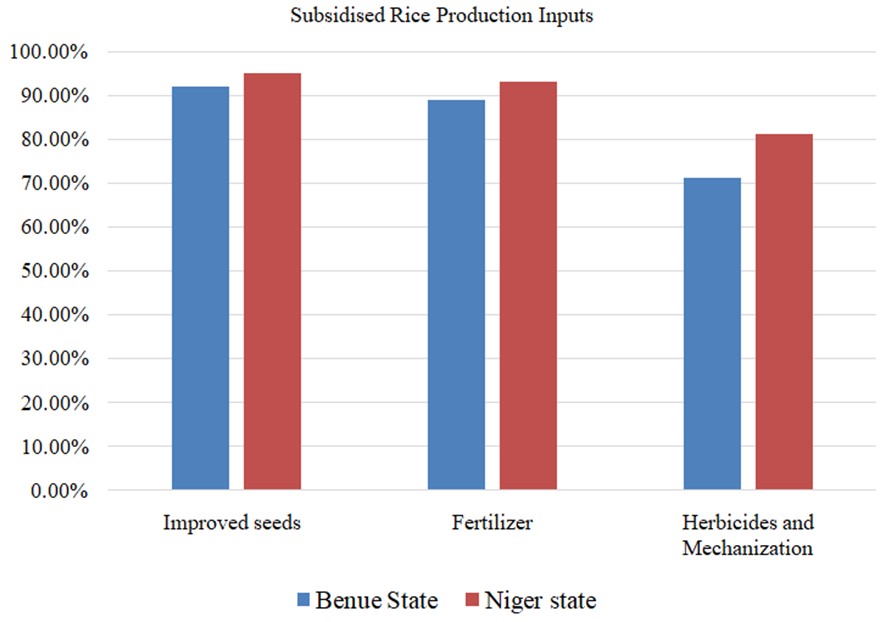
Fig. 1. Subsidized rice production inputs benefited by rice farmers
Determinants of rice farmers access to inputs subsidies
Ordered logit regression model was used to examine the determinant of rice farmers access to subsidized inputs under VCDP in the study area. Thus, the result in Table 2 shows the R2value of (0.7921 and 0.6334) for Benue and Niger states respectively. Implying that about (79 % and 63 %) respectively of Benue and Niger States variations that occurred in the determinants of rice farmers access to inputs subsidies were explained by the independent variables included in the models. while the remaining 21 % and 37 % respectively for Benue and Niger States rice farmers might be due to the non-inclusion of some important variables or measurement error. The Prob>chi2 is significant at 1 % level of probability. This implies the model is fit for the objectives.
The result shows that cooperative membership (p < 0.01), extension contact (p < 0.05), educational level (p < 0.01) and farm size (p < 0.05) were positively significant among the rice farmers in Benue and Niger states respectively. This implies that an increase in any of these variables leads to likelihood increase in rice farmers access to subsidized inputs provided by Value Chain Development Programme in both Benue and Niger states. This finding concurs with that of Ayoola et al. (2017), who reported that access to extension service increase the farmers’ level of awareness on various production inputs needed for farming practices. This also agrees with the findings of Wekesah et al. (2019), who posits that most farmers in sub-Saharan Africa have access to subsidized production inputs.
Table 2. Determinants of rice farmers access to subsidized inputs

Effects of subsidized inputs on productivity and livelihood outcomes
Based on the yield performance on average rice output increased from 2.9 t ha-1 before VCDP subsidy to 5.1 t ha-1 with the subsidized inputs programmed from VCDP. This is consistent with IFAD (2022), which reported yield increases of 3–5 t ha-1 among supported farmers. Improved seed adoption and balanced fertilization contributed significantly to yield gains. However, Farmers experienced:
- Improved food security
- Higher savings
- Increased access to social services
- Better decision-making autonomy
- Enhanced productive assets
These outcomes reflect the programme’s Theory of Change, which emphasises livelihood strengthening through market-driven productivity interventions (IFAD, 2022).
Conclusion
The study establishes that subsidized inputs under VCDP significantly enhanced rice productivity, income, and livelihood outcomes among farmers in Benue and Niger States. Determinants of access highlight the importance of cooperatives and extension services in reaching targeted beneficiaries. It is recommended that VCDP should ensure timely delivery of subsidized inputs to align with planting periods and also scale up mechanization support to reduce drudgery and expand cultivated areas. Rice farmers should also strengthen cooperative management capacities for efficient input distribution.
References
Ayoola, J. B. C., Dangbegnon, C. K., Daudu, A., Mando, T. M., Kudi, I. Y., Amapu, J. A., Adeosun, O., & Ezui, K. S. (2017). Socio-economic factors influencing rice production among male and female farmers in Northern Guinea Savanna, Nigeria: Lessons for promoting gender equity in action research. Agricultural and Biological Journal of North America.
Bello, T. A., Balogun, O. L., Afodu, O. J., Akinboye, O. E., Ndubusi-Ogbonna, L. C., & Shobo, B. A. (2016). Determinants of productivity of rice farmers in Ogun State, Nigeria. Research Journal of Agriculture, 3(4), 1–10.
Food and Agriculture Organization of the United Nations. (2018). The future of food and agriculture: Pathways to sustainable development and food security. FAO.
Federal Ministry of Agriculture and Rural Development. (2021). Value chain development programme baseline survey report. FMARD.
Fosu, A. K. (2017). Governance and development in Africa: A concise review (GDI Working Paper No. 2017-002). The University of Manchester.
Ibitoye, S. J., Idoko, D., & Shaibu, U. M. (2017). Economic assessment of rice processing in Bassa Local Government Area of Kogi State, Nigeria. Asian Journal of Basic and Applied Sciences, 1(2), 8–17.
International Fund for Agricultural Development. (2022). IFAD’s internal guidelines: Economic and financial analysis of rural investment projects. IFAD.
National Bureau of Statistics. (2020). Statistical fact sheets on economic and social development. NBS.
National Bureau of Statistics. (2022). Issue 33: Quarter one, May 2022. https://www.nigerianstat.gov.ng
Okpe, P. C., Atagher, M. M., & Iheanacho, A. C. (2022). Effect of socio-economic characteristics on postharvest losses among sweet orange marketers in Benue State, Nigeria. Journal of Agripreneurship and Sustainable Development, 5(2), 130–139.
Copyright
Open Access: This article is licensed under a Creative Commons Attribution 4.0 International License, which permits use, sharing, adaptation, distribution and reproduction in any medium or format, as long as you give appropriate credit to the original author(s) and the source, provide a link to the Creative Commons license, and indicate if changes were made. The images or other third party material in this article are included in the article’s Creative Commons license, unless indicated otherwise in a credit line to the material. If material is not included in the article’s Creative Commons license and your intended use is not permitted by statutory regulation or exceeds the permitted use, you will need to obtain permission directly from the copyright holder. To view a copy of this license, visit http://creativecommons.org/licenses/by/4.0/.

