

Levels of adoption of good agronomic practices on improved Cassava varieties in Anambra State, Nigeria
Udemezue J C1, Okafor A C1, Ewa F1, Agu P N1, Mbanasor C I2
Abstract
This study examined the levels of adoption of improved cassava varieties and good agronomic practices (GAP) among cassava farmers in Anambra State, Nigeria. The specific objectives were to; identify the extent of adoption of cassava varieties released in the years, estimate the levels of adoption of good agronomic practices, ascertain the determinants of adoption of good agronomic practices and identify constraints militating against adoption of good agronomic practices (GAP) in the study area. Using a multistage sampling technique, data were collected from 120 respondents across eight farming communities through structured questionnaires and analyzed with descriptive statistics and regression analysis. Findings revealed that majority of the farmers were female (51.7%), with an average age of 33 years, household size of six, farm size of 2 hectares, and farming experience of 20 years. Adoption rates of improved cassava varieties were high, particularly TME-419, which had the highest adoption index due to its disease resistance and high yield. Among GAP, adoption rates varied - ridge making (43.1%), use of improved cuttings (54.1%), and pest/disease control (67.9%) had relatively high adoption, while planting distance (16.0%) and fertilizer application (2.2%) had low uptake. Key determinants of adoption included education, income, cooperative membership, access to cuttings, and extension contact. However, high cost of cuttings, limited access to credit, inadequate knowledge of weather problems, pest pressure, and poor extension services constrained adoption. The study concludes that while adoption of improved cassava varieties is high, uptake of agronomic practices remains uneven and these necessitating targeted interventions.
Introduction
Cassava is the most widely and popularly cultivated root crop as regards to area allocation and the number of growers in Nigeria (Tesfamicheal et al, 2017). The importance of cassava is increasing as it is almost replacing yam and other traditional staple foods as a famine reserve and insurance crop against hunger (Wossen et al., 2017). The crop is important not only as a food but also as a major source of income for rural households. As a cash crop, cassava generates income for the group number of households compared to other staples (Wossen et al., 2017), and justifies people’s focus on the crop. Improving agricultural productivity, particularly, cassava productivity through efficient dissemination of improved varieties is therefore essential for poverty reduction efforts in Nigeria.
Cassava crop is a very versatile commodity with numerous uses and by products; the crop is planted all year round depending on the availability of moisture. Each component of the plant can be valuable to its cultivator, about 16 percent of cassava root production was used as industrial raw material in 2001 in Nigeria, 10 percent was also used as chips in animal feeds, 5 percent was processed into a syrup concentrate for soft drinks and less than 1 percent was processed into high quality cassava flour used in biscuits and confectioneries (Udemezue and Onwuneme, 2017).
According to Tesfamicheal et al (2017), it is generally known that improved agricultural technologies play a critical role in agricultural transformation and economic growth in developing countries. Correctly, adoption of improved agricultural technologies should, all things being equal, boost overall productivity and increase additional income for farmers. In doing so, technology adoption can accelerate economic growth, create marketing opportunities and help millions of farmers to be out of poverty traps (Wossen et al., 2017). In this regard, the dissemination and diffusion of improved crop varieties has been seen as the primary pathway through which technological change in the agricultural sector can bring about productivity gains (Tesfamicheal et al., 2017).
Intensification of better agricultural production system is one of the ways of increasing the welfare of farmers. This can be achieved if farmers take advantage of improved crop variety such as cassava. Some direct impacts of agricultural technologies (such as changes in agricultural productivity and farm income) are relatively easy to measure quantitatively, which is probably why they have been the focus of most impact research. It is however difficult to establish the causal effect of farming technology on welfare, but at the same time this is necessary if we want to know the extent of agricultural enhancement of the poor (Afolami et al., 2015).
To increase productivity, technology must be adopted in the production process and the rate of adoption of a new technology is subject to its profitability, degree of risk associated with it, capital requirements, agricultural policies and socioeconomic characteristics of farmers (Udemezue and Agwu, 2018). Therefore, adoption of innovation is the last step in a decision process to make full use of an innovation having considered that such will impact positively on the livelihood of the adopter. Adoption is regarded as a decision to make full use of an innovation or technology as the best course of action available.
Understanding the levels of adoption of agricultural technologies is essential in planning and executing technology related programs for meeting the challenges of food production in developing countries (Udemezue and Agwu, 2018). In view of this, the International Institute of Tropical Agriculture (IITA) initiated cassava research in the early 1970s with a focus on developing varieties with resistance to major diseases such as cassava mosaic virus disease (CMD) and cassava bacterial blight (CBB). Consequently, International Institute of Tropical Agriculture (IITA) in conjunction with National Root Crops Research (NRCRI) Umudike has developed and released more than 46 cassava varieties with multiple disease resistance and high yield potentials. In addition, they developed good agronomic practices and biological control and integrated pest management options to reduce losses due to insect pests. Despite these major efforts made by IITA and partners to develop and disseminate a growing number of improved cassava varieties and good agronomic practices, there is still a lack of comprehensive and rigorous evidence of adoption and impacts of these varieties and agronomic practices on poverty reduction. Against this backdrop, this research is designed to investigate adoption analyses of good agronomic practices on recent improved cassava varieties in Anambra State, Nigeria. The specific objectives were to; identify the extent of adoption of cassava varieties released in the years, estimate the levels of adoption of good agronomic practices, ascertain the determinants of adoption of good agronomic practices and identify constraints militating against adoption of good agronomic practices (GAP).
Material and Methods
The study area for this research is Anambra State. The State is located in the South East of Nigeria. It is bounded by Delta State to the West, Imo State to the South, Enugu State to the East and Kogi State to the North. The State lies on the longitude 6° 35'E and 7'E and latitude of 5° 38'N and 6° 47'E (Udemezue et al., 2024). The target population for this study was cassava seed farmers in the State. Multistage sampling techniques were used for this study. Four local governments out of 21 local governments in Anambra State were selected due to their popularity in cassava seed marketing. Ayamelum, Anambra East, Anambra west and Ogbaru local government were selected. In the second stage, two communities each from a local government were selected. Here Omor and Umumbo in Ayamelum Local Government, Igbariam and Umuoba Anam in Anambra East, Nzam and Iyi Ora Anam in Anambra west, Atani and Osamala in Ogbaru Local Government were purposely selected. These gave a total of eight (8) communities. Third stage, 15 farmers were selected from each community using simple random techniques and this gave a total sample size of 120 respondents. Data were collected through structured questionnaires. Data collected for the research were analyzed using statistical tools such as, descriptive statistics and regression analysis.
Results and Discussion
Findings of the study indicated that majorities (51.7%) of the farmers were female while 48.3% of them were male (Table 1). This finding contrasts with the general expectation that cassava farming is typically male-dominated, as reported by Tesfamicheal et al. (2017). The higher female participation observed in this study may be attributed to the role of cassava in household food security and its compatibility with domestic traditionally undertaken by women. Moreover, 40% of the cassava farmers were married and 20.3% were single. This implies that the respondents were dominated by married men and women who invariably contributed to increase in household size farm labour (Tesfamicheal et al., 2017). However, 45% of them completed primary school education while 25% of the farmers completed secondary school education respectively. This implies on the aggregate that the majority of the farmers had one form of education or the other, and thus had the advantage of adopting innovation, since education helps in adopting improved agricultural technologies as observed by Tesfamicheal et al. (2017).
Also, this buttresses the reason why most of the farmers adopted at least one of the improved cassava varieties. The average mean age, household size, farm size and farming experience of the farmers were 33 years, 6 persons, 2ha and 20 years therein. The average age of the farmers implies that the farmers are in their active years, with an advantage of transferring innovations that enhance farm productivity. It is expected that improved varieties of cassava will be adopted at a faster rate in this area, which is in line with the observation of (Uchemba et al., 2021). However, the average hecterage of the farmers indicates a predominance of smallholder farming, which is typical in cassava production systems in Nigeria. This finding corresponds with Esheya (2019) and Oshioriamhe et al. (2025), who observed that most cassava farmers operate on relatively small plots of land, possibly due to land constraints or resource limitations.
As regards to farming experience, farmers had an average year of 20 and Such levels of experience suggest that most cassava farmers have been in the sector long enough to gain practical knowledge, which can enhance their adaptability and risk management. According to Aboajah et al. (2018) and Oshioriamhe et al. (2025), this depth of experience positively influences the adoption of improved practices and technologies.
In terms of the extent of adoption of cassava varieties released to farmers, TME-419, TMS-98/0581, TMS-98/0505, TMS, 30572, TMS-3055 and TMS-98/0510 were adopted by the farmers according to their order of preference respectively (Table 2). TME-419 variety has a high level of adoption, seconded by TMS-98/0581 and TMS-980505.
Table 1: Socio-economic characteristics of cassava farmers in Anambra State
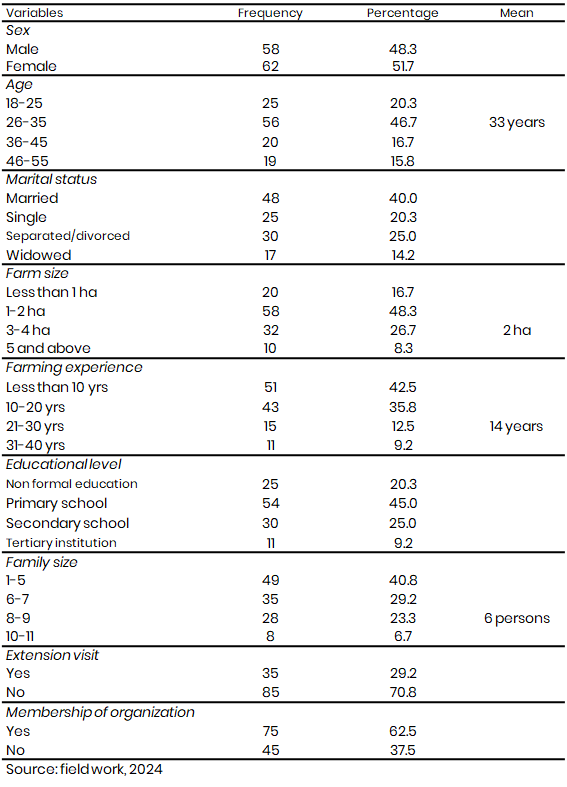
Table 2: The extent of adoption of cassava varieties released to farmers

This result is in agreement with Afolami et al. (2015) that majority (60.2 %) of the farmers adopted TME 419 variety among the introduced improved cassava varieties in the states because of its thin stem and larger yield compared to other varieties introduced while 39.8 % did not. This result is similar to the findings of Ojo and Ogunyemi’ (2014) in Ekiti State where 60.6 % farmers were found to have adopted TME 419 among improved cassava varieties introduced to them in the State. This finding was also not in line with the result of Uchemba et al. (2021) which showed that improved cassava production technologies has not been fully adopted by all the farmers in their study. This could be that majority of their respondents were still at the evaluation stage of adoption in the study areas. The farmers also established the fact that TME 419 was the best technology introduced to them due to its disease resistance and low water moisture content compared to other varieties. Therefore, the improve cassava varieties disseminated to farmers in the study were adopted with an adoption index of 0.78(78%) indicating high adoption level.
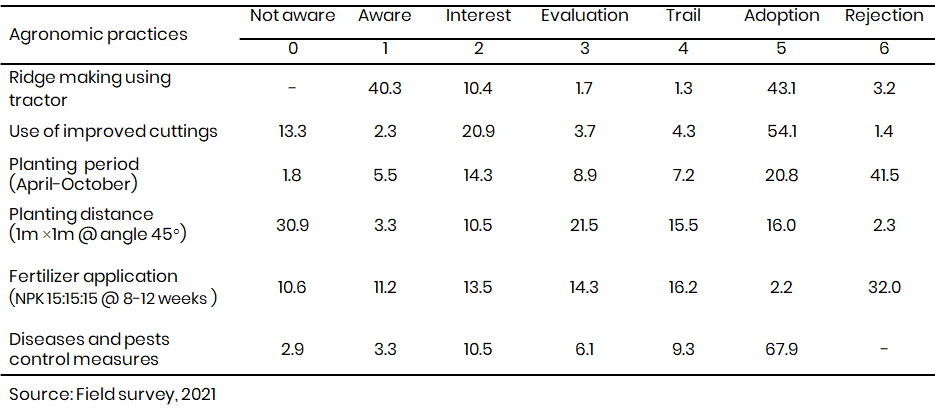
On the extent of levels of adoption of improved cassava agronomic practices by the farmers (Table 3), 43.1% of the farmers adopted ridge making disseminated to them while 3.2% of the farmers rejected it. However, 54.1% of the farmers adopted the use of improved cassava cuttings disseminated against 1.4% of them who rejected the technology. Moreso, 20.8% of the farmers adopted planting period of cassava production disseminated while 41.5% of them rejected the technology. As regards to planting distance, fertilizer application and disease/pest control; 16.0%, 2.2% and 67.9% of the farmers adopted the technologies while 2.3%, 32.0% and 0% of the farmers rejected the technologies disseminated to them.
Table 3: Levels of adoption (%) of improved cassava agronomic practices by the farmers
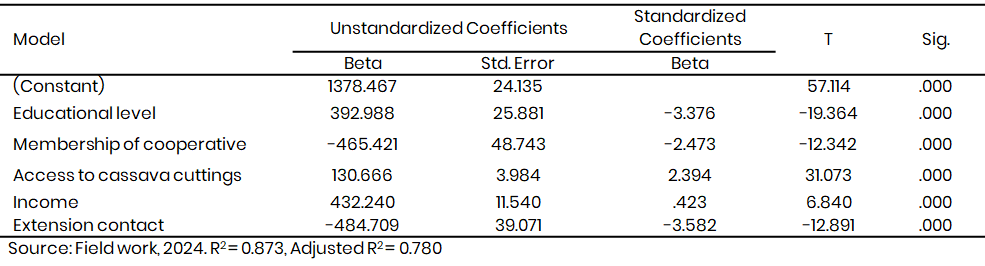
The decision to adopt agronomic practices by the farmers was significantly influenced by some socioeconomic factors (Table 4). Among these were: educational level, membership of cooperative, access to cassava cuttings, income and extension contact. These variables were found to be statistically related to the factors influencing the levels of adoption of improved cassava agronomic practices by the farmers in study area. Educational level, income, extension contact, and cooperative membership are significant determinants of improved agronomic practices in cassava production, with higher education, increased income, frequent extension contact, and active participation in cooperatives generally leading to greater adoption of best practices (Nwaobiala, 2018). These factors provide farmers with the knowledge, resources, and social support needed to adopt new technologies and improve their production systems. The finding agrees with Afolami et al. (2015) that availability of improved cassava cutting within the village determines the adoption of improved cassava agronomic practices by the farmers in study area. Also, the study is in agreement with Fidelis et al. (2023) that access to extension services and cooperative membership significantly influenced adoption of cassava farmers' agronomic practices in the study area. According to Wossen et al. (2017), access to extension services can boost the adoption of new farm technology by removing barriers caused by information inefficiencies. Extension access, in particular, supports adoption by exposing farmers to new technology and teaching them about appropriate agricultural and management practices (Fidelis et al., 2023).
In addition to directly impacting adoption, access to extension services has a positive impact on welfare by assisting farmers in closing the yield gap between expected and actual harvests (Fidelis et al., 2023). Cooperatives are often considered an essential institutional innovation that might assist farmers to overcome the stumbling blocks to their access to farm inputs (Verhofstadt & Maertens, 2014; Ma & Abdulai, 2016). Cooperatives can provide scale advantages and hence enhance agricultural technology adoption by pooling multiple resources such as credit, knowledge, and labour among members.
Table 4: Determinants of adoption of good agronomic practices of improved cassava varieties disseminated to farmers
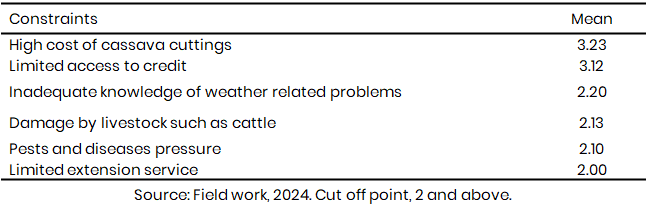
On the other hand, the constraints to adoption of good agronomic practices (GAP) among cassava farmers; high cost of cassava cuttings, limited access to credit, lack of knowledge of weather related problems, damage by livestock such as cattle, pests and diseases pressure and limited extension service respectively (Table 5). This result is in line with Fidelis et al. (2023) that high cost of improved cassava materials and inadequate information of the improved variety were the constraints working against agronomic practices in their study, also the finding is in line with where they said that inadequate funds were the major constraint facing adoption of cassava agronomic practices in their study.
Table 5: Constraints militating against adoption of Good Agronomic Practices (GAP) among cassava farmers
Conclusion
The research established that cassava remains a crucial livelihood crop in Anambra State, especially for women and smallholder farmers. Improved cassava varieties such as TME-419 have been widely adopted, showing significant potential for increasing yield and resilience against diseases. However, adoption of good agronomic practices is relatively low, constrained by socioeconomic and institutional challenges. Factors such as education, access to extension services, and cooperative participation significantly enhance adoption levels. Addressing these barriers is essential to maximize the benefits of improved technologies, close yield gaps, and enhance food security and income for rural households.
References
Aboajah, F. N., Onjewu, S. S., Chia, J. I., & Okeme, S. (2018). Socio-economic determinants of cassava production in Benue State, Nigeria. International Journal of Environment, Agriculture and Biotechnology, 3(2), 550–557.
Afolami, C., Obayelu, A., & Vaughan, I. (2015). Welfare impact of adoption of improved cassava varieties by rural households in South Western Nigeria. Agricultural and Food Economics, 3(1), 1–17. https://doi.org/10.1186/s40100-015-0037-2
Esheya, S. E. (2019). Economics of cassava production in Ohaukwu Local Government Area of Ebonyi State, Nigeria. Journal of Agricultural Economics, Extension and Rural Development, 2(2), 92–98. Akwa Ibom State University.
Fidelis, E. S., Abiola, I. B., & Olajide, O. R. (2023). The effect of extension access and cooperative membership on improved cassava varieties adoption among farmers in Imo State, Nigeria. Proceedings Book of the International Paris Congress on Applied Sciences, 256–262.
Ma, W., & Abdulai, A. (2016). Does cooperative membership improve household welfare? Evidence from apple farmers in China. Food Policy, 58, 94–102.
Nwaobiala, C. U. (2018). Farmers’ adoption of cassava agronomic practices and intercrop technologies in Abia and Imo States, Nigeria. Journal of Agricultural Extension, 22(2), 1–15. https://doi.org/10.4314/jae.v22i2.8
Ojo, S. O., & Ogunyemi, A. I. (2014). Analysis of factors influencing the adoption of improved cassava production technology in Ekiti State, Nigeria. International Journal of Agricultural Sciences and Natural Resources, 1(3), 40–44.
Oshioriamhe, I., Oyotomhe, A., Aiyedun, E. A., & Ebukiba, E. S. (2025). Determinants of cassava production among smallholder farmers in Edo State, Nigeria. Global Academic Journal of Agriculture and Biosciences, 7(3). https://doi.org/10.36348/gajab.2025.v07i03.001
Tesfamicheal, W., Tahirou, A., Arega, A., Shiferaw, F., Ismail, R., Asumugha, G., Kulakow, P., & Victor, M. (2017). Impact of improved cassava varieties in Nigeria (Final report submitted to the CGIAR Research Program on Roots, Tubers and Bananas [RTB]). pp. 6–7.
Uchemba, V. U., Nenna, G. M., & Obianefo, A. C. (2021). Adoption of improved cassava production technologies among small-scale farmers in Anambra State, Nigeria. Journal of Plant Sciences, 9(4), 119–127. https://doi.org /10.11648/j.jps.20210904.11
Copyright
Open Access: This article is licensed under a Creative Commons Attribution 4.0 International License, which permits use, sharing, adaptation, distribution and reproduction in any medium or format, as long as you give appropriate credit to the original author(s) and the source, provide a link to the Creative Commons license, and indicate if changes were made. The images or other third party material in this article are included in the article’s Creative Commons license, unless indicated otherwise in a credit line to the material. If material is not included in the article’s Creative Commons license and your intended use is not permitted by statutory regulation or exceeds the permitted use, you will need to obtain permission directly from the copyright holder. To view a copy of this license, visit http://creativecommons.org/licenses/by/4.0/.

