

Influence of arable crop farmers use of Climate Smart Agricultural Practices on food security in North Central Nigeria
Abstract
This paper examined the influence of arable crop farmers’ use of Climate-Smart Agricultural Practices (CSAPs) on food security in North-Central Nigeria. Primary data were collected using a structured questionnaire, and a multistage sampling procedure was adopted to select 120 respondents. Data were analyzed using descriptive statistics, sigma scoring, mean score, and logit regression. The results revealed a mean age of 48.0 ± 5.7 years, a household size of 5.9 ± 1.6 members, farming experience of 18.0 ± 6.6 years, a farm size of 1.4 ± 0.6 hectares, and an annual income of ₦173,210 ± ₦ 5,000. The majority were male (92.3%), married (88.0%), had no secondary occupation (72.5%), had formal education (72.3%), and were members of associations (58.4%). The sigma scores on perceived effects of climate change indicated hotness (5.30), irregular rainfall (5.30), and yield reduction (5.08). In contrast, the mean scores of constraints to CSAPs' use included rainfed farming (2.93) and inadequate finance (2.90). The CSAPs most commonly employed were shifting planting schedules (5.02), mixed cropping (4.91), and planting cover crops (4.70). The influence of CSAPs on food security showed that sex (-0.5535), age (-0.0372), household size (-0.0413), education status (-0.4317), farming experience (-0.0620), and association membership (-0.0849) had significant negative effects. In contrast, secondary occupation (0.1894), farm size (0.2568), extension visits (0.3715), and total CSAPs used (0.3498) were highly significant positive determinants. Intensive CSA training and grant awards were recommended to enhance the effective use of CSAPs and improve food security.
Introduction
Agriculture has been recognized globally as a primary source of human life since it produces the food that humans need to survive. As an important industry that significantly contributes to local and global food security, job creation, and farmer income generation, it is carried out by many smallholder farmers in developing nations, including Nigeria, where it is rain-fed due to its dependence on rainfall, a key climatic factor (Pierre et al., 2024). Other climatic factors that influence agriculture in a place include temperature, humidity, wind direction and speed, precipitation type, frequency, and amount, as well as solar radiation.
Note that it is not only climate elements that influence agriculture, but there is also an inter relatedness between the two (agriculture and climate). Agriculture has several ways in which it influences and is influenced by the environment, with the two having inverse, reversible, and reciprocal relationships. This is consistent with Wakweya (2023), who noted a nexus between agriculture and climate and Yilai et al. (2024), who identified a substantial dependency between agriculture and climate. For example, agriculture will flourish, and humans will reap the natural benefits of optimal production and productivity, including stable food supplies and food security, if climatic conditions are ideal and optimal (Wakweya, 2023). On one hand, vegetation (forest) can influence atmospheric elements such as rainfall and even absorb excess heat thereby influencing the weather condition of a place meaning that agriculture is a key carbon sink, in that agricultural perennial such as pasture, forests, fruit orchards and tea plantations can capture CO2 from the atmosphere for/through photosynthesis (Yilai et al., 2024).
Conversely, Yilai et al. (2024) stated that agriculture contributes to the emission of greenhouse gases (GHGs) such as methane (CH4) from the metabolic activity of bacteria that produce methane, nitrous oxide (N2O) from ruminant gastrointestinal fermentation and farmland soil nitrification and denitrification under nitrogen fertilizer application, and anthropogenic Non-CO2 from the conversion of forest land to cropland. Others include agricultural activities such as machinery operations, fertilizer and feed inputs also indirectly increase the carbon footprint of agriculture via various pathways such as fossil fuel consumption, traditional and predominant method of clearing farmland by bush burning and the indiscriminate cutting down of trees for use as firewood and making charcoal all releases and increases the concentration of GHGs in the atmosphere which traps heat and contribute to global warming and consequently resulting into climate change (Onoja, 2023).
Long-term changes to temperature, precipitation, wind patterns, and other aspects of the Earth's climate system are referred to as climate change (Henri-Ukoha and Adesope, 2020). In Chepng'etich et al. (2024), the Intergovernmental Panel on Climate Change (IPCC) further defined climate change as the swift and unpredictable shifts in Earth’s surface temperature and precipitation patterns that have made agricultural systems more vulnerable worldwide. They went on to say that, although the effects of climate change are felt globally, Sub-Saharan Africa (SSA) is expected to experience the most severe impacts on its food systems and agriculture. They claimed that this is due to the region's fragility, stemming from the fact that agriculture, the main driver of their economies, is largely dependent on rainfall and is therefore extremely vulnerable to climate change. This supports the position of Tabe-Ojong et al. (2023), who found that droughts, rising temperatures, and changes in rainfall patterns, including both increased and decreased rainfall, are examples of how climate change is affecting smallholder arable crop agriculture in many tropical locations.
It is worth noting that half the world consumes arable crops such as rice, yams, beans, maize, wheat, guinea corn and cassava, among others and in Nigeria, every household consumes them (Chima et al., 2024). They added that the impact of a changing climate on arable crops is a catastrophe shared by many countries of the Globe, especially Sub-Saharan Africa (SSA), including Nigeria, where biodiversity-based rice and cassava farming is facing extinction, especially in the northern part, where drought and flood disasters are destroying agrifood systems, causing food insecurity.
Food insecurity is when people are unable to meet their food needs. They may eat once a day but not know where they will get their next meal or that people experiencing severe food insecurity may have run out of food completely and go a day or more without anything to eat at all (Oxfam, 2025). Oxfam further explained that food insecurity is when only 1 in 11 people have access to food, and the Number of people globally without access to adequate food is 31%. Nigeria ranks ninth among the top 10 nations in the world with the greatest food crises, according to Onoja (2023). In 2019, more than five million individuals in Nigeria were affected, which accounted for 5% of the global total (Global Network Against Food Crises-GNAFC, 2020). According to the WFP 2024 report, in Action Aid Nigeria (2024), there were 100 million food-insecure Nigerians in Q1 2024, up from 66.2 million in Q1 2023. They added that out of these, 18.6 million are experiencing acute hunger, and as of March 2024, 43.7 million Nigerians are exhibiting crisis-level or above crisis-level hunger coping strategies. Food security is therefore essential for human existence, and this has been the reason why successive governments in Nigeria have attempted to address the food crisis and insecurity situation caused by other factors, until recently, climate change. Regrettably, the country has never come close to attaining this goal. In Nigeria, smallholder farmers are facing threats to their livelihoods and food security due to climate change, resulting in a growing decline in agricultural production, food accessibility, and financial stability. This has bolstered Wakweya's (2023) assertion that climate change has negative implications for food security.
Food security is when "all people, at all times, have physical, social, and economic access to sufficient, safe, and nutritious food to suit their dietary needs and food preferences for an active and healthy life," (Tabe-Ojong et al., 2023) and (Oxfam, 2025). The United Nations 2030 Sustainable Development Goals (SDGs) "Zero Hunger" target is seriously threatened by the world's population growth, which is predicted to surpass 9 billion people by 2050, even as climate change continues to threaten the ability to produce food (Yilai et al., 2024). Food security as a concept encompasses four primary aspects: (a) Food availability, especially of local food, which must always be readily present on shop shelves and at market stalls. (b) Food access means having physical, social, and financial freedom to access food. (c) Food utilization, which occurs when people have access to wholesome, disease-free food in enough quantities to support an active and full life; and (d) Food stability, which occurs when the food supply is steady and consistent, and rising food costs and seasonal food shortages brought on by climate change do not jeopardize food security. Food security, therefore, is about ensuring that no one goes hungry and in practical terms, it means that the fundamental assurance of human survival is food security. Onoja (2023) cited Pachauri & Meyer (2014) as warning that African nations may see a 10% to 25% decrease in farm production if the required adaptation measures are not implemented. As an addendum, Pierre et al. (2024) noted that the two most significant issues of our day are food insecurity and climate change; therefore, it is imperative to develop sustainable agricultural practices that mitigate the consequences of these two factors on agriculture.
To address these two challenges, Fig. 1 clearly shows the World Bank and partners' resolution from the Seminar on Climate Change and Risk Management, where they developed Climate Smart Agriculture (CSA) to help farmers adapt to and mitigate climate change and address the interconnected challenges of food insecurity that has been made worse by climate change (World Bank, 2024 in Wanglin and Rahut, 2024).
The concept of CSA was first proposed by the Food and Agriculture Organization of the United Nations (FAO) at the Hague Conference in 2010 (Yilai et al., 2024), aiming to achieve the multi-win goals of increased food production, security, and income, as well as climate change mitigation and adaptation. As illustrated in Fig. 1, the three main goals of CSA are: (a) Increasing agricultural productivity sustainably by producing more and better-quality food without further taxing natural resources in order to increase incomes and improve nutrition security, particularly for the 75% of the world's poor who live in rural areas and depend primarily on agriculture for their livelihoods. (b) Developing resilience and adapting to climate-related hazards and shocks, such as droughts, pests, and diseases; and enhancing the ability to grow and adapt to longer-term pressures, such as more unpredictable weather patterns and increasing seasonal variability and (c) Reducing GHGs emissions from agriculture of the food system, avoid deforestation due to cropland expansion, and increase the carbon sequestration of plants and soils (World Bank, 2024 in Wanglin and Rahut, 2024).
Wakweya (2023) noted that climate-smart agriculture is now positioned as an exceptional perspective for meeting both global warming reduction and adaptation objectives while also ensuring/enhancing agricultural production and feeding people worldwide. The CSA is gaining recognition as a viable approach to mitigating the impact of climate change on the food security of farming households. Although the idea of CSA is still evolving, little research has been conducted on the connections between CSA and sustainable agriculture, and how CSA behaviors might be encouraged to achieve food security. Climate-smart agricultural practices and technologies (CSAPs) are a group of agricultural production-related practices that can "effectively adapt agriculture to climate change and reinforce agricultural production capacity" (Wanglin and Rahut, 2024).
Based on the foregoing, this paper investigated the influence of arable crop farmers’ use of CSAPs on food security in North-Central, Nigeria. The purpose of the study was to;
i. describe the socio-economic characteristics of arable crop farmers.
ii. identify arable crop farmers’ perceived effects of climate change;
iii. identify CSAPs used by arable crop farmers;
iv. identify constraints faced in the use of CSAPs by arable crop farmers; and,
vi. examine the influence of CSAPs usage on food security.
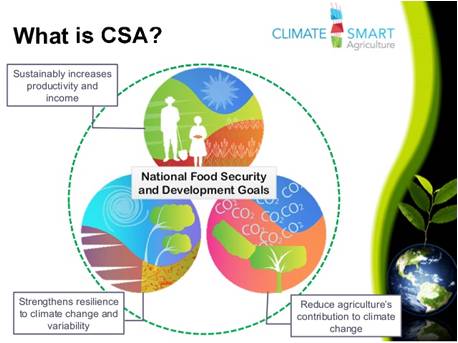
Fig. 1: Climate-smart chart adapted from World Bank (2024) in Wanglin and Rahut (
Material and Methods
The study was conducted in the North-Central zone of Nigeria, covering an area of 242,425 Km2, comprising Kwara, Niger, Nasarawa, Plateau, Benue, and Kogi states, as well as the Federal Capital Territory (FCT). The research design used for this study was a descriptive survey. A multistage random sampling procedure was used as follows to obtain samples: a simple random sampling technique was used to select two states, namely Benue and Kogi State. Benue State is located at coordinates longitude 7° 47' and 10° 0' East and Latitude 6° 25' and 8° 8' North, and has a total area of 34,059 km2, while Kogi State is in coordinates ‘Latitude 7○30'N 8○10'N and Longitude 6○01'E 7○50'E and covers an area of about 29,833 km2. The states are primarily rural and major arable crop production zones because nature has endowed them with suitable edaphic and climatic factors that are conducive to the growth of major arable crops. This may be the reason why most of the populace, including both males and females, young and old, were arable crop farmers until recently, when the prevailing effects of climate change negatively affected their livelihood activities, resulting in a food crisis. The researcher used the ADP structure to obtain the sample size as follows: Benue and Kogi States comprised three and four ADP zones, respectively, and two zones were selected from each state. These four zones comprised 42 blocks, out of which 50% (21 blocks) were selected. The selected blocks consist of 216 cells, from which 50% were randomly selected, resulting in 108 cells being obtained. Each selected cell comprised 10 contact farmers who were aware of and used CSAPs, from which 12.5% were selected, resulting in a total of 120 respondents used for this research. A structured questionnaire was used to collect data from respondents and was initially subjected to both face and content validity. The reliability of the instrument was assessed using the split-half method, yielding a reliability coefficient of 0.73. Data were analyzed using descriptive statistics, the sigma scoring method, mean scores from the Likert scale, ordinary least squares regression, and ordered logit regression models.
Results and Discussion
Awareness and perceived effects of climate change
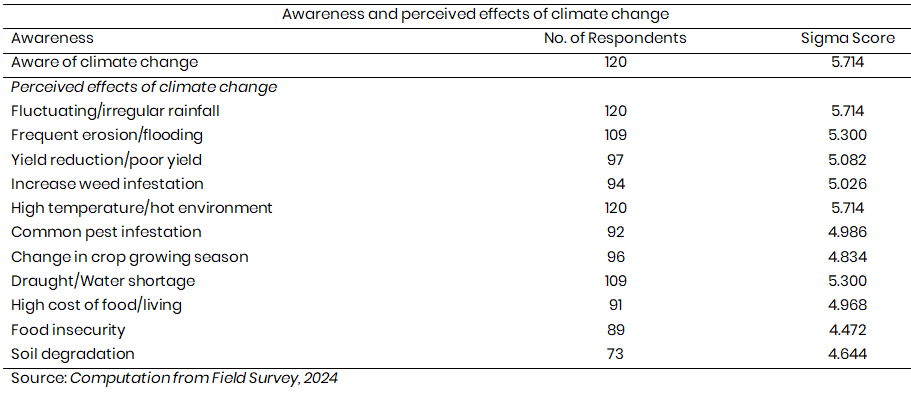
Results in Table 1 reported in sigma scores show that all (5.714) arable crop farmers were aware of climate change. Arable crop farmers' understanding of climate change is a crucial step in determining the actions to be taken to mitigate its effects. Their awareness may be due to personal observations and experiences of changes in weather factors, contact with extension services, interaction with other farmers, and information on weather forecasting from electronic and/or print media. This finding corroborates that of Jackson et al. (2021), who reported that farmers are aware of climate change, as evidenced by their experiences.
Perception is a cognitive process by which people interpret and make meaning of the sensory data they receive from their surroundings. The results on respondents’ perception of the effects of climate change reported in sigma scores also in Table 1 includes; fluctuating/irregular rainfall and Hot environment (5.714), frequent erosion/flooding and drought (5.300), yield reduction (5.082), increase weed infestation (5.026), common pest infestation (4.986), high cost of living (4.968), change in crop growing season (4.834), soil degradation (4.644) and food insecurity (4.472). This implies that respondents’ perception of the effects of climate change is many and mostly negative. These findings are in tandem with similar researches that reported decline, fluctuating, inconsistent, irregular and uneven rainfall patterns, reduced growing season and increasing atmospheric temperature resulting into hot environment (Onyeneke and Madukwe, 2020), (Tajudeen et al., 2022), (Tabe-Ojong et al., 2023) and (Bruce and Oluyede, 2024) loss/decrease/failure in the yield/output of arable crops (Tabe-Ojong et al., 2023), (Wanglin and Rahut, 2024), (Yann et al., 2024) and (Yilai et al., 2024), soil erosion and flooding (Araya and Adjaye, 2021) and (Tajudeen et al., 2022), soil degradation/declining soil fertility (Nhemachena, 2022) and (Alakpa and Ogbe, 2024), outbreak / thriving of insects pests, draught, decrease in farm sales and income, high cost of living and food scarcity/insecurity (Orgu et al., 2024) and (Pierre et al., 2024).
Table 1: Distribution of respondents’ awareness and perceived effects of climate Change
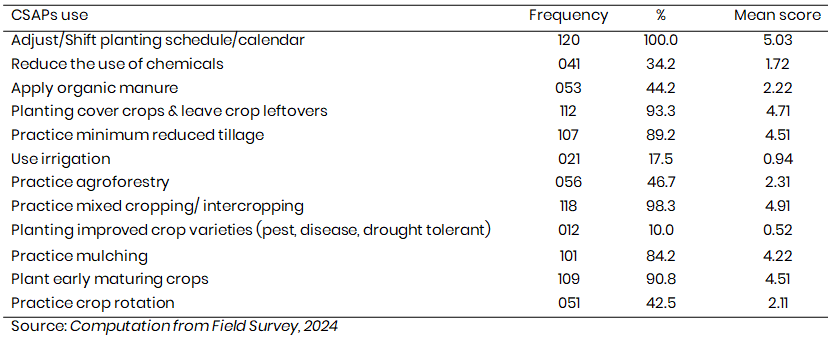
The CSAPs used by arable crop farmers in the study area
Results in Table 2 indicates the mean scores of CSAPs used by arable crop farmers in the study area which indicated; adjust/shift planting schedule (5.03), practice mixed/inter cropping (4.90), planting cover crops/leave crop leftovers (4.70), planting early maturing crops and practice minimum/reduced tillage (4.51), practice mulching (4.22), practice agroforestry (2.31), apply organic manure (2.22), practice crop rotation (2.11), reduced use of chemicals (1.72) and use irrigation (0.94).
These findings imply that, out of the twelve packages, only six were the most frequently used by arable crop farmers in the study area, meaning they use fewer CSAPs, and those used by them are related to their traditional practices.
These findings align with those reported in a related researches such as; planting variety and mixed/multiple crops / intercropping because different crops have different levels of resilience to weather variability, hence planting many crops could ensure that the farmer get some output in the face of extreme weather situations, shifting / modifying husbandry practices, use of organic fertilizers, practicing irrigation, mulching, crop rotation, change timing/date of planting, planting early maturing, pest/disease/drought resistant crop varieties and planting trees (Nhemachena, 2022), (Katz and Brown, 2022), (Tabe-Ojong et al., 2023), (Wakweya, 2023), (Onoja, 2023), (Alakpa and Ogbe, 2024), (Orgu et al., 2024), (Yakasi, 2020), (Wanglin and Rahut, 2024) and (Liwei et al., 2024).
Table 2: Distribution of respondents’ use of CSAPs n=120
Level of use of CSAPs
Results in Table 3 reveal the level of CSAPs used by arable crop farmers, where a mean of 15.2±4.1 was obtained. The majority (59.2%) of the respondents had low-level use, while 40.8% had high-level use of CSAPs.
By implication, there was low-level use of CSAPs in the study area, indicating that farmers had not yet fully utilized the package, and those that were used were related to farmers' conventional/traditional farm practices. This finding agrees with a similar study by Tabe-Ojong et al. (2023), who reported that Nigerian farmers have been using CSAPs partially, rather than fully or in a bundled form. They added that bundling matters more and is associated with higher productivity and food security gains. Arable crop farmers in the study area, therefore, are to be encouraged to utilise CSAPs in full, through enlightenment / education programmes via extension services to create awareness on CSAPs and how to access their required inputs easily. Experience in agricultural education services will enhance farmers’ knowledge, training, and access to information on climate change and farming practices, enabling them to adapt to and mitigate the associated problems (Wakweya, 2023).
Table 3: Level of CSAPs used by arable crop farmers (n = 120)

Constraints to the use of CSAPs
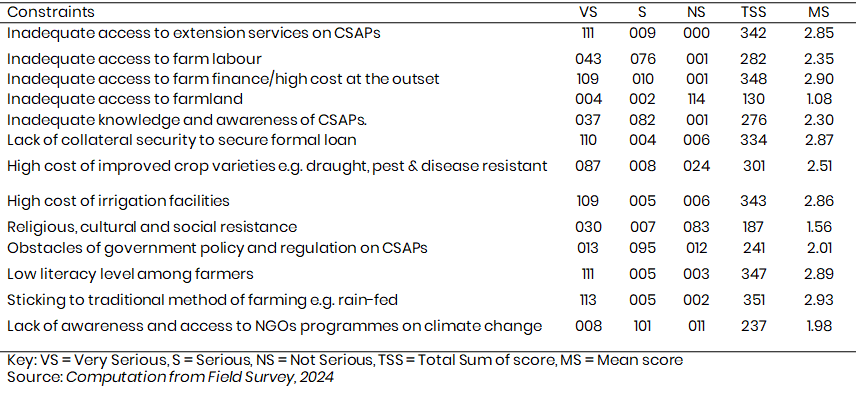
The results in Table 4 reveals mean scores of constraints faced by arable crop farmers in CSAPs use which comprised; sticking to traditional method of farming e.g. rain-fed method of farming (2.93), inadequate access to farm finance/high cost at the outset (2.90), low literacy level among farmers (2.89), lack of collateral security to secure formal loan (2.87), high cost of irrigation facilities (2.86), inadequate access to extension services on CSAPs (2.85), high cost of improved crop varieties e.g. draught, pest & disease resistant (2.51), inadequate access to farm labour (2.35), inadequate knowledge and awareness of CSAPs (2.30), obstacles of government policy and regulation on CSAPs (2.01), lack of awareness and access to NGOs programmes on climate change (1.98), religious, cultural and social resistance (1.56) and inadequate access to farmland (1.08).
This implies that arable crop farmers in the study area faced numerous challenges in their endeavor to use CSAPs; this could also be the reason for their low-level use of the technology and the prevalent food scarcity in the area. These findings are in line with similar researches that found the following as constraints to use of CSAPs; low literacy level, poor access and high cost of irrigation facilities, lack of knowledge of CSA technologies, inadequate financial resources, inadequate extension service, lack of access to farm inputs, high cost of improved crop varieties, lack of proper policies and political commitment by government to climate change (Wakweya, 2023 and Yilai et al., 2024).
Table 4: Mean score of constraints to use of CSAPs by arable crop farmers
Respondents’ Food Security Index (FSI)
Table 5 presents the findings on respondents’ food security index (FSI) which indicates 1.44, this implies that a very terrible, worrisome and concerning food insecurity situation existed among respondents in the study area where majority 65.0% were found to be food insecure, 2.58% were partially/slightly/moderately food secure and as low as 09.2% were highly food secure.
This finding is in line with Tabe-Ojong et al. (2023), who reported in similar research that smallholder farmers in SSA are food insecure due largely to challenges faced, such as inadequate access to production resources (land, labour, capital and information) and, most recently, the effects of climate change that have added up. Therefore, encouraging the use of CSAPs in full has the potential to improve the food security situation of the people (Wakweya, 2023; Omotosho and Omotayo, 2024).
Computation of Food Security Index (FSI)
Step 1: Assign Scores
Highly food secure = 3 points
Slightly/Moderately food secure = 2 points
Low Food secure = 1 point
Step 2: Calculate proportion for each category (Divide freq. by sample for each)
Highly food secure = 11 divided by 120 = 0.091
Slightly/Moderately food secure = 31 divided by 120 = 0.258
Low Food secure = 78 divided by 120 = 0.650
Step 3: Multiply each proportion by its assigned score
Highly food secure = 0.092 × 3 = 0.276
Slightly/Moderately food secure = 31 divided by 120 = 0.258 × 2 = 0.516
Low Food secure = 78 divided by 120 = 0.650 × 1 = 0.65
Step 4: Sum the results of step 3
= 0.276 + 0.516 + 0.65 = 1.442
Therefore FSI = 1.44
Table 5: Respondents’ Food Security Status

Influence of CSAPs on food security
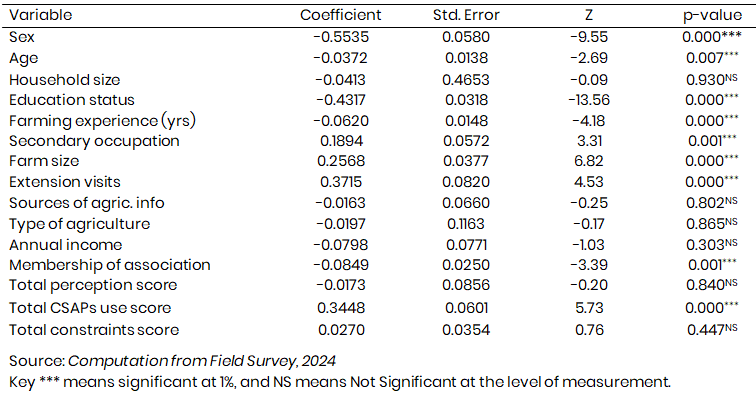
The ordered probit regression analysis, presented in Table 6, shows the influence of CSAPs on food security. Eight of the fifteen examined variables exert a statistically significant impact at the 1% level (p < 0.01).
Sex shows as a significant predictor with a negative coefficient (-0.5535), suggesting that female-headed households are associated with a reduced likelihood of achieving food security. This finding aligns with existing literature highlighting systemic disparities in access to crucial agricultural resources, such as land tenure, credit, and extension services, which often disproportionately affect women farmers and, consequently, their capacity to adopt Climate-Smart Agricultural Practices (CSAPs).
Similarly, the age of the household head reveals a statistically significant negative coefficient (-0.0372), indicating that advanced age is associated with diminished food security. This may be attributed to a combination of factors, including potential physical limitations that hinder labour-intensive agricultural activities and a documented aversion among older farmers to embracing innovative, risk-averse technologies like CSAPs. In a somewhat counterintuitive finding, education status also displays a statistically significant negative coefficient (-0.4317). While conventional wisdom posits a positive correlation between education and technology adoption, this result may indicate that higher educational attainment can create opportunities for individuals to transition out of direct agricultural production into alternative, potentially more lucrative occupations. Farming experience shows a negative and significant effect (-0.0620), which suggests that prolonged reliance on traditional farming methods may impede the adoption of novel CSAPs among more experienced practitioners.
Secondary occupation (0.1894) has a positive impact on food security, underscoring the critical role of diversified income streams in enabling households to overcome initial investment barriers associated with CSAPs, thereby enhancing their capacity for sustainable food production. Likewise, farm size (0.2568) and extension visits (0.3715) are both positively correlated with food security. Larger landholdings provide greater scope for experimenting with and scaling CSAPs. At the same time, consistent engagement with agricultural extension services serves as a vital conduit for disseminating knowledge, providing training, and facilitating the uptake of these beneficial practices. Membership in associations (-0.0849), although statistically significant, reveals an inverse relationship with food security. This unexpected outcome may warrant further investigation into potential inefficiencies within group benefit distribution or exclusionary practices that might inadvertently marginalize some members.
The total CSAPs use score (0.3448) is found to be a highly significant positive determinant of food security. This finding directly reinforces the premise that a more comprehensive and extensive adoption of Climate-Smart Agricultural Practices contributes to improved food security outcomes, enhancing resilience to climate-related shocks and fostering stable food production. This positive relationship underscores the potential of CSAPs when integrated effectively into farming systems.
Table 6: Influence of CSAPs on food security
Conclusion
The study concluded that the major constraints affecting rice production in the Dadin-kowa irrigation scheme were the high cost of farm inputs, incidence of pests and diseases, and farmers–herders conflicts. Other challenges identified by farmers included inadequate extension services, land fragmentation, inadequate storage facilities, land encroachment, and high labor costs, all of which negatively affected production efforts and farm income. These constraints discouraged farmers and limited their productivity and standard of living.
Based on the findings, the study recommended that the government and relevant agencies should provide adequate security to address farmers–herders clashes in the study area, thereby enabling farmers to maximize productivity. It also recommended exploring alternative methods of land acquisition beyond inheritance to increase land available for rice cultivation and expand production. In addition, improving farmers’ technical efficiency through credit facilities was suggested as a means of sustaining rice production. Finally, the study emphasized the need for timely provision of farm inputs and supplies such as machinery, improved seeds, agrochemicals, and fertilizers at affordable prices to enhance productivity, income, and the overall standard of living of farmers.
Acknowledgement
The authors acknowledge the smallholder farmers who served as respondents. We also appreciate the contributions of the research assistants and reviewers.
References
Action Aid Nigeria Biannual Newsletter SWIFT – Issue 21, July - December 2024. (2024). Retrieved from https://reliefweb.int/report/nigeria/actionaid-nigeria-biannual-newsletter-swift-issue-21-july-december-2024
Alakpa, S. O., & Ogbe, V. I. (2024). Sources of information on climate change among arable crop farmers, Edo State, Nigeria. Journal of Applied Science, Environment and Management, 28(5), 1623–1630. https://www.ajol.info/index.php /jasem
Araya, B., & Adjaye, J. A. (2001). Adoption for farm level soil conservation practices in Eritrea. Indian Journal of Agricultural Economics, 56, 239–252.
Bruce, C., & Oluyede, A. (2024). Harvesting resilience: The fight for food security through climate-smart agriculture. Retrieved from https://www.preventionweb.net/organization/global-center-adoption
Chepng'etich, E., Josiah, Ateka, M., Robert, M., & Forah, O. (2024). Climate-smart agriculture: Supporting smallholder livestock farmers’ adaptive capacity to climate change in Kenya: What role does entrepreneurial orientation and uptake of CSA play? Pp. 1–9.
Copyright
Open Access: This article is licensed under a Creative Commons Attribution 4.0 International License, which permits use, sharing, adaptation, distribution and reproduction in any medium or format, as long as you give appropriate credit to the original author(s) and the source, provide a link to the Creative Commons license, and indicate if changes were made. The images or other third party material in this article are included in the article’s Creative Commons license, unless indicated otherwise in a credit line to the material. If material is not included in the article’s Creative Commons license and your intended use is not permitted by statutory regulation or exceeds the permitted use, you will need to obtain permission directly from the copyright holder. To view a copy of this license, visit http://creativecommons.org/licenses/by/4.0/.

